Is Space Pirate Captain Harlock Worth Reading? Review & Where to Read
Quick Answer
Yes, if you want the moody, principled-outlaw space opera that influenced a generation of anime after it. It's short at five volumes, but it uses that space efficiently for most of the run.
Quick Verdict
“Melancholy runs through every page of this one, and it's exactly what makes Harlock's defiance mean something.”
Best for: Readers who want a moody, melancholic space opera built around a principled outlaw hero.
Not for: Readers who want a lighter, faster-paced space adventure and a more developed young viewpoint character.
- Type
- Manga
- Genres
- Drama, Sci-Fi
- Status
- Completed
- This review
- Minor Spoilers
- Author
- Leiji Matsumoto
- Publisher
- Akita Shoten (Play Comic)
- Platform
- Seven Seas Entertainment
| Quick facts | |
|---|---|
| Format | Manga (seinen), 55 chapters, 5 volumes |
| Run | 1977–1979 · completed |
| Community score | AniList 7.2 |
| Content | Violence, dark themes |
| Where to read | Seven Seas Entertainment — official |
Overview
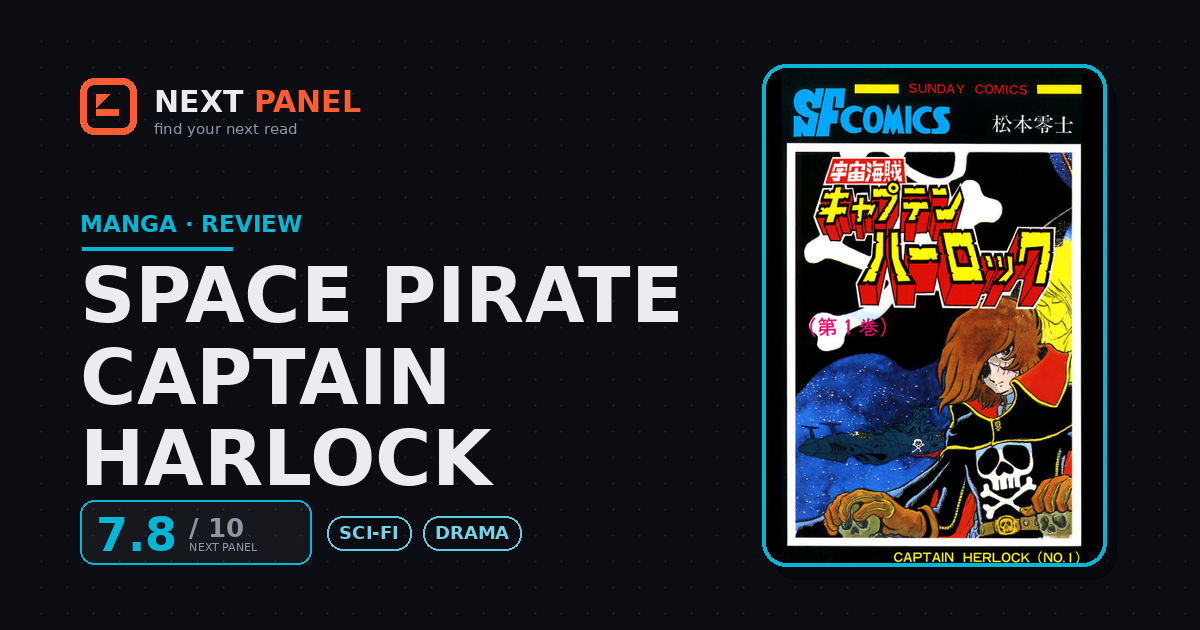
Before Cobra, before Trigun, before half of anime's brooding-outlaw archetypes, there was Captain Harlock, Leiji Matsumoto's 1977 manga about a one-eyed space pirate who'd rather die free than live obedient. Earth's government has gone soft and complacent while an alien invasion creeps in unnoticed, and it falls to an exiled crew aboard the skull-flagged battleship Arcadia to actually do something about it. Tadashi Daiba, a grieving teenager whose scientist father tried and failed to warn the world, gets pulled into that crew and becomes the reader's way in.
What it does well
Matsumoto's art carries a mood a lot of space operas from this era don't reach for, long silences, huge empty starscapes, a hero who talks in world-weary code rather than one-liners. Harlock himself isn't just cool, he's sad in a way that gives the whole book weight: every choice he makes is shadowed by people he's already lost, and the manga never lets you forget that his defiance comes at a real personal cost rather than being a free pose.
The Arcadia's crew, especially the near-mute engineer Tochiro and the fierce pirate captain Emeraldas orbiting the story's edges, build a found-family dynamic that feels earned rather than convenient. These are people who chose exile over compromise, and the manga trusts the reader to pick up on the weight of that choice through behavior rather than spelling it out. And when the manga does go big, Earth under invasion, Harlock refusing to bow to a government that's already failed everyone, the scale genuinely lands, because it's been building toward that moment through mood rather than noise.
Where it falls short
Five volumes isn't a lot of room, and the manga sometimes rushes plot beats that a slower series would let breathe, especially in the latter half as the invasion plot accelerates. Political maneuvering that could use another chapter or two to land gets compressed into a few panels, and readers who want every faction and motivation fully explained may come away with some gaps. Tadashi, our entry point into this world, ends up thinner than Harlock and the adult cast around him, he mostly reacts to what's happening rather than driving it, which makes the later chapters feel more like an ensemble piece orbiting Harlock than a story truly following him.
The tone is also relentlessly melancholic throughout. There's very little levity here to break up the grief and quiet defiance, and if you want a lighter, punchier space adventure, this isn't it.
Verdict
Space Pirate Captain Harlock is one of the foundational texts of moody, principled-outlaw space opera, and it still hits, just go in ready for grief and quiet defiance rather than swashbuckling fun.
Strengths & Weaknesses
Strengths
- Matsumoto's art gives the story real atmosphere — vast, empty starscapes and a hero who communicates as much through silence as dialogue.
- Harlock's grief-driven code of honor gives the outlaw archetype genuine emotional weight instead of just style.
- Side characters like Tochiro and Emeraldas add real found-family texture without slowing the plot down.
- The escalating Earth-invasion plot delivers real stakes despite the manga's short five-volume run.
Weaknesses
- At five volumes, some later plot beats move fast enough to skip room to breathe.
- Tadashi, the reader's entry point, stays a fairly thin, reactive character next to the adults around him.
- The tone is consistently somber, so it won't work for anyone wanting a lighter, more fun space adventure.
Similar Titles
Cobra
Another foundational late-'70s space opera, though far brighter and pulpier in tone.
Galaxy Express 999
Matsumoto's other iconic space epic, sharing its melancholic, wandering-outlaw sensibility.
A later gunslinger-in-space story that inherits some of Harlock's world-weary heroism.
Where to Read Officially
| Platform | Format | Pricing | Region notes | Link |
|---|---|---|---|---|
| Seven Seas Entertainment | Print & digital volumes | Paid | Region availability varies | Open |
Frequently Asked Questions
Is the Captain Harlock manga complete?
Yes — the original run in Play Comic from 1977 to 1979 wraps up in five volumes and tells a complete story.
Where can I read Space Pirate Captain Harlock in English?
Seven Seas released the full series in English as Captain Harlock: The Classic Collection, available in print and digitally through Kindle, comiXology, BookWalker, and other platforms.
Is the manga the same story as the Space Pirate Captain Harlock anime?
They share the same core cast and premise, but enough plot details differ that fans generally treat the manga as its own distinct telling of the story.