Is Trigun Worth Reading? Review & Where to Read
Quick Answer
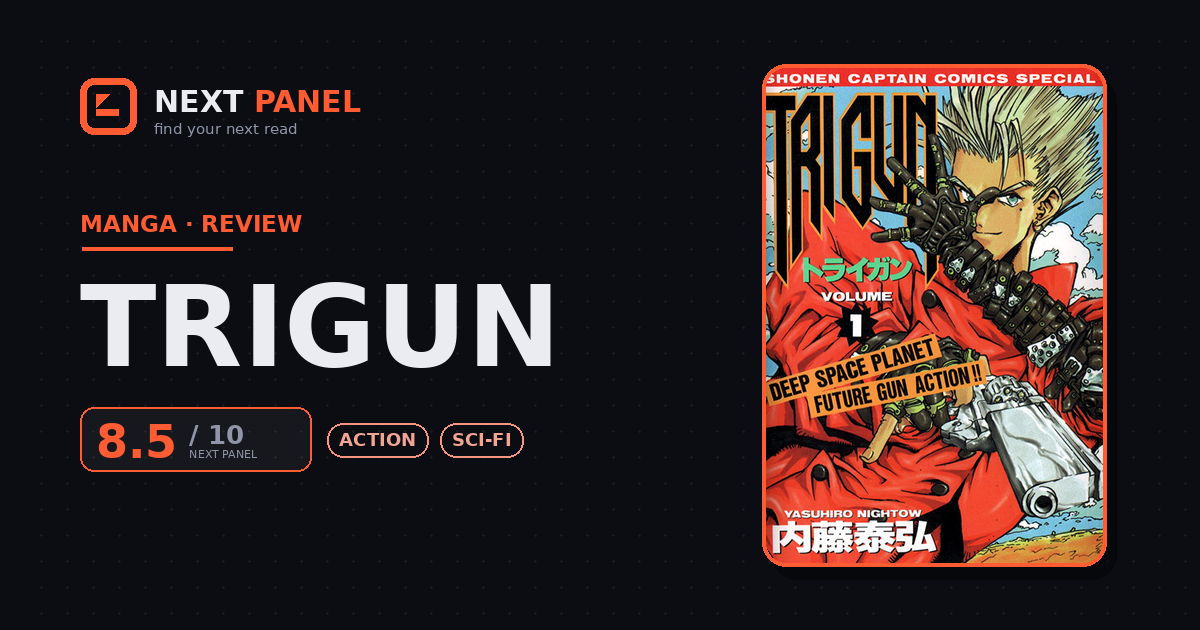
Yes, if you're willing to sit through a rough, gag-heavy opening stretch to get to a story with real weight. Vash the Stampede is a legendary gunslinger with a 60-billion-dollar bounty who's secretly a committed pacifist, and the manga builds from comedic western antics into a genuinely emotional story about violence, guilt, and family. The tonal whiplash isn't for everyone, but the payoff justifies it.
Quick Verdict
“The silly cowboy-comedy opening undersells what this turns into — by the second half it's one of the better sci-fi tragedies manga has to offer.”
Best for: Readers who want a sci-fi western with a real philosophical core and don't mind a slow, gag-driven start.
Not for: Readers who want a consistent tone from chapter one and a tightly plotted mystery throughout.
- Type
- Manga
- Genres
- Drama, Sci-Fi, Action
- Status
- Completed
- This review
- Minor Spoilers
- Author
- Yasuhiro Nightow
- Publisher
- Dark Horse Comics
- Platform
- Dark Horse Comics
| Quick facts | |
|---|---|
| Format | Manga, 23 chapters, 3 volumes |
| Run | 1995–1997 · completed |
| Community score | AniList 7.5 |
| Content | Violence, war, character death |
| Where to read | Dark Horse Comics — official |
Overview
Trigun started in Monthly Shōnen Captain in 1995, moved to the seinen magazine Young King OURs as Trigun Maximum after its first home stopped publishing, and the two runs together make up one continuous story by Yasuhiro Nightow. It's set on Gunsmoke, a desert planet colonized by humans generations ago, and follows Vash the Stampede, a gunslinger with a 60-billion-dollar bounty on his head for supposedly leveling entire towns. The twist is that Vash is a clumsy, big-hearted pacifist who refuses to kill anyone, no matter what it costs him, and spends the story trying to live by that rule while two insurance agents, Meryl and Milly, tail him to contain the damage he's blamed for.
What it does well
The central idea, an immensely powerful man who's sworn off violence, walking through a world that keeps forcing his hand, gives Trigun a spine that a lot of gunslinger stories don't bother with. As the manga digs into Vash's past and introduces his brother Knives, who's reached the opposite conclusion about humanity, the story turns into something much heavier than its opening chapters suggest: a fight over whether Vash's code is even survivable, fought against someone he loves.
Nightow's art carries a lot of that weight. His action sequences are fast, detailed, and clearly influenced by American western comics, and he knows when to slow down and let a quiet page do the emotional work instead. By the time the story reaches its climax, the goofy cowboy-comedy tone of the early volumes has been almost completely replaced by something closer to tragedy, and the shift feels earned rather than forced.
Where it falls short
Getting there takes patience. The opening stretch is largely episodic, joke-driven western-of-the-week material that doesn't do much to signal where the story is headed, and some readers bounce off before it turns serious. Even once the tone shifts, Trigun keeps swinging between slapstick comedy and genuine tragedy in the same volume, sometimes the same chapter, and that whiplash doesn't always land smoothly. The middle stretch also slows down to build out lore and side characters in ways that occasionally sap momentum right when the main conflict should be tightening.
Verdict
Trigun asks you to sit through a rough, silly start to get to a story about guilt, family, and whether nonviolence can actually survive contact with a violent world, and it's worth making that trade. The 1998 anime is the more famous version, but the manga is the fuller one.
Strengths & Weaknesses
Strengths
- Vash's core conflict, a pacifist with the power to end anyone, forced into a violent world, gives the action real stakes instead of just spectacle.
- The back half of the story, once Vash's past and his brother Knives come into focus, turns into a genuinely affecting tragedy about family and guilt.
- Nightow's action art is kinetic and detailed, with a distinct western-comic influence that still looks sharp today.
- It never lets Vash's philosophy of non-violence come for free; the story keeps making him pay a real cost for sticking to it.
Weaknesses
- The early chapters lean hard on goofy, episodic comedy that doesn't hint at how serious the story eventually gets, which makes for an uneven start.
- The tonal jumps between slapstick humor and heavy tragedy can feel jarring even once you're used to the series' rhythm.
- Some worldbuilding and side-cast material in the middle stretch slows the momentum before the story tightens back up.
Similar Titles
A very different setting, but the same core question of whether a fighter can hold onto a code against violence.
Another sci-fi action series that uses its violence to ask harder questions about its characters.
For readers who want more of Nightow's kind of dense, atmospheric sci-fi world underneath the action.
Where to Read Officially
| Platform | Format | Pricing | Region notes | Link |
|---|---|---|---|---|
| Dark Horse Comics | Print & digital volumes | Paid | Region availability varies | Open |
Frequently Asked Questions
Should I read Trigun and Trigun Maximum as one story?
Yes. Trigun is the original 3-volume run, and Trigun Maximum is the direct continuation that finishes the story across 14 more volumes. Dark Horse's omnibus and deluxe editions collect them as one continuous saga.
How different is the manga from the 1998 anime?
Quite different in structure. The anime reorders and compresses a lot of what happens, especially early on, and softens some of the manga's gag-heavy opening. The 2023 Trigun Stampede reboot takes an even more different approach. The manga is the fullest, most direct version of the story.
Is this more comedy or more drama?
It starts mostly comedic and episodic, then shifts hard into drama as Vash's backstory and his conflict with his brother take over. Both tones are present throughout, but the balance changes a lot as the story goes on.