Is Sunny Worth Reading? Review & Where to Read
Quick Answer
Yes, if you're open to a quiet, plotless story that trades action for feeling. Sunny is a gorgeously drawn, semi-autobiographical look at kids in a group home, and it's deeply moving. Just don't expect a plot that builds to anything.
Quick Verdict
“Barely a plot, and it doesn't need one; Matsumoto turns the small aches of childhood into something quietly unforgettable.”
Best for: Readers who love quiet, character-driven slice-of-life and striking, unconventional art.
Not for: Readers who want a strong plot, clear character arcs, or a fast, eventful read.
- Type
- Manga
- Genres
- Drama, Slice of Life
- Status
- Completed
- This review
- Minor Spoilers
- Author
- Taiyo Matsumoto
- Publisher
- Shogakukan
- Platform
- VIZ Media
| Quick facts | |
|---|---|
| Format | Manga (seinen), 37 chapters, 6 volumes |
| Run | 2010–2015 · completed |
| Community score | AniList 8.2 · MangaUpdates 7.5 |
| Content | Child abandonment, emotional hardship |
| Where to read | VIZ Media — official |
Overview
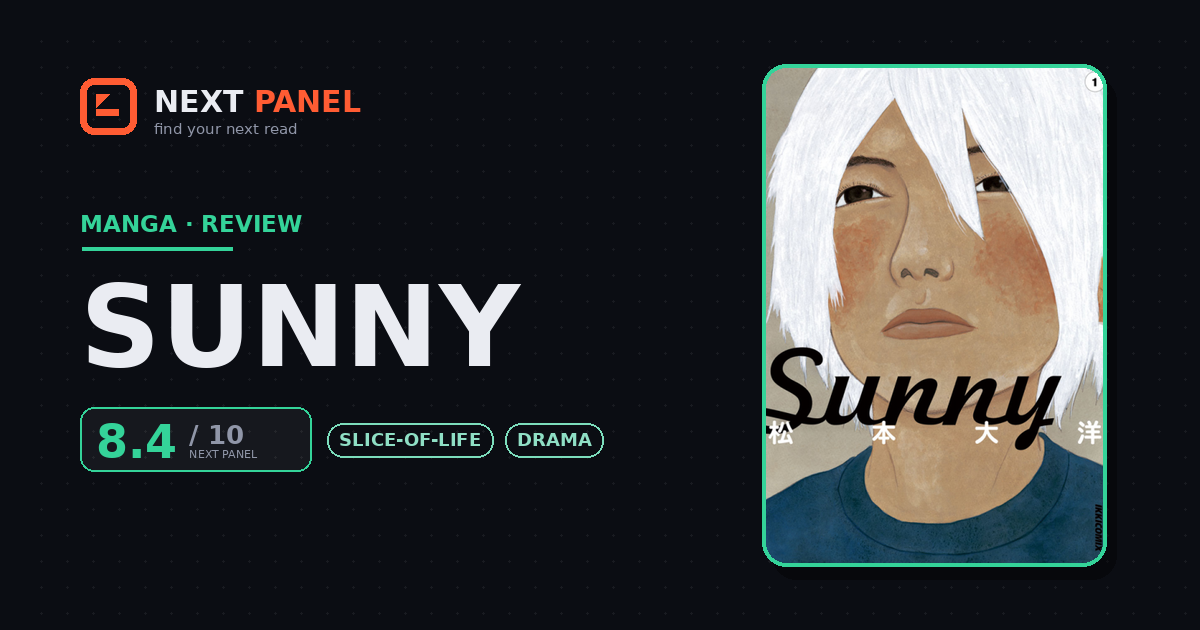
Sunny is a quiet, semi-autobiographical manga by Taiyo Matsumoto, the artist behind Tekkonkinkreet and Ping Pong. It's set at Star Kids, a Japanese group home for children who've been orphaned or left there by parents who couldn't keep them. In the yard sits an old, broken-down Nissan Sunny, a car that doesn't run anymore, and the kids climb inside it to daydream, argue, and pretend they're going somewhere. That car is the whole book in miniature: a way to escape a life you didn't choose, if only in your head. Matsumoto, who grew up in a home like this, tells the story in loosely connected vignettes rather than one big arc, and it won the Shogakukan Manga Award for good reason.
What it does well
The art alone is worth the price. Matsumoto draws like no one else, scratchy and soft and expressive, and he nails the way children actually look and move, all knees and elbows and big feelings. He captures a kid's-eye view of the world so well that ordinary things, a snack, a rainy day, a visit that doesn't happen, carry enormous weight.
The kids are the real achievement, though. Haruo acts out, Sei watches quietly, and each child at the home has a particular way of coping with being left behind. Matsumoto never talks down to them or milks them for tears; he just shows them honestly, and that honesty is what gets you. The book finds its power in small moments, a lie a kid tells to save face, a wish that won't come true, and it lets them land without underlining them. Because so much of it comes from Matsumoto's own childhood, every corner of the home feels lived-in and true.
Where it falls short
This is barely a plot, and that's the sticking point for a lot of readers. Sunny is a mood, a set of vignettes that circle the same handful of kids without building toward a climax. If you need momentum or a clear arc, you may find yourself waiting for something that never quite arrives.
The tone is also uniformly low-key and melancholic. That's the point, but it means the book can feel samey if you read a lot at once, and the emotional register rarely lifts. And with such a large cast and a drifting focus, no single kid gets a full, traditional character arc; you get impressions and moments rather than a clean beginning, middle, and end for anyone. It asks you to meet it on its own gentle terms.
Verdict
Sunny is a small, beautiful book that sneaks up on you. It isn't trying to thrill you; it's trying to make you feel what it's like to be a kid with nowhere solid to stand, and it does that better than almost anything. If you like quiet, art-forward slice-of-life and you don't mind a story without a real plot, this is essential. VIZ publishes it in English, and it's best read slowly, a chapter at a time, so each moment gets room to breathe.
Strengths & Weaknesses
Strengths
- Matsumoto's art is instantly recognizable and gorgeous, and it captures a kid's-eye view of the world better than almost anything.
- The children feel real, each with their own hurt and defenses, and the book treats them with total honesty.
- It finds huge emotion in tiny moments, so a small scene can hit harder than a big dramatic beat.
- It's semi-autobiographical, and that lived-in truth shows in every detail of the home and the kids.
Weaknesses
- There's almost no overarching plot; it's a series of vignettes, so readers who need momentum may get restless.
- The tone is melancholic and low-key throughout, which can feel samey over a long sitting.
- The cast is large and the focus drifts between kids, so no single character gets a full traditional arc.
Similar Titles
Matsumoto's own story of kids on the margins, same unmistakable art and bittersweet heart.
Quiet, melancholic, and built on found family and slow emotional healing.
A gentler, sunnier take on seeing the everyday world through a child's eyes.
Where to Read Officially
| Platform | Format | Pricing | Region notes | Link |
|---|---|---|---|---|
| VIZ Media | Print & digital volumes | Paid | Region availability varies | Open |
Frequently Asked Questions
Is Sunny based on a true story?
Partly. Taiyo Matsumoto grew up in a children's home himself, and the book draws on that, though it's fiction.
Does Sunny have an ongoing plot?
Not really. It's built as a set of connected vignettes about the kids and the home, so it's more of a mood piece than a plot-driven story.
Is there an official English release?
Yes. VIZ Media publishes the complete series in English in both print and digital.