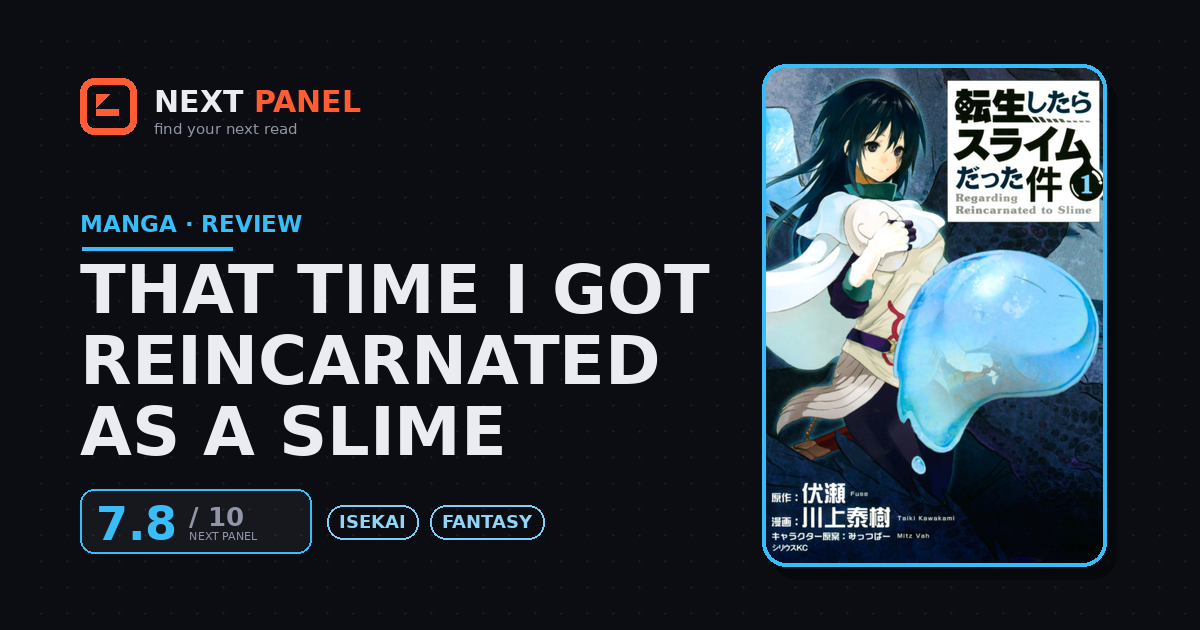
Is That Time I Got Reincarnated as a Slime Worth Reading? Review & Where to Read
Quick Answer
Yes, if you like your isekai warm and slow-building rather than tense. It's one of the most likeable monster-in-a-new-world stories going, as long as you're not expecting real danger.
Quick Verdict
“Nation-building, not fights, is the real draw here — if watching a slime turn a cave of goblins into a functioning country sounds fun, this is an easy recommendation.”
Best for: Readers who enjoy slow-building isekai and a big found-family cast more than constant peril.
Not for: Readers who want high, sustained stakes and a short, focused story.
- Type
- Manga
- Genres
- Fantasy, Isekai
- Status
- Ongoing
- This review
- Minor Spoilers
- Author
- Fuse (story), Taiki Kawakami (art)
- Artist
- Taiki Kawakami
- Publisher
- Kodansha (Kodansha USA in English)
- Platform
- Kodansha / K MANGA
| Quick facts | |
|---|---|
| Format | Manga (shōnen), 32 volumes |
| Run | 2015–present · ongoing |
| Community score | AniList 8.2 · MAL 8.4 · MangaUpdates 8.2 |
| Content | Fantasy violence |
| Where to read | Kodansha / K MANGA — official |
Overview
A jaded office worker gets stabbed on the street and wakes up in a fantasy world — as a slime. That's the setup, and it sounds like a joke, but That Time I Got Reincarnated as a Slime takes it somewhere more interesting than the punchline suggests. Rimuru, the newly slimed hero, can absorb the abilities of things he eats and talk his way into almost any alliance, and he uses those gifts not to conquer the world but to build a home for the monsters everyone else treats as vermin. Taiki Kawakami's manga adapts Fuse's hugely popular web novel, and it's become one of the defining comfort isekai of the last decade.
What it does well
The thing that sets Slime apart from the pack is that the fighting isn't really the point. The real draw is construction. You watch Rimuru meet a struggling village of goblins, give them names, organize them, bring in dwarves and ogres and lizardmen, and slowly turn a patch of wilderness into a functioning country with roads, trade, and laws. It scratches the same itch as a good management game — steady, visible progress that pays off chapter after chapter.
It also just has a warm heart. Rimuru is overpowered, which usually kills tension, but the story leans into his generosity instead of his strength. He'd rather make a friend than an enemy, and the monsters he gathers around him feel like a found family rather than a list of subordinates. That tone carries a lot of weight and keeps the book pleasant to spend time in.
Kawakami's art deserves credit too. It's clean and readable, switches easily between cute slice-of-life beats and large-scale battles, and — importantly — it paces the early arcs better than the novels do, trimming some of the exposition and keeping things moving. If you tried the source material and bounced off the walls of text, the manga is the friendlier version.
Where it falls short
The flip side of a hero this powerful is that stakes are hard to come by. Rimuru rarely feels threatened, and you seldom doubt how a confrontation will end, so the fights land more as spectacle than suspense. If you read manga for real danger, this isn't it.
The other issue is sprawl. As the nation grows, so does the cast, and the middle stretch throws a lot of factions, politics, and new names at you in a short span. It can get genuinely hard to remember who everyone is and why a particular summit matters. And the story still likes to stop and explain its own mechanics — skills, evolutions, and systems get spelled out at length, which slows the momentum right when it should be building.
Verdict
Judged as what it's trying to be — a feel-good power fantasy about building something — Slime is a standout. It's generous, cozy, and more thoughtful about community than most of its rivals, and the manga is the best-paced way to read it. Go in for the world and the cast, not for white-knuckle tension, and it's an easy series to sink a long, happy afternoon into.
Strengths & Weaknesses
Strengths
- The hook isn't the fighting, it's the building — watching Rimuru recruit monsters, name them, and turn a goblin village into a real nation is genuinely satisfying to follow.
- The cast is easy to love. Rimuru is overpowered but generous, and the monsters around him read like a warm found family instead of a roster of stats.
- Taiki Kawakami's art is clean and expressive, good at both the cute day-to-day scenes and the big set-piece battles, and it paces the early arcs more tightly than the source novel.
- It's a low-stress comfort read — the tone stays hopeful and fun even when the plot gets busy.
Weaknesses
- Rimuru is so strong that real tension is rare; you rarely doubt how a fight will end.
- The scope sprawls. The middle arcs pile on factions, politics, and named characters faster than it's easy to keep track of them.
- It leans on exposition — skills and systems get explained at length, which slows the momentum.
Similar Titles
Another reincarnation story where growing up and building a life matters as much as the action.
A denser take on the 'reborn into a fantasy world and start over' isekai.
Where to Read Officially
| Platform | Format | Pricing | Region notes | Link |
|---|---|---|---|---|
| Kodansha / K MANGA | Print & digital volumes | Paid | Region availability varies | Open |
Frequently Asked Questions
Do I need to watch the anime first?
No. The manga stands on its own and covers the story from the start, so it's a fine entry point.
Is the manga finished?
No, it's still ongoing. It adapts the light novels and is well over 20 volumes so far.
Where can I read it in English officially?
Kodansha publishes it in English in print and digital, and it's available on the K MANGA app.