Is The Bugle Call: Song of War Worth Reading? Review & Where to Read
Quick Answer
Yes, if you want a war-fantasy manga with a genuinely different hook. Luca hates war and wants to be a musician, but his rare ability to "see" sound and a supernatural power tied to it get him pulled into the conflict between two rival factions anyway. It leans heavily on worldbuilding, so it asks for some patience, but the premise pays that patience back.
Quick Verdict
“Forcing a musician to fight with the one thing he loves is a sharp enough hook to carry a fairly dense war-fantasy setup.”
Best for: Readers who want a war-driven fantasy with a distinct central power and a protagonist who doesn't want to be there.
Not for: Readers who want a simple, low-lore setup instead of a layered political and magical system to keep track of.
- Type
- Manga
- Genres
- Fantasy, Action
- Status
- Ongoing
- This review
- Minor Spoilers
- Author
- Mozuku Sora
- Artist
- Higoro Toumori
- Publisher
- VIZ Media
- Platform
- VIZ Media
| Quick facts | |
|---|---|
| Format | Manga (shōnen), 14 volumes |
| Run | 2022–present · ongoing |
| Community score | AniList 8.2 · MangaUpdates 7.9 |
| Content | War violence |
| Where to read | VIZ Media — official |
Overview
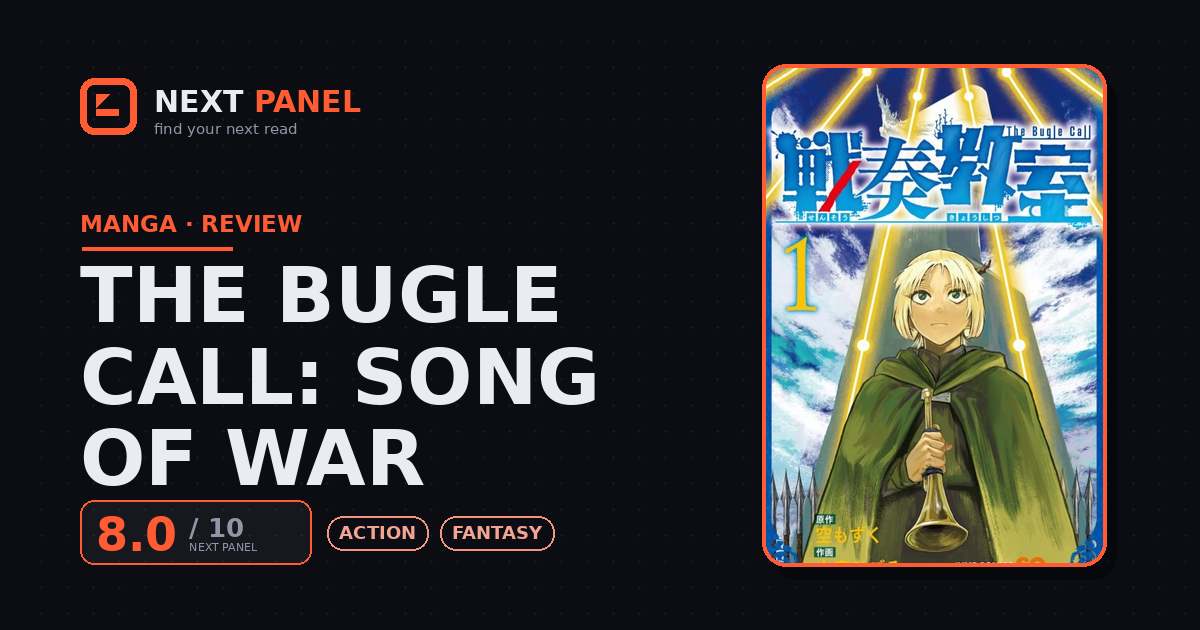
The Bugle Call: Song of War began serialization in Shueisha's Jump Square in 2022 and is licensed in English by VIZ Media, with story by Mozuku Sora and art by Higoro Toumori. Set in an imagined 1294, it follows Luca, a boy who can "see" sound and dreams of becoming a musician despite belonging to a mercenary band. He's one of the Branch-hexed, marked with a supernatural power tied to his instrument, and that power puts him directly in the path of a growing war. The world is shaped by nine massive Spires, remnants of an ancient civilization that now serve as centers of political power, with the Papal States and the expansionist Erin Empire holding the two Great Spires between them. When the Pontiff recruits Luca to lead his troops, hoping his abilities can shift the balance of the coming conflict, a boy who hates fighting ends up at the center of it.
What it does well
The core hook, a musician who despises war being forced to use the thing he loves as a weapon, gives Luca's arc real thematic weight instead of just another chosen-one setup. His power isn't separate from his identity, it's an extension of it, and that connection keeps the story's action grounded in who he is rather than just what he can do. The political backdrop around the Spires and the rival factions adds real stakes to the war itself, this isn't a vague good-versus-evil conflict, it's built on a specific power structure with its own history and ambitions.
The art carries both halves of that equation well, rendering Luca's sound-based abilities in a way that's visually distinct while still handling large-scale battle sequences clearly. The series has picked up enough traction to land a 2027 anime adaptation, which tracks with how developed the world and power system already are this deep into its run.
Where it falls short
All that worldbuilding comes at a cost early on. Between the Spire system, the Branch-hexed power set, and the political rivalry driving the plot, new readers have a fair amount to absorb before the story's shape fully clicks into place. Being an ongoing series, several of the larger political and power-system threads are still being built out rather than resolved, and readers looking for a tighter, more character-first war story may find the amount of lore front-loaded rather than doled out gradually.
Verdict
The Bugle Call: Song of War earns its momentum with a genuinely distinct hook, a musician's power turned into a weapon of war, wrapped in a dense but well-constructed political fantasy. It asks for some patience with its worldbuilding, but the core idea is strong enough to carry it.
Strengths & Weaknesses
Strengths
- Luca's power being tied directly to his hatred of war and love of music gives the action a thematic hook most war-fantasy leads don't have.
- The political structure around the Spires and the rival factions gives the conflict real stakes beyond a generic good-versus-evil war.
- The art handles both the sound-based power visuals and large-scale battle scenes with a clear, distinct style.
- It's picked up enough momentum to get a 2027 anime adaptation, which reflects the strength of the source material.
Weaknesses
- The worldbuilding is dense from early on, with multiple factions, the Spire system, and the Branch-hexed power set all introduced quickly.
- As an ongoing series, some of the larger political threads are still unfolding rather than paying off yet.
- Readers who want a simpler, character-first war story may find the amount of lore front-loaded.
Similar Titles
A different premise, but the same scale of political stakes layered under a war-driven fantasy plot.
Another war-fantasy built on a distinct power system tied closely to its protagonist's personal convictions.
For readers who want more of the same core tension: a fighter forced into a war he doesn't believe in.
Where to Read Officially
| Platform | Format | Pricing | Region notes | Link |
|---|---|---|---|---|
| VIZ Media | Digital chapters | Print & digital volumes | Paid | Region availability varies | Open |
Frequently Asked Questions
Is the series finished?
No — it's ongoing, with around 14 volumes released in Japan as of mid-2026, and a TV anime adaptation announced for 2027.
Do I need to know the historical period it's based on?
No — it's set in an imagined version of 1294 with its own fantasy elements like the Spires and Branch-hexed powers, so no real-world history is required.
Is Luca a willing soldier?
No — he hates war and wants to be a musician. He's recruited because of his rare abilities, not because he wants to fight.