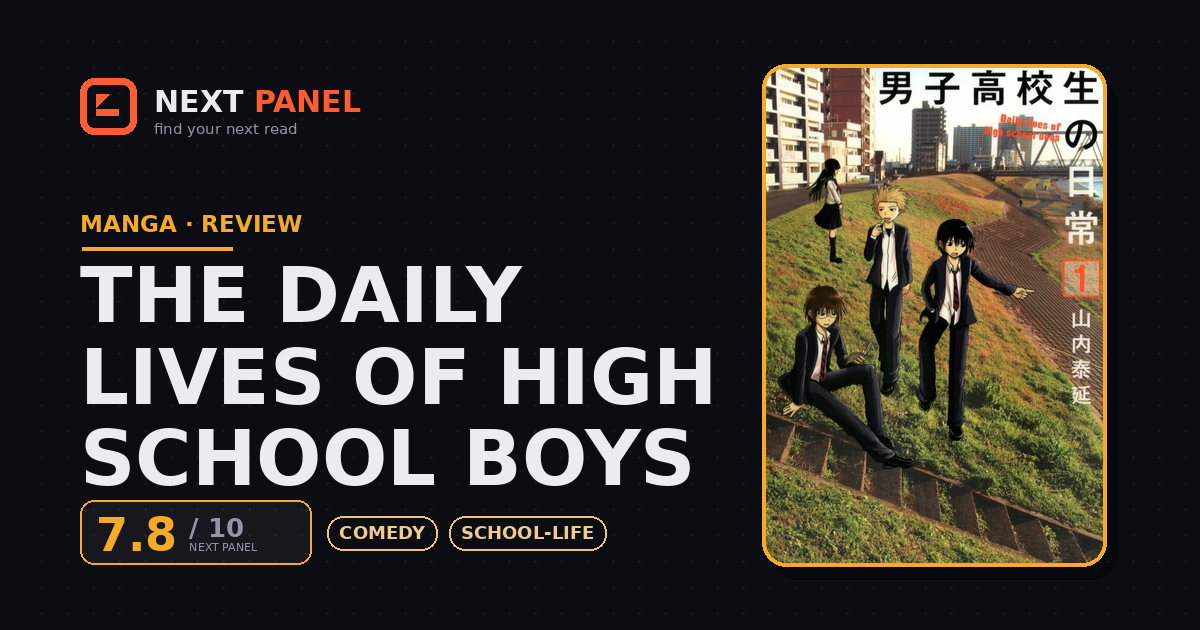
Is The Daily Lives of High School Boys Worth Reading? Review & Where to Read
Quick Answer
Yes, if you want pure gag comedy. There's no story and no growth — just short skits about teenage boys with too much free time, executed with superb deadpan timing. A few sketches whiff, but the hit rate is high and the whole thing is a quick, complete read.
Quick Verdict
“Sketch comedy about teenage boys doing absolutely nothing, and at its best it delivers some of the hardest laughs in manga. Accept up front that a few skits will whiff.”
Best for: Readers who want short, absurd gag chapters they can drop into anywhere, with no plot to track.
Not for: Readers who want an ongoing story, character growth, or romance played straight.
- Type
- Manga
- Genres
- School Life, Comedy
- Status
- Completed
- This review
- Minor Spoilers
- Author
- Yasunobu Yamauchi
- Publisher
- Square Enix
- Platform
- Kodansha
| Quick facts | |
|---|---|
| Format | Manga (shōnen), 138 chapters, 7 volumes |
| Run | 2009–2012 · completed |
| Community score | AniList 8.0 · MangaUpdates 8.3 |
| Where to read | Kodansha — official |
Overview
Tadakuni, Yoshitake, and Hidenori are three completely unremarkable boys at an all-boys high school, and this series is about nothing more than how they pass the time: inventing games, testing dumb hypotheses, role-playing fantasy scenarios in the living room, and getting into deeply serious arguments about deeply unserious things. There's no plot, no arc, and almost no continuity — just short sketch chapters about the specific, universal boredom of being a teenage boy.
What it does well
The observational accuracy is the engine. Plenty of gag manga run on randomness; this one runs on recognition. The boys commit to stupid bits with total sincerity, escalate imaginary scenarios until they collapse, and roast each other with the casual brutality of people who've been friends too long. If you were ever a bored teenager in a group of bored teenagers, half these sketches will feel personally observed.
Yamauchi's timing is the other half. The comedy is built on deadpan — long silent panels, dead-eyed reaction faces, punchlines placed exactly on page turns — and the restraint is what makes it hit. He knows when to end a sketch a beat early and let the absurdity echo, and he trusts the reader to catch jokes he never underlines.
The recurring material builds real momentum too. Hidenori's riverbank encounters with the wannabe-novelist 'Literature Girl' — two strangers trapped in mutual overthinking — grow into one of the great running gags in manga, and the 'High School Girls Are Funky' interludes flip the premise to show the girls being every bit as dumb as the boys. For a series with no story, it's surprisingly good at making bits pay off across volumes.
And because every chapter stands alone, it's an ideal in-between read. You can clear it in an afternoon or keep it on the shelf as a palate cleanser for months.
Where it falls short
Sketch comedy always has variance, and this is no exception. Some gags are so specific they're transcendent; others whiff completely, and which is which depends on your sense of humor. Every reader hits a stretch of chapters that does nothing for them.
There's also nothing underneath. The characters don't grow, relationships don't move, and the series ends because it ends, not because anything resolves. That's the genre working as intended, but readers who need even a little warmth or progression to stay attached won't find it here. The plain, functional art doesn't offer much to linger on either — it exists to deliver timing, and that's all.
Verdict
This is one of the funniest manga ever translated, full stop, and its only real demands are a tolerance for absurdity and zero expectations of story. Judged as what it is — a sketchbook of teenage idiocy executed with elite timing — it's close to the top of its genre. Short, complete, easy to find in English, and very easy to recommend.
Strengths & Weaknesses
Strengths
- Nails how teenage boys actually joke — committing hard to dumb bits, escalating imaginary scenarios, and roasting each other without mercy.
- Yamauchi's deadpan timing is elite; punchlines are built around reaction faces and page turns, and they land clean.
- The recurring bits compound — Hidenori's riverbank encounters with the 'Literature Girl' build into one of manga's great running gags.
- Chapters stand alone completely, so it works equally well as a binge or as something you graze between heavier reads.
Weaknesses
- Sketch quality varies — every reader will hit stretches where the jokes just don't land for them.
- There's zero character development by design, so there's nothing to hold onto beyond the next gag.
- The art is plain and functional; it serves the comedy but never impresses on its own.
Similar Titles
The same everyday-nonsense energy pushed into full surrealism, with far flashier art.
Escalating idiot-comedy among students, with the same commitment to the bit.
Another all-timer gag series about dumb boys treating absurd situations with total seriousness.
Where to Read Officially
| Platform | Format | Pricing | Region notes | Link |
|---|---|---|---|---|
| Kodansha | Print & digital volumes | Paid | Region availability varies | Open |
Frequently Asked Questions
Is The Daily Lives of High School Boys finished?
Yes. The manga is complete, and Kodansha (via its Vertical imprint) has published the entire series in English in print and digital.
Do I need to read the chapters in order?
No. Almost every chapter is a self-contained skit. A handful of running gags reward reading in order, but you can open any volume anywhere.
Is this the manga the anime was based on?
Yes — the well-liked comedy anime adapts this manga. The manga covers more skits overall, so it's worth reading even if you've seen the show.