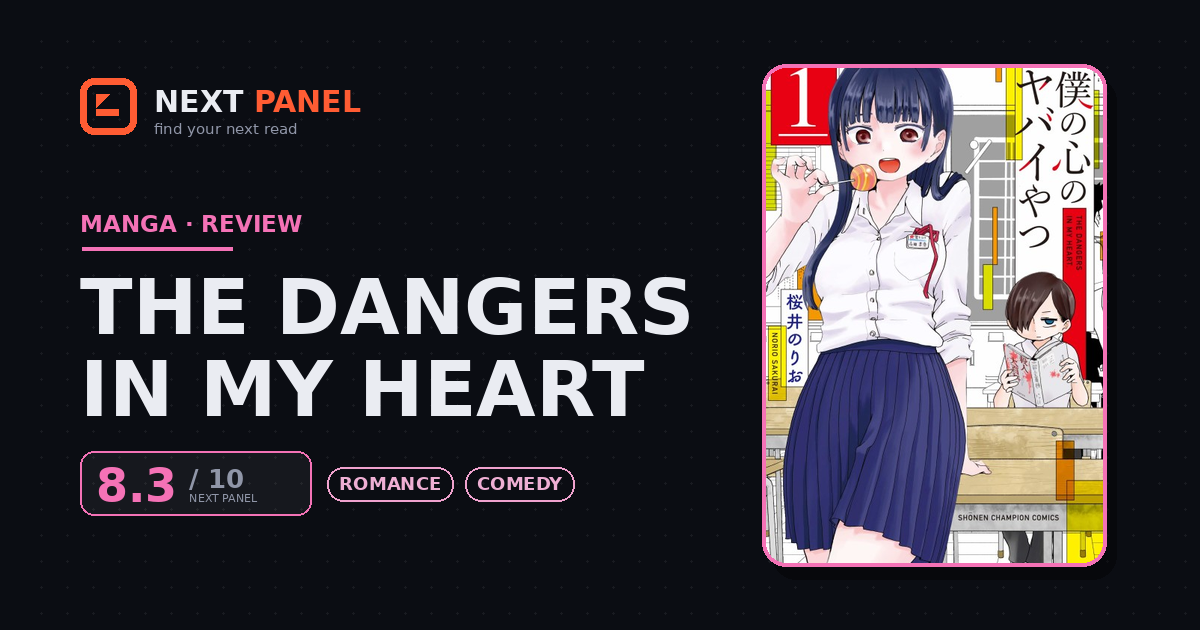
Is The Dangers in My Heart Worth Reading? Review & Where to Read
Quick Answer
Yes — it's one of the best romance manga of its generation, and it's now heading into its announced final volume, so you're not signing up for an endless tease. The catch is the opening: the early edgelord framing puts some readers off before the series shows what it's really doing.
Quick Verdict
“Push through the edgelord opening chapters — what's underneath is the tenderest, best-acted romcom of its generation.”
Best for: Readers who want a slow-burn first-love story told through tiny gestures and facial acting rather than big set pieces.
Not for: Readers who want fast relationship progress, adult-aged leads, or comedy free of secondhand embarrassment.
- Type
- Manga
- Genres
- Romance, Comedy
- Status
- Ongoing
- This review
- Minor Spoilers
- Author
- Norio Sakurai
- Publisher
- Akita Shoten
- Platform
- Seven Seas
| Quick facts | |
|---|---|
| Format | Manga (shōnen), 14 volumes |
| Run | 2018–present · ongoing |
| Community score | AniList 8.1 · MangaUpdates 8.2 |
| Content | Dark humor, mild sexual humor |
| Where to read | Seven Seas — official |
Overview
Kyōtarō Ichikawa sits at the bottom of his class hierarchy, reading serial-killer trivia and quietly fantasizing about murdering Anna Yamada, the beautiful, popular girl who sits near the top. That's the premise as chapter one presents it, and it's a costume. What the series is actually about reveals itself fast: Kyōtarō keeps catching Anna being ridiculous — sneaking snacks in the library, losing fights with vending machines, laughing at nothing — and every glimpse of the real her knocks another brick out of his edgelord wall. The 'dangers' in his heart were never about violence. They're about how terrifying it is for a kid who's decided he's a monster to admit he likes someone, and that she might like him back.
What it does well
Nobody working in romance manga right now acts on the page like Norio Sakurai. The storytelling runs on micro-expressions — a glance held one beat too long, a blush that arrives in stages, a panel of silence where a lesser series would put a monologue. Entire relationship turns happen without dialogue, and the manga trusts you to catch them. It makes reading the series feel active, like you're deciphering the same signals the characters are.
The leads deserve the craft. Kyōtarō's inner voice is the best thing in the book: self-aware enough to know his gloom is a pose, honest enough to admit every cowardly impulse, funny in how brutally he judges himself. And Anna, who a weaker series would leave as an unattainable prize, is a complete person — a working model with a bottomless stomach, a dorky sense of humor, and her own loneliness that Kyōtarō is uniquely positioned to see. The story is a two-way rescue, and both directions are earned.
It's also structured like it respects your time. Moments that other romcoms would stretch across years of serialization actually happen. The story keeps moving through thresholds — noticing, admitting, acting — and each phase changes the comedy and the tension instead of resetting them. With the ending now announced, the whole thing is shaping up as a complete arc rather than an indefinitely milked one.
Where it falls short
That opening, though. The murder-fantasy framing of the first chapters is doing deliberate character work, but it reads as cheap shock humor until the series shows its cards, and it has cost the manga plenty of readers who never got to the good part. The other honest caveat is scale: this is a story about thirteen-and-fourteen-year-olds where a shared umbrella is a season finale. That intensity-of-small-things is exactly the appeal, but if you're immune to it, the series will feel like it's vibrating over nothing. And outside the two leads, the cast is thin — friends and classmates serve the central relationship and not much else.
Verdict
The Dangers in My Heart takes the most worn-out setup in manga — gloomy boy, radiant girl — and executes it with so much observational skill that it feels new. It's funny, painfully sincere, and drawn with the best emotional timing in the genre, and it's about to be complete. Start it knowing the first volume is a bluff you're meant to see through. If you've ever liked a slow-burn school romance, this is the current high-water mark.
Strengths & Weaknesses
Strengths
- Sakurai's facial acting and panel timing are the best in the genre right now — entire emotional turns happen in a glance, a held beat, or a wordless panel, and the manga trusts you to read them.
- Both leads are real people. Kyōtarō's narration is painfully honest about his own posturing, and Anna is a specific, funny, flawed girl rather than a trophy the plot dangles in front of him.
- The character growth is the actual story: watching a kid who hides behind morbid fantasies learn to do small brave things is more satisfying than most confession scenes in the genre.
- It keeps developing past the point where most romcoms stall, treating the relationship itself — not just the chase — as material worth writing.
Weaknesses
- The first volume's murder-fantasy framing is a genuine hurdle. It's doing deliberate work (the act is the point), but plenty of readers bounce off before the series tips its hand.
- It's a slow burn about middle schoolers, and the intensity of every tiny interaction can read as precious if you're not on its wavelength.
- Side characters exist mostly as furniture around the two leads; nobody else gets close to their depth.
Similar Titles
The same quiet, atmospheric two-people-finding-each-other energy, with rooftops and astronomy instead of library snacks.
Another romcom about reading a classmate everyone else misreads, played broader and gentler.
A romance that also skips the endless tease and actually lets its leads become a couple.
Where to Read Officially
| Platform | Format | Pricing | Region notes | Link |
|---|---|---|---|---|
| Seven Seas | Print & digital volumes | Paid | Region availability varies | Open |
Frequently Asked Questions
Is The Dangers in My Heart finished?
Nearly. The series is in its announced final stretch — volume 14 has been confirmed as the last — so it's about to become a complete, bingeable story.
Where can I read it in English?
Seven Seas publishes the manga in English in print and digitally, with releases running a few volumes behind Japan.
Is the dark humor actually dark?
Not really. The murder-fantasy bit is a lonely kid's coping pose, and the series dismantles it quickly. It's a romance with a spiky opening, not an edgy thriller.