Is The Flowers of Evil Worth Reading? Review & Where to Read
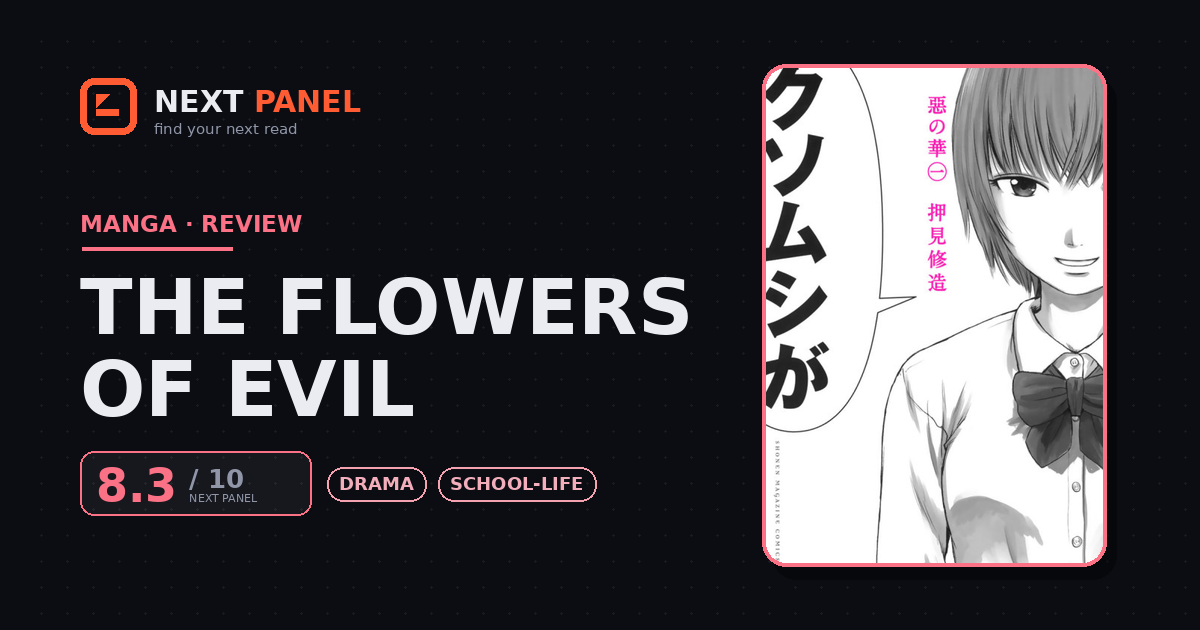
Quick Answer
Yes, if you can handle deeply uncomfortable psychological drama. The Flowers of Evil is a raw, often excruciating portrait of adolescent alienation, kicked off when a bookish boy's impulsive bad decision puts him under the thumb of a disturbing classmate. It's intense, awkward, and not always pleasant, but it's one of the sharpest looks at the ugliness of being a teenager out there.
Quick Verdict
“It's deliberately excruciating to read — that squirming, exposed feeling of being thirteen — and that's exactly what makes it brilliant.”
Best for: Readers who want raw, uncomfortable psychological drama about adolescent alienation and aren't put off by deeply awkward, dark material.
Not for: Readers who want comfortable, likable characters or a fast, plotty story.
- Type
- Manga
- Genres
- School Life, Drama
- Status
- Completed
- This review
- Minor Spoilers
- Author
- Shuzo Oshimi
- Publisher
- Kodansha / Vertical
- Platform
- Vertical
| Quick facts | |
|---|---|
| Format | Manga (shōnen), 58 chapters, 11 volumes |
| Run | 2009–2014 · completed |
| Community score | AniList 8.1 · MAL 7.6 · MangaUpdates 8.1 |
| Content | Disturbing psychological and sexual themes; bullying and self-destructive behavior |
| Where to read | Vertical — official |
Overview
The Flowers of Evil turns an ordinary middle-school crush into something deeply unsettling. Takao Kasuga is a quiet, bookish kid who fancies himself above his dull town and dull classmates — he reads Baudelaire and dreams of being someone special. He has a crush on Nanako Saeki, the class idol. Then, on impulse, he does something he can't take back, and the class outcast, Sawa Nakamura, sees him do it. She uses what she knows to pull him into a "contract," and from there Kasuga's safe little life starts to come apart. Shuzo Oshimi wrote and drew it across 11 volumes, and it's published in English by Kodansha.
What it does well
It captures adolescence with brutal, uncomfortable honesty. Most coming-of-age stories flatter the experience; this one digs into the parts you'd rather forget — the pretension, the shame, the desperate need to be seen as special, the way a single mistake can feel like the end of the world. Reading it can be physically uncomfortable, in the specific way of remembering your own worst teenage moments. That's not a bug; it's the whole point, and almost nothing else nails it this precisely.
Oshimi's craft is what makes it work. His art is plain and realistic, which grounds the melodrama and makes the psychological pressure feel real, and he's a master of the silent panel — a held expression, an empty street, a long beat of dread. The tension comes not from plot twists but from watching people corner themselves emotionally, and he wrings extraordinary unease out of very ordinary settings.
Nakamura is one of the great unsettling characters in manga — nihilistic, volatile, impossible to predict — and the warped pull between her and Kasuga drives the whole thing. It's less a relationship than a slow mutual unraveling, and it's riveting.
Where it falls short
It is genuinely hard to read, and not everyone will want to. The discomfort is relentless, the characters often behave in cringe-inducing or alarming ways, and there's no easy catharsis for long stretches. If you need someone to root for, you may be left cold.
It's also divisive in structure. Without spoiling anything, the series makes a significant shift partway through, and while many consider the later stretch its strongest, others feel it loses the claustrophobic charge of the opening. And Oshimi's slow-burn approach means it occasionally lingers past tension into tedium.
Verdict
The Flowers of Evil is a remarkable, deeply uncomfortable psychological drama — one of the truest depictions of the ugliness and intensity of being a teenager you'll find in manga. It asks a lot of you: patience, a strong stomach for secondhand embarrassment and dread, and a willingness to sit with unpleasant people. But if you meet it halfway, it's unforgettable, and it confirms Oshimi as one of the best in the genre. Not a comfortable read — a great one.
Strengths & Weaknesses
Strengths
- It captures adolescence with brutal honesty — the pretension, shame, and desperate need to be special that most coming-of-age stories smooth over.
- Oshimi is a master of the silent panel; his plain, realistic art wrings extraordinary dread out of very ordinary settings.
- Nakamura is one of manga's great unsettling characters, and the warped pull between her and Kasuga is riveting.
- The discomfort is the point — it makes you feel the squirming intensity of being a teenager in a way almost nothing else does.
Weaknesses
- It's genuinely hard to read: relentless discomfort, cringe-inducing behavior, and little easy catharsis or anyone obvious to root for.
- It's divisive in structure — a major mid-series shift loses the claustrophobic charge of the opening for some readers.
- Oshimi's slow burn occasionally lingers past tension into tedium.
Similar Titles
Inio Asano's bleak, brilliant coming-of-age — the same unflinching look at growing up wrong.
Oshimi's other psychological masterwork, this time mining horror from a mother-son bond.
Another raw study of alienation and self-destruction, with more dark comedy.
Where to Read Officially
| Platform | Format | Pricing | Region notes | Link |
|---|---|---|---|---|
| Vertical | Print & digital volumes | Paid | Region availability varies | Open |
Frequently Asked Questions
Is The Flowers of Evil completed?
Yes. It ran from 2009 to 2014 and is complete in 11 volumes, available in English from Kodansha (originally Vertical).
Is it a romance?
Not in any comfortable sense. There are intense relationships, but it's a psychological drama about obsession, alienation, and adolescence — not a feel-good love story.
Is the anime a good place to start?
It's divisive — the 2013 anime used rotoscoping for an eerie, realistic look that fans either loved or hated. The manga is the more widely recommended version.