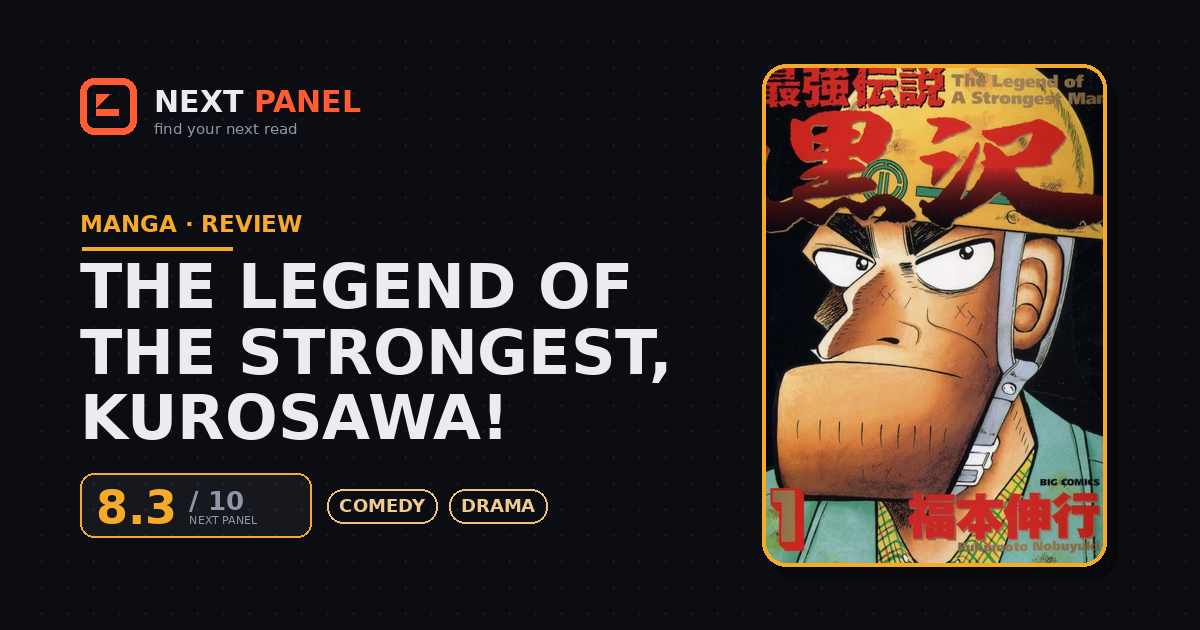
Is The Legend of the Strongest, Kurosawa! Worth Reading? Review & Where to Read
Quick Answer
Worth reading if you want a darkly funny character study about an overlooked man finding unexpected strength, not a straightforward power fantasy.
Quick Verdict
“Worth it for Fukumoto's sharp, melancholic take on a very familiar premise, an underrated pick in his catalog.”
Best for: Readers who want dark comedy grounded in real character pathos and an unglamorous, deliberately awkward protagonist.
Not for: Readers who want a tightly plotted power fantasy with escalating tournament stakes and a clean hero's journey.
- Type
- Manga
- Genres
- Drama, Comedy
- Status
- Completed
- Author
- Nobuyuki Fukumoto
- Publisher
- Shogakukan
- Platform
- Crunchyroll Manga
| Quick facts | |
|---|---|
| Format | Manga, 90 chapters, 11 volumes |
| Run | 2003–2006 · completed |
| Community score | AniList 8.2 · MangaUpdates 8.0 |
Overview
Kurosawa is 44 years old, an unremarkable site foreman at a small construction company, and nobody at work even remembers his birthday. That quiet humiliation is the spark for everything that follows. Realizing he's spent his whole life invisible, Kurosawa decides to stop being a pushover and start living with some actual nerve, and it turns out that underneath the exhausted, awkward exterior is a man capable of terrifying physical force. He starts getting pulled into confrontations with local delinquents and gang members, and word starts to spread about the quiet construction worker nobody should mess with. This is Nobuyuki Fukumoto, the mind behind "Kaiji" and "Akagi," working in a much more grounded and darkly funny register than his gambling thrillers, but with the same interest in what desperation does to an ordinary man.
What it does well
The tone is the whole trick here. This could easily have been a straightforward power fantasy, awkward nobody turns out to be secretly strong, but Fukumoto keeps circling back to how lonely and sad Kurosawa's life actually is, so every fight carries an undercurrent of pathos instead of pure catharsis. The comedy lands because it comes from real character observation rather than gags, Kurosawa's social awkwardness and stubborn pride are funny in a way that feels true to a specific kind of overlooked, middle-aged man. Fukumoto's linework is as intense as ever, all sweat and strained muscle and wide-eyed dread, which makes even small confrontations feel like they matter. And there's a real emotional throughline under the episodic fights: this is fundamentally a story about wanting to be seen, and it never loses sight of that.
Where it falls short
The episodic structure means plot momentum comes and goes in waves, some stretches read like a loose string of confrontations rather than a tightly serialized story. Kurosawa himself is a deliberately unglamorous, sometimes uncomfortable protagonist, his social cluelessness and misplaced pride can grate rather than endear depending on your patience for that archetype. And because this isn't a shonen power fantasy despite the premise sounding like one, readers expecting an escalating tournament structure or a clean hero's journey will be disappointed by how messy and human it stays instead.
Verdict
If you want a character study about an overlooked, middle-aged man discovering he has more fight in him than anyone assumed, and you're fine with dark comedy that doesn't fully resolve into triumph, this is a genuinely underrated entry in Fukumoto's catalog. It's stranger and sadder than the premise suggests, in a good way.
Strengths & Weaknesses
Strengths
- Genuinely funny while staying grounded in real character sadness
- Fukumoto's intense, sweat-and-strain art style suits every confrontation
- Kurosawa is a specific, lived-in character rather than a generic underdog
- Emotional throughline about wanting to be seen ties the episodic fights together
Weaknesses
- Episodic structure means plot momentum ebbs and flows
- Kurosawa's social awkwardness can grate as much as endear
- Not the escalating power-fantasy structure the premise might suggest
- Dark comedic tone won't land for readers wanting a straighter story
Similar Titles
Same author, same interest in what desperation does to an ordinary man, though far more thriller-focused
Another comedic take on a frighteningly capable man hiding in an unglamorous, everyday role
Frequently Asked Questions
Is this a straightforward action or power-fantasy manga?
Not really. It's framed like one, but it plays out more as a dark character comedy about loneliness and pride than an escalating fight series.
Is there an official English release?
Yes, it's licensed digitally in English through Crunchyroll Manga (formerly available via Manga Planet), complete at 11 volumes.
Is this connected to Kaiji or Akagi?
Not in story, but it's by the same creator, Nobuyuki Fukumoto, and shares his interest in ordinary men pushed to extremes.
Is the series finished?
Yes, it's complete at 11 volumes / 90 chapters.