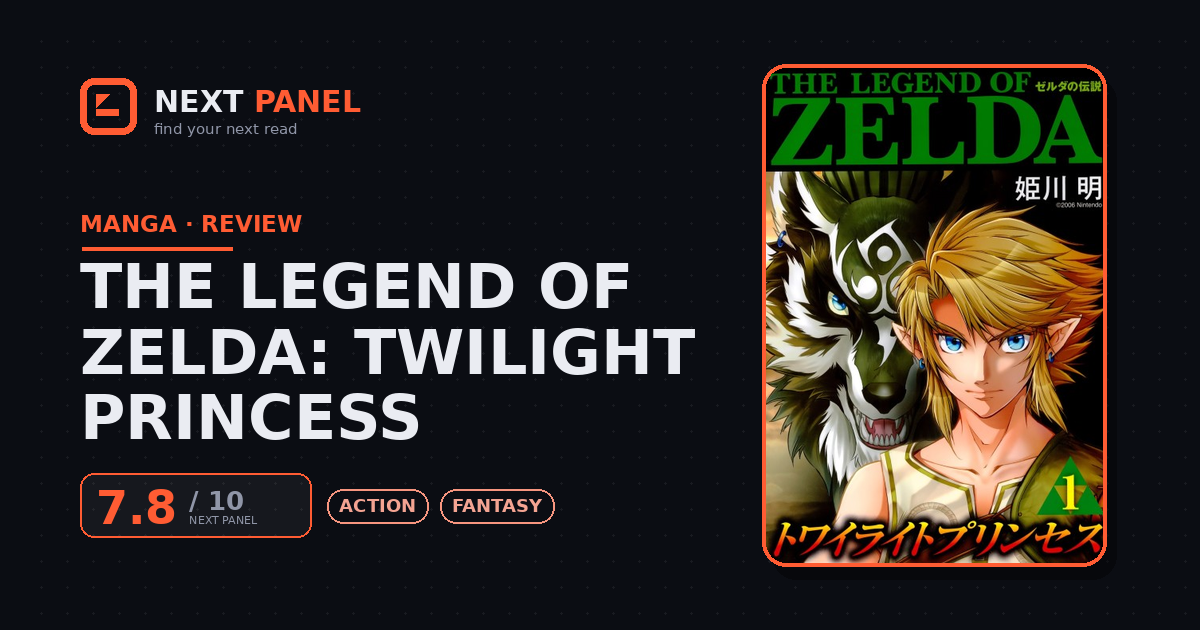
Is The Legend of Zelda: Twilight Princess Worth Reading? Review & Where to Read
Quick Answer
If you already love the game, yes — this adds real character depth the original never had room for. If you've never played it, it still works as a solid, self-contained fantasy adventure.
Quick Verdict
“Video game manga adaptations are usually padding; this one is the rare case that actually improves on its source material's character work.”
Best for: Readers who want a fantasy action-adventure with a strong emotional core, especially fans of the original game curious how it translates.
Not for: Readers who want fast, plot-dense pacing rather than a story willing to slow down for character moments.
- Type
- Manga
- Genres
- Fantasy, Action
- Status
- Completed
- This review
- Minor Spoilers
- Author
- Akira Himekawa
- Publisher
- VIZ Media
- Platform
- VIZ Media
| Quick facts | |
|---|---|
| Format | Manga, 58 chapters, 11 volumes |
| Run | 2016–2022 · completed |
| Community score | AniList 8.0 |
| Where to read | VIZ Media — official |
Overview
Video game manga adaptations have a rough reputation, usually treated as glorified novelizations that add little to the source material. The Legend of Zelda: Twilight Princess, adapted by the creative duo Akira Himekawa across eleven volumes, is one of the exceptions. It follows the same basic beats as the 2006 game, Link's journey through a world half-swallowed by a shadow realm called the Twilight Realm, guided by the mysterious imp Midna, but it uses the comic format to do something the game structurally couldn't: slow down and actually develop its characters.
What it does well
The biggest improvement is Midna. In the game she's a great character conveyed mostly through action and a handful of cutscenes; in the manga, Himekawa gives her real interiority, and her relationship with Link becomes the emotional spine holding the whole adaptation together. That shift matters, because it turns what could have been a straightforward dungeon-crawl adaptation into a story that's actually about something: trust, sacrifice, and an unlikely bond between two people from worlds that are supposed to be enemies.
Zelda herself also benefits, getting more agency and screen time than she usually gets in a mainline game, and the manga is smart about restructuring the open-world pacing of the original into something that reads well as a serialized story rather than a level-by-level walkthrough. The art is a strong match for the material too, capable of handling both the game's melancholic, twilight-drenched atmosphere and its bigger action set pieces without either one undercutting the other.
Where it falls short
The manga is still fundamentally bound to the game's plot structure, which means anyone who's played Twilight Princess already knows most of the major story beats going in — the character work adds depth, but it doesn't reinvent the shape of the story. Some of the game's dungeon puzzle-solving, which is a huge part of its identity, gets compressed into quick sequences that lose some of that satisfaction in translation. And newcomers without any Zelda background may find a few worldbuilding elements assumed rather than explained, since the manga leans on the series' established lore.
Verdict
This is genuinely one of the better video game manga adaptations out there, elevating its source material's character work rather than just illustrating the plot beats. Whether you're revisiting the game's story with more depth or coming to it fresh as a fantasy adventure, it holds up well on its own terms.
Strengths & Weaknesses
Strengths
- Midna gets far more interiority here than the game ever gave her, and her dynamic with Link becomes the emotional core of the whole story.
- Himekawa restructures the game's open-world dungeon crawl into an actual paced narrative without losing what made the original memorable.
- The art handles both the game's darker, more melancholic tone and its big action set pieces convincingly.
- Zelda herself gets more to do and more agency than she typically does in the games, which is a welcome change.
Weaknesses
- Readers who haven't played the game may find some worldbuilding assumed rather than explained, since it leans on established Zelda lore.
- A few dungeon sequences get compressed into quick montages that lose some of the puzzle-solving satisfaction the games are built around.
- The overall plot beats are still constrained by having to hit the same story markers as the source game, so surprises are limited for anyone who's played it.
Similar Titles
Legend of Zelda: Ocarina of Time
Same creative team adapting another entry in the series with a similar approach.
Shares an interest in a stoic, mostly-silent swordsman navigating a genuinely dark fantasy world.
Similar large-scale fantasy adventure built around a young hero coming into his own.
Where to Read Officially
| Platform | Format | Pricing | Region notes | Link |
|---|---|---|---|---|
| VIZ Media | Print & digital volumes | Paid | Region availability varies | Open |
Frequently Asked Questions
Do I need to have played the game to enjoy the manga?
No, though familiarity with the game's world helps. The manga works as a self-contained fantasy adventure even without that background.
How many volumes are there?
Eleven volumes, all released in English by VIZ Media, and the story is fully complete.
Where can I read it officially in English?
VIZ Media publishes all 11 volumes in print and digital, including a complete box set.