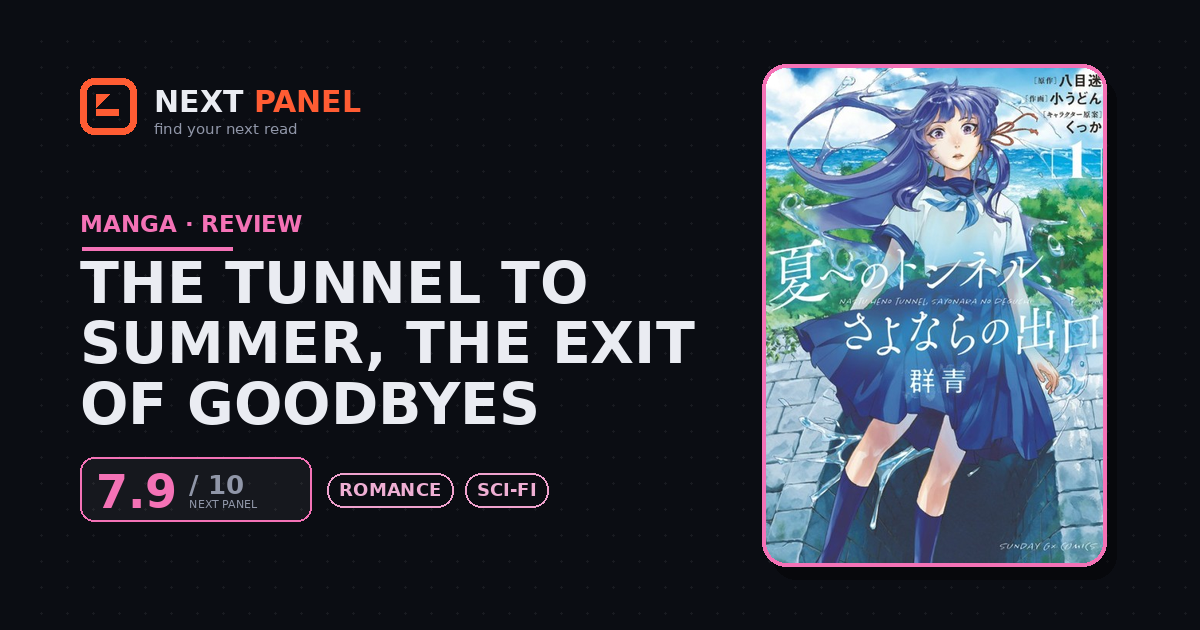
Is The Tunnel to Summer, the Exit of Goodbyes Worth Reading? Review & Where to Read
Quick Answer
Yes, if you want a short, emotionally sharp sci-fi romance you can finish in an afternoon. It trades some depth for its compact four-volume length, but the central idea and the central relationship both land.
Quick Verdict
“This is a tight, bittersweet what-would-you-trade story that earns its ending instead of just aiming for one.”
Best for: Readers who want a short, emotionally direct sci-fi romance with a strong central concept and don't need a long series to get attached.
Not for: Readers who want a large cast, a long runtime, or a story that lingers on its world-building instead of its two leads.
- Type
- Manga
- Genres
- Romance, Sci-Fi
- Status
- Completed
- This review
- Minor Spoilers
- Author
- Mei Hachimoku
- Artist
- Koudon
- Publisher
- Shogakukan
- Platform
- Seven Seas Entertainment
| Quick facts | |
|---|---|
| Format | Manga (seinen), 6 chapters, 1 volumes |
| Run | 2019–2019 · completed |
| Community score | AniList 8.2 |
| Content | Grief, mild peril |
| Where to read | Seven Seas Entertainment — official |
Overview
Kaoru Tono has heard the rumor his whole life: somewhere out there is the Urashima Tunnel, a passage where the normal rules of space and time don't apply. Walk through it, the story goes, and you'll find your heart's deepest wish waiting on the other side — but it comes at a cost measured in years of your own life. Kaoru has a wish he's desperate enough to pay that price for. Then he meets Anzu Hanashiro, a new transfer student with a very different reason for wanting to find the same tunnel, and the two of them end up searching for it together.
The manga, subtitled Ultramarine, adapts Mei Hachimoku's original light novel with new art by Koudon, running for four volumes in Shogakukan's Monthly Sunday Gene-X. It shares its source material with the well-received 2022 anime film, but tells the story through its own pacing and art rather than retreading the movie panel for panel.
What it does well
The central premise is doing a lot of work, and it holds up. A wish granted at the cost of your own years is the kind of sci-fi hook that could easily stay abstract, but the manga keeps grounding it in what Kaoru and Anzu are actually willing to give up and why, which turns a clever concept into a real emotional question.
Keeping Kaoru's and Anzu's motivations separate for a stretch of the story is a smart structural choice. Both of them clearly want something badly enough to risk the tunnel's price, but the manga takes its time letting the reader — and the two leads — understand exactly what that something is, so the moment their reasons start to intersect actually means something instead of just being a plot mechanism.
Koudon's art is well suited to the material, particularly in the quieter scenes between the two leads, where a lot of the emotional weight is carried by small gestures and expressions rather than dialogue. And because the whole story runs a tight four volumes, there's very little padding — almost every chapter is pulling its weight toward the ending.
Where it falls short
That same compact length is a trade-off. World details and side characters get comparatively little space, and a couple of the story's later reveals move fast enough that they land more as information than as fully earned emotional beats, especially if you're coming to this cold without the film or novel as a reference point.
The story's central metaphor about what we're willing to trade for what we want also gets stated fairly plainly by the end, which lands emotionally but leaves less ambiguity than the premise's opening chapters seem to promise.
Verdict
The Tunnel to Summer, the Exit of Goodbyes is a small, well-constructed sci-fi romance that knows exactly how long it needs to be and doesn't overstay that length. If a tight, bittersweet story about what you'd trade for your deepest wish sounds appealing, this delivers it efficiently and sincerely; if you want a sprawling cast or a slow-burn world to get lost in, look elsewhere.
Strengths & Weaknesses
Strengths
- The Urashima Tunnel is a genuinely great sci-fi hook — a wish granted at the cost of your own years — and the story mines it for real emotional stakes instead of just using it as set dressing.
- Kaoru and Anzu both have their own private reasons for wanting the tunnel's power, and keeping those reasons separate for a while makes the moment they finally overlap hit harder.
- Koudon's art handles the quieter, more intimate scenes well, giving the central relationship room to breathe between the more concept-driven chapters.
- The four-volume length keeps the story tight — nothing here is padded, and the pacing rarely drags.
Weaknesses
- That same tight length means some side characters and world details get less room than a longer series would give them.
- Readers who haven't seen the anime film or read the original novel may find a couple of late reveals move quickly rather than being fully built up on the page.
- The central metaphor is stated fairly directly by the end, which works but leaves less to interpret than the premise initially promises.
Similar Titles
Another bittersweet, visually driven romance about time and distance pulling two people apart.
A different time-bending hook (letters from the future) built around the same kind of quiet, aching regret.
A more thriller-focused take on using time to fix the past, for readers who want higher stakes around the same core idea.
Where to Read Officially
| Platform | Format | Pricing | Region notes | Link |
|---|---|---|---|---|
| Seven Seas Entertainment | Print & digital volumes | Paid | Region availability varies | Open |
Frequently Asked Questions
Is this the same story as the anime movie?
Yes, the manga adapts the same source light novel as the 2022 anime film, with new art by Koudon rather than the film's studio.
Is the manga finished?
Yes, it's complete in four volumes, all licensed in English by Seven Seas Entertainment.
Do I need to read the light novel first?
No. The manga tells the complete story on its own and doesn't assume you've read the novel or seen the film.