Is Yu-Gi-Oh! Worth Reading? Review & Where to Read
Quick Answer
Worth reading if you're curious about the original manga behind the anime and card game, which is stranger, darker, and more mean-spirited than the franchise's family-friendly reputation suggests.
Quick Verdict
“Worth it as the foundational text for one of manga's biggest multimedia franchises, complete at 38 volumes. Expect real tonal whiplash between its horror-tinged early volumes and its later card-game focus.”
Best for: Readers curious about the stranger, darker manga behind the Yu-Gi-Oh! anime and card game, including its horror-tinged early volumes.
Not for: Readers who want a tonally consistent read, or who are only interested in card-game strategy content without the earlier Shadow Game material.
- Type
- Manga
- Genres
- School Life, Action, Supernatural
- Status
- Completed
- Author
- Kazuki Takahashi
- Publisher
- Shueisha
- Platform
- VIZ
| Quick facts | |
|---|---|
| Format | Manga, 343 chapters, 38 volumes |
| Run | 1996–2004 · completed |
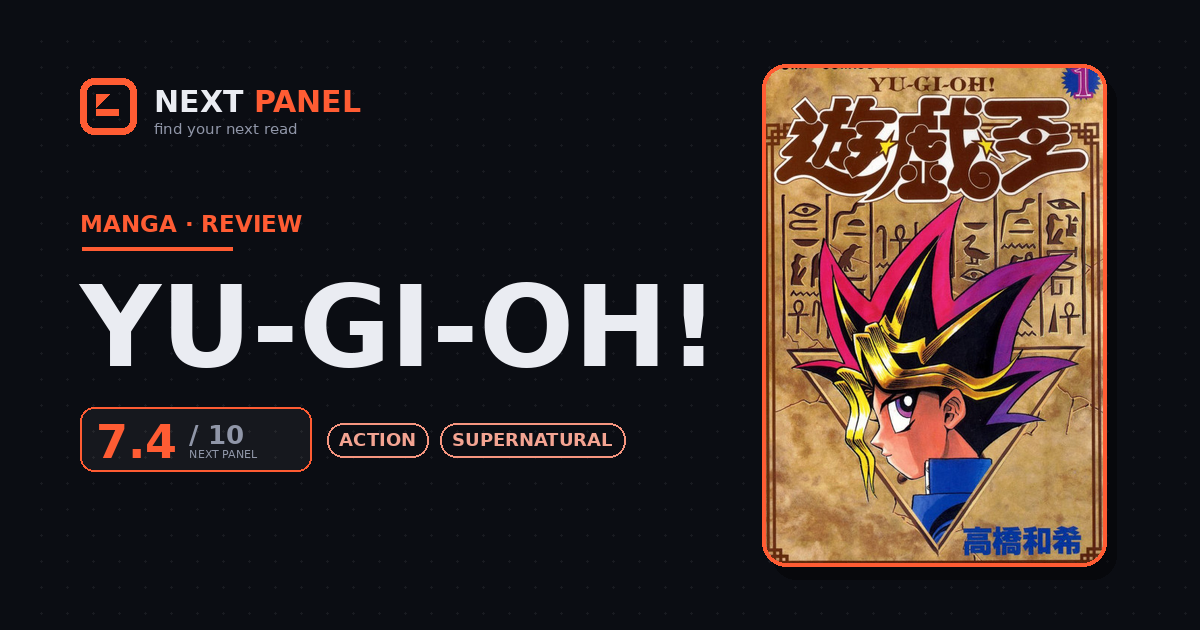
| Community score | AniList 7.7 · MangaUpdates 7.4 |
| Where to read | VIZ — official |
Overview
Yugi Mutou is a quiet, friendless high schooler who spends his time on puzzles and games instead of people. Then he finally solves the one that's been sitting on his desk for years, an ancient Egyptian relic called the Millennium Puzzle, and an ancient, vengeful spirit wakes up inside him. When bullies, con artists, or worse cross Yugi or the people he cares about, that spirit takes over and challenges them to a Shadow Game, a twisted, often supernatural contest where losing costs a lot more than pride.
What it does well
This is the manga that started an entire card game and a small media empire, and reading the source material reveals a story that's stranger and more mean-spirited than the family-friendly card-battling most Western fans associate with the name. Early volumes are closer to horror-tinged psychological thriller than shounen adventure: Yugi's alter ego dispenses genuinely dark, karmic punishment on bullies and criminals through twisted games of chance and skill, and that mean streak gives the whole series a distinctive edge even after Duel Monsters, the trading card game, becomes the main focus. Kazuki Takahashi's art has real personality, sharp character designs and a flair for making even a card game look genuinely dramatic and high-stakes. And it's the foundational text for one of the biggest manga-to-multimedia franchises ever built, worth reading on that historical significance alone, on top of being a genuinely fun read in its own right.
Where it falls short
The tonal whiplash is real. The shift from dark, standalone Shadow Game morality tales to a structured, rules-heavy card game arc can feel like two different series stapled together, and readers coming in expecting one or the other may be thrown by the switch. Once Duel Monsters takes over as the central focus, a lot of the story becomes explaining card rules and strategy in detail, which can drag if you're not personally invested in the game itself. And at 38 volumes spanning a genuinely different structure across its run, it's a real, somewhat uneven time commitment rather than a tightly consistent read start to finish.
Verdict
If a stranger, darker, more mean-spirited manga than the anime and card game franchise it spawned sounds appealing, the original is genuinely worth reading on its own terms, not just as a curiosity. Just go in ready for real tonal whiplash between its horror-tinged early volumes and its card-game-focused later volumes.
Strengths & Weaknesses
Strengths
- Early volumes deliver genuinely dark, horror-tinged morality tales through twisted Shadow Games, distinct from the franchise's family-friendly reputation
- Yugi's alter ego dispensing karmic punishment on bullies and criminals gives the series a distinctive mean streak
- Kazuki Takahashi's art has real personality and a flair for making even a card game look genuinely dramatic
- The foundational text for one of manga's biggest multimedia franchises, worth reading for that significance alone
Weaknesses
- Real tonal whiplash between the dark, standalone early Shadow Games and the structured, rules-heavy Duel Monsters card game arc
- Once the card game takes over as the central focus, a lot of the story becomes explaining rules and strategy in detail
- At 38 volumes spanning a genuinely different structure across its run, it's an uneven time commitment rather than a consistent read
- Readers only interested in card-game content may find the earlier Shadow Game material an unexpected detour
Similar Titles
Same high-stakes, brutal gambling-game DNA underneath the Shadow Games, minus the supernatural puzzle-spirit hook
Same dark, morality-driven game-of-wits structure between a clever lead and the people who cross him
Where to Read Officially
| Platform | Format | Pricing | Region notes | Link |
|---|---|---|---|---|
| VIZ | Print & digital volumes | Paid | Region availability varies | Open |
Frequently Asked Questions
Is this the same as the Yu-Gi-Oh! anime and card game most people know?
It's the source material, but the early volumes are notably darker and less card-game-focused than the anime and Duel Monsters trading card game that followed.
Which arc introduces the trading card game?
Duel Monsters is introduced partway through and becomes the dominant focus for the rest of the series, spinning off into its own separate manga continuations.
Is there an official English translation?
Yes, it's licensed in English by VIZ, with all 38 volumes available.
Is the series finished?
Yes, it's complete at 38 volumes.