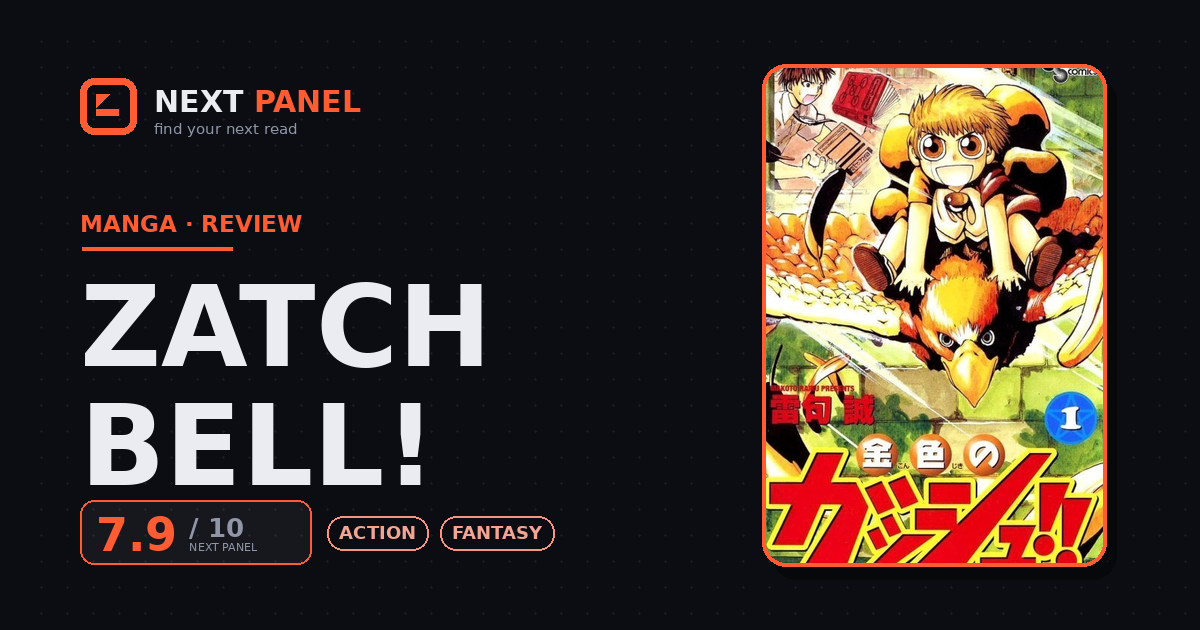
Is Zatch Bell! Worth Reading? Review & Where to Read
Quick Answer
Yes — it's an underrated battle shonen with a lot of heart and a genuinely satisfying ending. Just know it starts slow and the early art is rough, and the official English release is incomplete and out of print.
Quick Verdict
“It takes a while to get going and the early art is rough, but stick with it and it turns into one of the most heartfelt battle series of its era — and it actually sticks the ending.”
Best for: Readers who want a battle shonen with real heart and a complete, satisfying ending.
Not for: Readers who want polished art from page one or a story that hits the ground running.
- Type
- Manga
- Genres
- Fantasy, Action
- Status
- Completed
- Author
- Makoto Raiku
- Publisher
- Shogakukan
| Quick facts | |
|---|---|
| Format | Manga (shōnen), 324 chapters, 33 volumes |
| Run | 2001–2007 · completed |
| Community score | AniList 8.2 |
| Content | Fantasy violence |
Overview
Kiyomaro Takamine is a bitter, whip-smart middle schooler who's given up on other people. Then his father sends him a strange gift from abroad: a cheerful little boy named Zatch Bell. Zatch turns out to be a "mamodo," one of a hundred demon children dropped into the human world to fight. Each mamodo has a human partner who reads spells from the mamodo's book, and when a book burns up, that mamodo is sent home. The last one standing becomes king of the mamodo world. Zatch has no memory and only wants to be a kind king, and his gentleness slowly starts to pull Kiyo out of his shell. It's a battle shonen by Makoto Raiku.
What it does well
The heart is what makes it. Zatch is earnest and kind to a fault, and the series is really about how that kindness changes the people around him — Kiyo most of all. Watching a cold, lonely kid gradually learn to care, because a weird little demon boy refuses to give up on him, is genuinely affecting. That warm center is what people remember about it.
The fights are smarter than they look, too. The spell-book setup means a partner has to read spells out loud, so battles hinge on timing, positioning, and figuring out an enemy's weakness — not just powering up. Raiku keeps inventing new wrinkles on the system, and the strategy gives the action a puzzle-like feel that keeps it fresh over a long run.
It also takes its villains seriously. Plenty of the enemy mamodo get real, often sad histories, and the story keeps asking what kind of king each of them would be. By the later arcs the battles aren't just spectacle — they carry actual emotional stakes, and some of them hit hard.
And crucially, it ends well. This is a complete story that builds toward a real conclusion and pays off its central ideas, which is more than a lot of long shonen manage.
Where it falls short
It asks for patience up front. The early chapters are mostly episodic, monster-of-the-week fights before the larger plot and stakes take shape, so the first stretch is the weakest part. The early art is a factor too — Raiku's work gets much stronger as it goes, but the opening volumes look rough and a bit stiff.
The tone can also be a lot. It swings between broad slapstick and genuine tragedy, sometimes within the same arc, and the goofier comedy doesn't always sit well beside the heavier material.
Verdict
Zatch Bell! is a battle shonen that's better than its reputation, carried by a big heart and a fighting system with real brains behind it. You have to get past a slow, rough start, and the tonal whiplash won't be for everyone. But if you stick with it, it grows into something genuinely moving and, rarely for the genre, finishes strong. The catch is availability — it's worth reading, but tracking down a complete English copy is the hard part.
Strengths & Weaknesses
Strengths
- Zatch is the heart of the whole thing — he's relentlessly kind, and watching that slowly thaw the bitter, closed-off Kiyo is genuinely moving.
- The spell-book system makes for smart fights; teams win on strategy and timing rather than just yelling a bigger attack, and Raiku keeps finding clever twists on it.
- The villains get real, often tragic backstories, so the later battles carry emotional weight instead of just being another power-up.
- It's a complete story with an ending that actually pays off what it built — rare for a long-running shonen.
Weaknesses
- It's slow to start — a lot of the early chapters are episodic monster-of-the-week fights before the bigger stakes kick in.
- The early art is rough and a little stiff; Raiku improves a lot across the run, but the first volumes don't show his best.
- The tone swings hard between broad slapstick and real tragedy, and the goofier comedy doesn't always sit comfortably next to the heavy moments.
Similar Titles
Another complete battle shonen with big heart, smart fights, and villains who get real backstories.
A kid paired with a powerful partner-spirit, fighting through a tournament to reach the top.
Foundational battle shonen that mixes goofy comedy with escalating fights and a warm core.
Frequently Asked Questions
Can I read Zatch Bell! officially in English?
Not easily right now. Viz Media released the first 25 of the 33 volumes years ago, but the English run was left incomplete and is out of print, with no official digital version. There's no complete, in-print English release at the moment.
Is it a kids' series or something heavier?
Both. It looks and often acts like a lighthearted kids' battle series, but it builds toward some surprisingly heavy, emotional material later on.
Does it have a real ending?
Yes. Unlike a lot of long shonen, it wraps up completely and pays off its main threads — the ending is one of the most praised parts.