Beginner's Guide to Manhwa and Webtoons: Formats, Genres, and Apps
Quick Answer
Manhwa is Korean comics, today mostly published as full-color vertical-scroll webtoons read on your phone. Start on an official platform's free tier (episodes unlock daily), pick a completed series first, and learn three genre words - regression, villainess, murim - because half of what people will recommend you lives there.
Manhwa has the best onboarding in comics and almost nobody explains it, because everyone who's already in assumes you know. The whole format was designed for a phone in one hand on a commute. You scroll, it's in color, episodes take eight minutes, and the official apps are free if you have patience. That's it. That's the tutorial.
What actually needs explaining is the culture around it - the formats, the genre words people throw at you, and which app does what. Here's all of it.
The scroll is the format
A webtoon episode is one long vertical strip. No pages, no spreads - a ribbon, composed top to bottom, where the scroll itself is a camera move. Creators stretch silence across three screens of falling snow, drop a full-screen reaction panel after a beat of nothing, choreograph fights down the vertical axis. Read one well-made episode and you'll feel how different it is from a page.
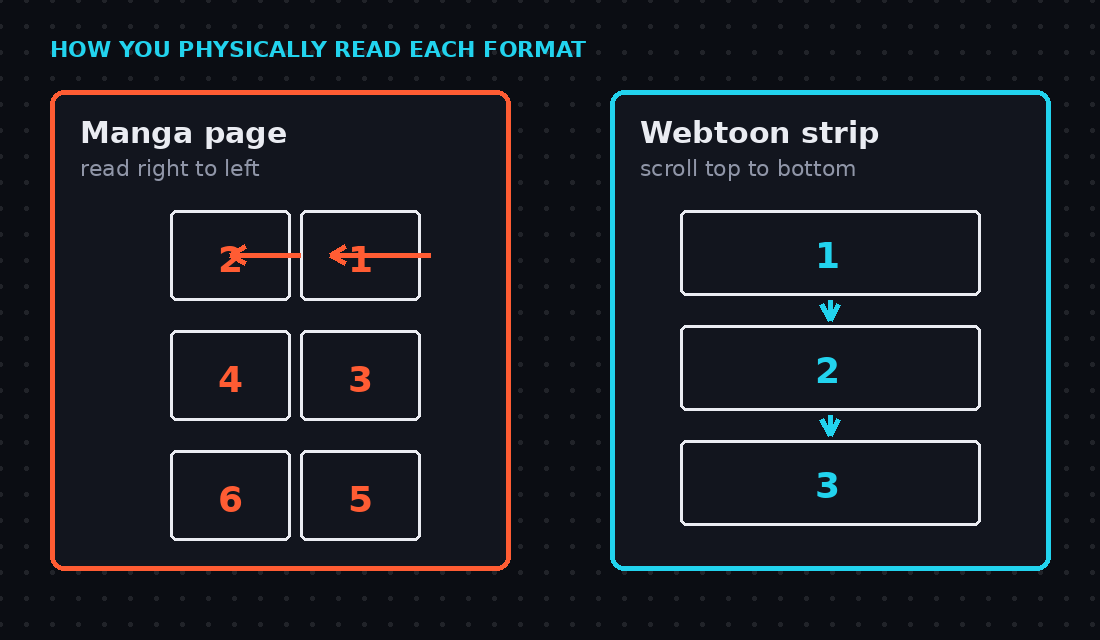
Two practical notes. Read in the app or on the official site, not in a cramped browser view - composition assumes a phone-width column. And episodes are sized for sessions: most series run weekly in seasons, like TV, with breaks between.
The free model, explained honestly
Mainstream webtoon platforms run free-first: episodes unlock on a timer (typically one per day per series), and payment buys impatience - reading ahead - rather than access. A patient reader pays nothing, indefinitely, officially. I want to be precise here because people assume a catch: the catch is time, that's the whole model.
Premium licensed platforms are the other half of the ecosystem: per-episode coins, deep catalogs of exactly the titles everyone keeps recommending, and sales so frequent that paying full price is a rookie mistake. One general app plus one premium app covers nearly everything; our reading guide and platform directory break down which is which by region.
The genre words you actually need
Manhwa recommendations come pre-loaded with vocabulary, so here's the decoder. Regression: the lead is thrown back in time within their own life - usually to fix a catastrophe they remember. Reincarnation: reborn as someone else entirely, memories intact. Villainess: reborn or regressed into a story's doomed antagonist, who then rewrites her route - court intrigue plus romance plus competence. Murim: the Korean martial-arts world of sects and masters, cousin to Chinese wuxia. System / hunter: modern world with dungeons, stats, and ranked professionals.
Korea didn't invent second chances, but manhwa has turned them into an industrial art form. If the idea of preparation meeting payoff does anything for you, you're going to be fine here. The best manhwa by genre hub sorts the standouts lane by lane.
A sane first week
Pick one completed series - completed beats famous for a first read, because you get a real ending instead of a two-year wait. Action lane: Solo Leveling is the obvious on-ramp, and it earns the cliche; clean power progression, action drawn for scroll speed. Romance-fantasy lane: a finished run like See You in My 19th Life shows what full-color character drama can do. Then add one ongoing series to learn the weekly rhythm - Omniscient Reader's Viewpoint if you want the smart-blockbuster end of things.
Three series, different weights, all on official apps. After that the algorithm knows you and frankly does a decent job.
Mistakes I'd save you from
Don't open fifteen series in week one; the daily-unlock model nudges you toward it and it scatters your attention into mush. Don't judge full-color art by screenshots - webtoon art is motion art, built for the scroll, and stills undersell it. And don't sleep on completed series just because the hype lives on ongoing ones; finished stories are the format's best-kept secret.
When you're ready to cross the aisle, the manga beginner guide covers the page-based side, and our reviews stay spoiler-light so you can window-shop safely.
Frequently Asked Questions
What's the difference between manhwa and webtoons?
Manhwa is Korean comics generally; webtoon is the vertical-scroll digital format most modern manhwa is published in. Most manhwa you'll be recommended are webtoons, but older manhwa was page-based, and non-Korean creators make webtoons too.
Are webtoons really free?
The mainstream platforms genuinely are, on a patience model: episodes unlock on daily timers, and paying only buys speed. Premium licensed platforms charge per episode but run constant sales.
What should my first manhwa be?
A completed series with a clean hook - completed matters more than famous for a first read. Something like Solo Leveling shows off the action style; a finished romance like See You in My 19th Life shows the full-color drama style.
What does 'regression' mean in manhwa?
A protagonist is sent back in time within their own life to redo it with future knowledge. It's the engine of a huge share of current manhwa, alongside reincarnation and villainess stories.