Where to Read Manga, Manhwa, and Manhua: Official Apps and Sites Guide
Quick Answer
You can read most major manga officially through publisher apps with free chapter windows, most manhwa through webtoon platforms with daily-unlock free models, and a growing amount of manhua through the same webtoon platforms. Free official options exist for all three - the trick is knowing which platform covers what you read.
So you want to read officially and you don't know where anything lives. Fair - the official landscape is genuinely confusing, because manga, manhwa, and manhua were licensed by different companies at different times for different apps, and nobody designed any of it to make sense from the outside.
Here's the map. It's shorter than you think.
The short version
Manga lives mostly in publisher apps and ebook stores. Manhwa lives mostly in webtoon platforms. Manhua, where it's officially translated at all, mostly rides along on those same webtoon platforms. Almost every one of these services has a real free tier, because publishers figured out years ago that the best way to fight piracy is to make the official option genuinely usable.
Our platform directory keeps the current list with region notes. This guide explains how to actually use it.
Manga: publisher apps first
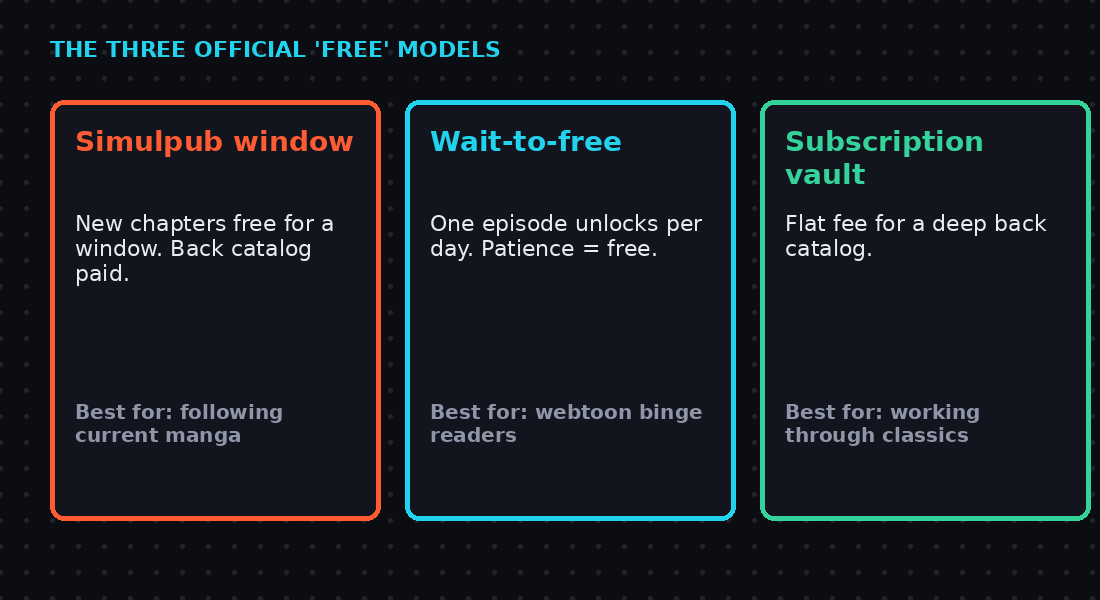
The single best thing that's happened to English manga reading is the simulpub app - official translations released the same day as Japan, with the recent chapters free. The usual model is a window: a new series can be read from chapter one, an ongoing series in its latest stretch. For a new reader that's effectively a free buffet, because you haven't read any of it yet.
After the free window, you have three honest options. Buy the digital volumes (ebook stores run constant multi-volume sales - waiting for one is standard practice, not cheapness). Subscribe to a vault service if you're working through back catalogs - the cost of one printed volume a month for thousands of chapters is the best deal in comics. Or hit your library, which I'm convinced is the most underused official source in the entire hobby. Libraries carry manga in print and through digital lending apps, and the catalog depth surprises everyone who finally checks.
Manhwa: free-first by design
Webtoon platforms grew up free and built their business on patience. The standard deal: episodes unlock on a timer - one per day, give or take - and money buys you speed, not access. If you can stand reading one episode a day, an enormous catalog costs you nothing, forever.
The premium platforms work differently: per-episode purchases, frequent and deep sales, and catalogs heavy on exactly the licensed titles people keep recommending to you. A sane setup is one general platform for breadth plus one premium platform for the two or three series you're actually obsessed with. Set a monthly coin budget before your first purchase. I'm serious about that part - the per-episode model is engineered for impulse.
Manhua: improving, honestly
English manhua licensing is the thinnest of the three, and pretending otherwise would make this guide useless. The big webtoon platforms carry a growing licensed selection - mostly cultivation epics and romance - and a few Chinese publishers now run official portals of their own. When a manhua you want has no official translation, the honest answer is the boring one: wait, and make your interest visible. Publishers track requests more than people think.
How to spot a pirate site in ten seconds
You don't need a checklist, you need one question: does this site claim to have everything? No official platform does, because no company holds every license. Aggregators with every series, every chapter, zero cost and a wall of gambling ads are piracy, full stop - and the creators whose work fills them see nothing from your visit.

The other tells: no named licenses anywhere, chapter numbers that appear before official release, and "mirror" domains that change monthly. An official platform is boringly stable. That's the point of it.
The strategy that actually works
Sample on free tiers. Follow your weekly series in the simulpub apps. Binge patiently on the daily-unlock platforms. Buy the volumes of the series you'd grieve if they vanished. Use the library for completed runs. That mix covers ninety percent of reading habits at a cost between zero and one streaming subscription.
If you're brand new and the formats themselves are still confusing, start with our manga vs manhwa vs manhua explainer, then the beginner guide for manga or manhwa, depending on which way you're leaning. And when a specific series is the question - where do I read this one, officially, in my country - that's exactly what our per-title reading guides are for.
Frequently Asked Questions
Is it actually possible to read manga officially for free?
Yes, and not in a fine-print way. Publisher simulpub apps give you free windows on current chapters, webtoon platforms unlock episodes daily for free, and public libraries lend digital volumes. You can follow a dozen series without spending anything.
How do I know if a manga site is official?
Official platforms name their licenses, charge transparently (or run a clear free model), and never claim to have everything. A site offering every chapter of every series, free, the day it comes out, is a pirate site - no exceptions.
Why does it matter if I use official sources?
Because official readership is the only number publishers can see. Licensing decisions, continuations, and print runs follow it. Reading officially is how your favorite niche series survives.
Do these platforms work in every country?
No - licensing is regional, and catalogs differ by country. Our platform directory tracks region notes for each service, and most platforms publish their own availability lists.