Reading Orders, Release Guides, and Official Chapter Availability
Quick Answer
Default reading order for any series: the source comic first (volumes for completed series, official simulpub chapters for ongoing ones), the anime adaptation second, spin-offs after the arc they branch from. When a franchise gets messy, our per-title reading guides give the exact order with official links.
Nobody warns you that the hard part of a big series isn't reading it - it's figuring out what order everything goes in. Chapters, volumes, a prequel, two spin-offs, an anime that diverges, a sequel series with a different title. Franchises grow like coral. This guide is the machete; the per-title reading guides are the detailed maps.
One story, several official shapes
Any successful series exists in at least two forms, often more, and knowing what each one is solves most ordering questions before they start.
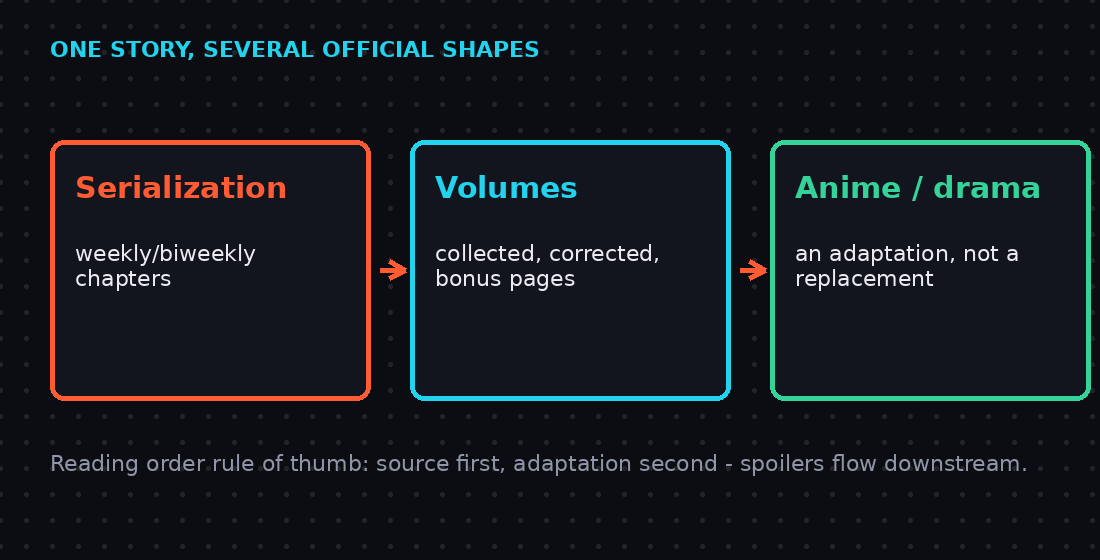
Serialization is the weekly or biweekly chapter drip - the live broadcast. Official simulpub apps carry these same-day in English, recent chapters free. Volumes are the collected edition: corrected art, retouched pages, bonus content, the version the artist wishes you'd read. Adaptations - anime, dramas - are downstream retellings: usually behind the source, sometimes compressed, occasionally divergent enough to count as a different story.
The default order falls out naturally: source first, adaptation second, spin-offs after the arc they branch from. You can violate it - everyone who started with an anime did - but do it knowingly, because spoilers flow downstream and discussion culture assumes you're current with the source.
Chapters or volumes? (The honest answer: both)
This is a rhythm question, not a correctness one. Weekly chapters give you the live conversation and the cliffhanger Wednesdays; volumes give you binge pacing and the polished art. The pattern that works for most people: simulpub chapters for the one or two series you're currently obsessed with, volumes for everything you're catching up on. Completed series should almost always be read in volumes - the chapter-by-chapter shape was scaffolding.
Webtoon-format series simplify this: the episode is the only unit, seasons are the volumes, and the free daily-unlock models handle catch-up natively.
Release schedules, decoded
Weekly manga means roughly 48 chapters a year and a brutal pace for the author - breaks are normal and announced. Monthly means denser chapters, slower arcs, and a different kind of patience. Webtoons run weekly in seasons with hiatuses between - treat a season break like a TV gap, not a cancellation. Hiatus means paused (sometimes years - ask a Berserk or Hunter x Hunter reader); axed means cancelled quickly, which usually shows in a rushed final arc. Our reviews label a work's status - ongoing, completed, hiatus - precisely so you know what you're signing up for before chapter one.
When franchises get messy
Spin-offs, prequels, sequel series under new titles - the rule of thumb: publication order beats chronological order. Prequels written later assume you know the original; reading them 'in timeline order' usually defuses the very reveals they were built on. The exceptions are real but rare, and they're exactly what our per-title guides exist to flag.
Availability: the part that actually bites
The most common reading-order problem isn't order at all - it's that chapter 1 lives on one service and chapter 200 on another, or that your region's catalog starts at volume 4. Licensing is regional and shifting; that's not fixable from here, but it is trackable. Each official reading guide we publish maps a specific title's chapters, volumes, and platforms with region notes, and the directory covers the platforms themselves.
If a series confuses you enough to need a map we haven't drawn yet - name it. Confusing franchises jump the queue, because that's where a guide earns its keep.
Frequently Asked Questions
Should I read chapters or wait for volumes?
Following a series week to week? Official simulpub chapters. Starting something established or completed? Volumes - corrected art, bonus pages, better binge rhythm. Many readers do chapters for their two favorites and volumes for everything else.
Anime first or manga first?
Source first if you care about spoilers - adaptations trail the comic, and discussion around them spoils freely. Anime first is fine as a sampler; just know where it stops and pick the comic up a little before that point, because adaptations compress.
What's a simulpub exactly?
Simultaneous publication: the official translation releasing the same day as the home-country chapter. It killed the main excuse for piracy - the wait - and it's free for recent chapters on most publisher apps.
Why do chapter numbers differ between sites?
Webtoon platforms count a prologue as episode zero or one inconsistently, and volume editions sometimes split or merge chapters. Our per-title guides note the offset whenever a series has one - it's almost always piracy sites miscounting anyway.