Manga vs Manhwa vs Manhua: Key Differences for New Readers
Quick Answer
Manga is Japanese comics - usually black and white, read right to left, page-based. Manhwa is Korean comics - today mostly full-color vertical-scroll webtoons read top to bottom. Manhua is Chinese comics - mostly digital and colored, strongest in cultivation fantasy. The deeper differences are pacing, art pipelines, and publishing culture.
Here's the thing nobody tells you up front: manga, manhwa, and manhua are all the same word. Same Chinese characters, three pronunciations, all meaning roughly "comics." The differences that matter to you as a reader aren't in the dictionary - they're in how each tradition gets made, paced, and delivered to your eyeballs.
Direction and format: the first five minutes
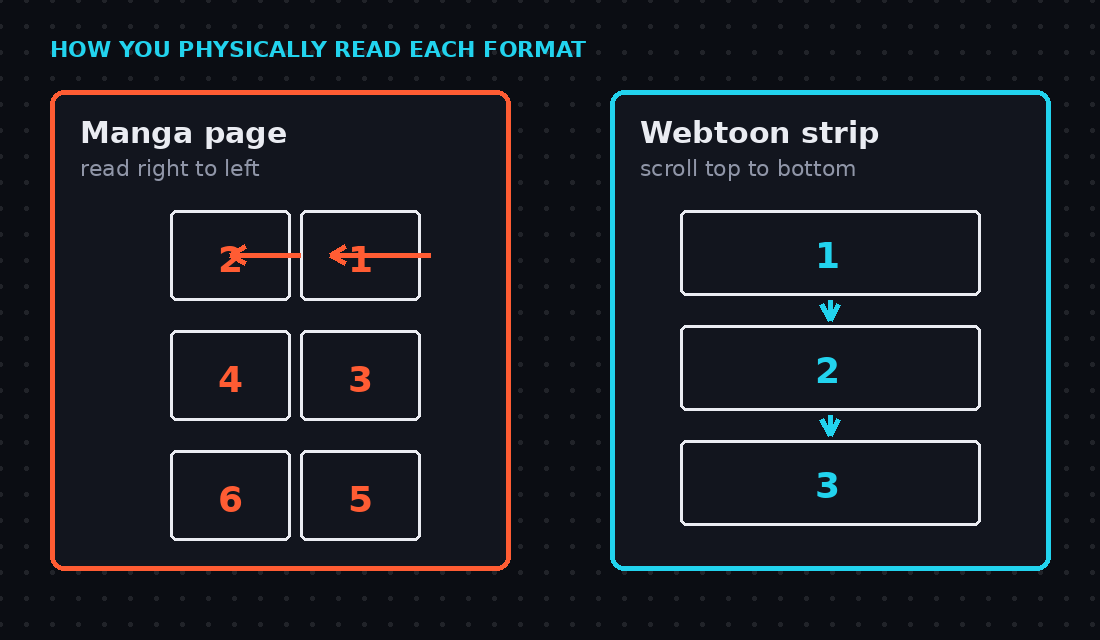
Open a manga and you read right to left. Everyone fumbles it for about a chapter and a half, then never thinks about it again - but those first pages feel like driving on the wrong side of the road.
Manhwa and manhua read left to right, and the digital-native stuff doesn't use pages at all. A webtoon is one continuous vertical strip per episode. You scroll. That sounds like a small thing and it absolutely is not - the scroll is a storytelling tool. A creator can put three screens of empty night sky between a question and its answer, and you feel the silence in your thumb.
Color: tradition, not budget
Manga's black and white isn't a cost-saving compromise, whatever it looks like from outside. Weekly magazine deadlines made ink the practical choice decades ago, and then artists built an entire visual language on top of it - screentone for texture, hatching for weight, white space for dread. Plenty of artists who could work in color don't, because monochrome is the craft.
Manhwa went the other way. The webtoon platforms that took over Korean comics were full-color from early on, and studios now run color pipelines the way TV runs production crews - line artists, colorists, background painters, all to hold a weekly schedule. Manhua sits between, and at its best produces some of the most painterly digital art in comics. At its worst it's rushed, and you can tell. Studio quality varies more in manhua than anywhere else, which is exactly why curation matters there.
Pacing: the difference you feel at chapter 30
This is the one that actually changes your experience. Print manga is paced in page-turns and chapter cliffhangers built for magazine serialization - dense pages that reward sitting down with a volume. Webtoon-format stories are paced in sessions: five-to-ten-minute episodes, momentum-first, structured in seasons like television.
Broadly - and I'll take the angry emails - manga rewards attention per page, manhwa rewards momentum per evening, and manhua varies by studio more than by format. None of this is about quality. It's about what your hands and your schedule are doing while you read.
Genres: where each tradition shows off
Everything exists everywhere, but the centers of gravity are real. Manga's range is the widest, from gag strips to literary fiction - it's had a century to spread out. Manhwa currently owns the regression/villainess/murim/system-fantasy cluster; if your feed keeps recommending stories about someone reborn with future knowledge, you've been recommended manhwa. Manhua's signature lane is cultivation fantasy - xianxia and wuxia epics adapted from a deep well of Chinese novels, with power systems that make Dragon Ball look restrained.
If a genre word in that paragraph lost you, our genre hubs define each one with starter picks.
So which one is yours?
Match the format to your reading life, not to an internet argument. Phone reader with stolen minutes? Start with manhwa and webtoons. Want deliberate art you can study, on a tablet or in print? Start with manga. Coming from Chinese fantasy novels? Manhua will feel like home immediately.
Then ignore the borders entirely, because the good stuff doesn't respect them. Everything here is officially readable in English - the reading guide covers exactly where.
Frequently Asked Questions
Is manhwa just Korean manga?
They're both comics, but calling manhwa 'Korean manga' undersells both. Different reading direction, different color tradition, different pacing culture, different platforms. The word for comics is just different in each language: manga, manhwa, manhua.
Why is manga black and white?
Weekly magazine schedules made ink practical, and then the artform turned the limitation into a style. Screentone, hatching, and negative space do what color does elsewhere - many artists stay monochrome by choice now.
Which one should I start with?
Whichever matches how you read. On your phone in stolen moments? Manhwa's vertical scroll was built for exactly that. Like deliberate, dense art you sit with? Start with manga. Already deep in Chinese fantasy novels or donghua? Manhua adapts that canon directly.
Do the genres differ between them?
Every genre exists in all three, but each has signatures: manga has the widest range overall, manhwa currently owns regression, villainess, and murim stories, and manhua's distinctive lane is cultivation (xianxia) epics.