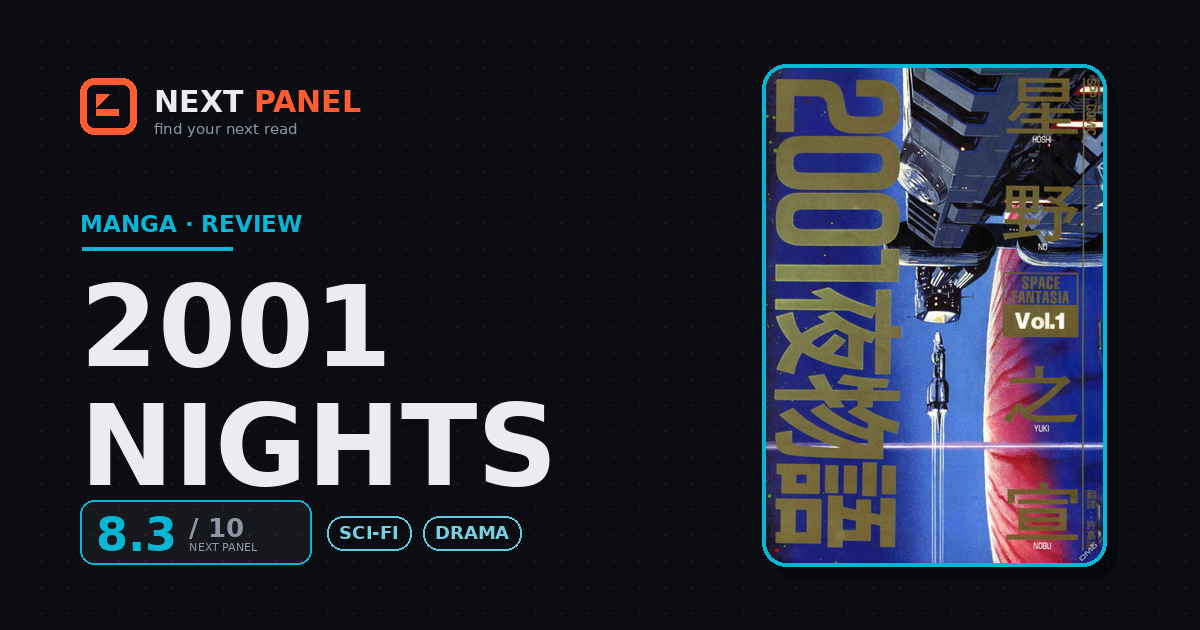
Is 2001 Nights Worth Reading? Review & Where to Read
Quick Answer
Yes, if you love classic hard science fiction. 2001 Nights is Yukinobu Hoshino's award-winning anthology charting humanity's spread into the galaxy across centuries, with gorgeous art and a real sense of wonder. It's episodic and idea-driven rather than character-driven, and the English edition is out of print, so it's one for dedicated SF fans.
Quick Verdict
“Closer to Arthur C. Clarke in comic form than to most manga — cold, gorgeous, and full of wonder.”
Best for: Readers who love classic, idea-driven hard sci-fi and big-picture future history.
Not for: Readers who want a continuous cast, fast-moving plots, and character-driven emotion.
- Type
- Manga
- Genres
- Drama, Sci-Fi
- Status
- Completed
- This review
- Minor Spoilers
- Author
- Yukinobu Hoshino
- Publisher
- Futabasha
| Quick facts | |
|---|---|
| Format | Manga (seinen), 20 chapters, 3 volumes |
| Run | 1984–1986 · completed |
| Community score | AniList 7.2 · MAL 7.7 · MangaUpdates 8.5 |
| Content | Nudity, mature themes |
Overview
2001 Nights is a hard science-fiction anthology by Yukinobu Hoshino, and a genuine classic of the genre. Rather than one continuous story, it's a series of loosely linked short chapters — each its own "night" — told in chronological order across several centuries. Together they trace humanity's expansion from Earth out into the galaxy: the first tentative steps off-world, the first interstellar voyages, colonization, alien contact, and the long, strange consequences of all of it. It's openly inspired by classic SF like Arthur C. Clarke and Kubrick's 2001, and it wears that influence proudly.
What it does well
The sense of wonder is the whole point, and Hoshino nails it. These stories are built on big, classic sci-fi ideas — relativity and deep time, first contact, the loneliness of space — and they deliver the same awe you get from the best prose SF. Each chapter takes a concept and follows it to a thoughtful, often haunting conclusion, and a few of them rank among the best short science fiction in any medium.
The anthology structure is a strength too. Because every "night" is a fresh story with new characters, the book never runs out of ideas, and the cumulative effect — watching a whole future history assemble itself chapter by chapter — is genuinely grand. You can also dip in and out, since many chapters stand on their own.
And it's beautiful. Hoshino's art is detailed and realistic, with gorgeous spacecraft, planets, and cosmic vistas that sell the scale and the silence of space. For a work from the 1980s, it still looks striking, and the hardware feels genuinely designed rather than just drawn.
Where it falls short
The flip side of the anthology format is that there's no continuous protagonist to latch onto. Characters come and go every chapter, so you don't build the long attachment you would with an ongoing cast. It's a book about ideas first and people second, and readers who need a strong central character may feel held at arm's length.
It's also very much a product of classic, cerebral SF. The pacing is measured, the tone is cool and a little melancholy, and some of the science and retro-future aesthetic show their age. It can feel distant rather than thrilling, and that won't be for everyone.
Verdict
2001 Nights is one of the finest science-fiction manga ever made, and essential if you love the grand, idea-driven SF of writers like Clarke. It's episodic and cerebral rather than warm and character-driven, so go in for the wonder and the ideas. One catch: the English edition (Viz) is long out of print, so it's hard to find officially right now — we'll flag it here if it's ever reissued.
Strengths & Weaknesses
Strengths
- It nails the classic sci-fi sense of wonder, building each chapter on big ideas like deep time, first contact, and the loneliness of space.
- The anthology format keeps it fresh, and the chapters add up to one grand future history of humanity in the galaxy.
- Hoshino's detailed, realistic art makes the spacecraft, planets, and cosmic vistas genuinely beautiful.
- Many chapters stand on their own, so it's easy to dip into.
Weaknesses
- There's no continuous protagonist — characters change every chapter, so you don't build long attachment to anyone.
- It's idea-driven and cerebral, with measured pacing and a cool tone that can feel emotionally distant.
- It's an '80s work, so some of the science and the retro-future look show their age.
Similar Titles
Frequently Asked Questions
Where can I read 2001 Nights officially in English?
It's tricky — Viz published an English edition in the 1990s, but it's long out of print. There's no current official digital or in-print release, so you'd be hunting used copies. We'll update this if it's ever reissued.
Do I need to read the chapters in order?
It helps, since they're chronological and build a single timeline, but many work as standalone stories if you want to sample.
Is it like the movie 2001: A Space Odyssey?
In spirit, yes — it shares that film's awe and hard-SF sensibility, with plenty of homages, but it's its own sweeping set of stories.