Is Planetes Worth Reading? Review & Where to Read
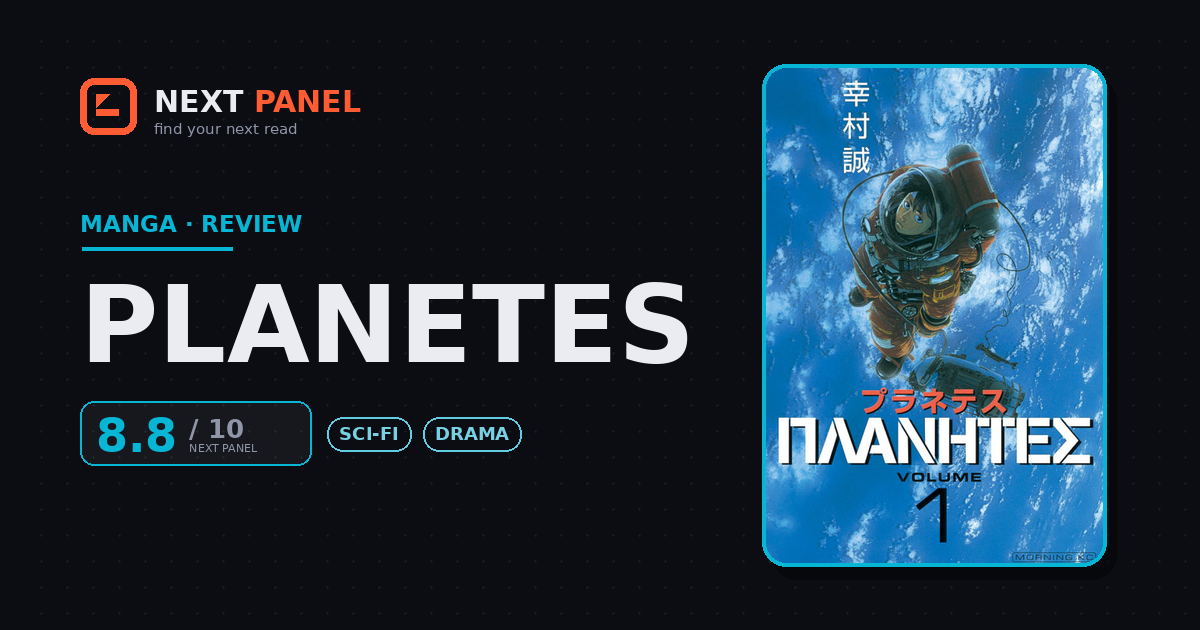
Quick Answer
Yes. If you like grounded, character-driven sci-fi, Planetes is about as good as it gets, and it's short and complete on top of that. Just know the latter half trades workplace stories for heavier philosophy.
Quick Verdict
“This is the space manga to hand someone who swears they don't like sci-fi — grounded, humane, and finished before it wears out its welcome.”
Best for: Readers who want grounded, character-first science fiction and a complete story they can finish in a weekend.
Not for: Readers who want fast-paced action or a tight, single-arc plot.
- Type
- Manga
- Genres
- Drama, Sci-Fi
- Status
- Completed
- This review
- Minor Spoilers
- Author
- Makoto Yukimura
- Publisher
- Dark Horse Manga
- Platform
- Dark Horse
| Quick facts | |
|---|---|
| Format | Manga (seinen), 28 chapters, 4 volumes |
| Run | 1999–2004 · completed |
| Community score | AniList 8.0 · MangaUpdates 8.4 |
| Content | Mature themes, some violence |
| Where to read | Dark Horse — official |
Overview
Planetes is set in the 2070s, when humanity has spread into orbit and onto the Moon and started reaching for the rest of the solar system. All that traffic left a problem behind: debris. A stray bolt at orbital speed hits like a bullet, so someone has to clean it up. That someone is the crew of the Toy Box, a debris-collection ship, and they're basically the garbagemen of space — underpaid, overlooked, stuck with the job nobody brags about. The lead is Hachimaki, a young collector who wants his own ship and a seat on the first crewed flight to Jupiter. Makoto Yukimura — who'd go on to write Vinland Saga — uses that grounded setup to dig into what people are really chasing when they look up.
What it does well
The science feels real. Space here is a workplace, not a playground: airlocks, fuel budgets, radiation, the slow grind of a job in zero-G. The debris problem the whole story is built on is an actual thing engineers worry about today, and treating it seriously makes the world feel lived-in. You believe these people clock in and clock out.
It's a character piece first. Hachimaki starts as a cocky kid who's sure he knows what he wants, and the manga slowly pulls that certainty apart. The rest of the crew — the gruff veteran Fee, the gentle giant Yuri — each get quiet, human moments that stick with you. Nobody's a hero here. They're working people with debts, doubts, and small dreams, and the book treats them with real warmth.
And Yukimura can draw. The art is clean and detailed, equally good at the hardware and the faces. He sells the scale of space and the loneliness of it, then turns around and nails a small expression in a cramped cabin. For a relatively early work, it's confident stuff.
Best of all, it's short and complete. Four volumes, no filler, a clear ending. It says what it wants to say and gets out — which is rare, and makes it an easy one to actually finish.
Where it falls short
The latter half changes gears. Once the Jupiter mission kicks in, the grounded, episodic charm gives way to big speeches about love, ambition, and what going to space is even for. Some of it lands; some of it gets preachy. If you came for the workplace stories, the philosophical turn can feel like a different book.
Tanabe, the co-lead introduced along the way, carries a lot of that theme, and her "love is the answer" outlook is divisive — earnest to some, repetitive to others. And because the early chapters are episodic, a few side characters pop up and then disappear; this is more a string of connected stories than one tight plot.
Verdict
Planetes is one of the most human science-fiction comics out there, and one of the most efficient — it does in four volumes what lesser series stretch to twenty. The ending leans hard on philosophy and how much you click with Tanabe will decide a lot, but the core is grounded, heartfelt, and beautifully drawn. If you want sci-fi about people instead of spectacle, start here.
Strengths & Weaknesses
Strengths
- The hard science is grounded — space is a workplace of fuel budgets, airlocks, and real orbital debris, which makes the world feel genuinely lived-in.
- It's character-first: Hachimaki's cocky certainty gets slowly taken apart, and the side crew get quiet, human moments that stick.
- Yukimura's clean, detailed art is equally good at the machinery and the faces, selling both the scale of space and small cabin expressions.
- It's short and complete — four volumes, no filler, a clear ending — so it's easy to actually finish.
Weaknesses
- The latter half trades grounded workplace stories for heavy speeches about love and meaning, and the pacing slows with it.
- Tanabe's 'love is the answer' theme is divisive — earnest to some, preachy and repetitive to others.
- The episodic early structure means some side characters appear and vanish; it's more connected stories than one tight plot.
Similar Titles
Yukimura's later epic — same humane eye, much bigger canvas.
Gentle, grounded story of kids training to be astronauts.
Classic hard-SF manga anthology with the same realistic-space feel.
Where to Read Officially
| Platform | Format | Pricing | Region notes | Link |
|---|---|---|---|---|
| Dark Horse | Print & digital volumes | Paid | Region availability varies | Open |
Frequently Asked Questions
Is Planetes finished?
Yes. It ran from 1999 to 2004 and is complete in four volumes, collected in English as two Dark Horse omnibus editions.
Do I need to watch the anime first?
No. The manga and the 2003 Sunrise anime tell the same core story in different ways — you can start with either. The manga is tighter and more personal.
Is it really hard sci-fi?
Mostly. The orbital mechanics and the space-debris problem are grounded in real science, though the later chapters lean more philosophical than technical.