Is Black Bird Worth Reading? Review & Where to Read
Quick Answer
Worth reading for the atmosphere and demon-world worldbuilding if you can stomach a romantic lead who crosses real lines early and often — that's a dealbreaker for a lot of readers, and it should be.
Quick Verdict
“The demon-world mythology is genuinely well built; the central romance is the part that hasn't aged well, and no amount of pretty art papers over that.”
Best for: Readers drawn to dark, atmospheric supernatural shoujo with a rich demon-world mythology and don't mind a possessive, controlling love interest.
Not for: Readers who want a romance built on mutual respect rather than obsession and repeated boundary-crossing.
- Type
- Manga
- Genres
- Romance, Supernatural
- Status
- Completed
- This review
- Minor Spoilers
- Author
- Kanoko Sakurakouji
- Publisher
- VIZ Media (Shojo Beat)
- Platform
- VIZ
| Quick facts | |
|---|---|
| Format | Manga, 84 chapters, 18 volumes |
| Run | 2006–2012 · completed |
| Community score | AniList 6.8 · MangaUpdates 7.7 |
| Where to read | VIZ — official |
Overview
Black Bird follows Misao Harada, a high school girl who has been able to see spirits since childhood — most of whom want to eat her, because her blood and body are said to bring demons who consume her immortality and fortune. The one demon who doesn't want to eat her is Kyo, her childhood friend, who instead wants to make her his bride and the guardian deity of his clan. From there, the manga becomes a tug-of-war between rival demon factions who all have designs on Misao, with Kyo positioning himself as her protector.
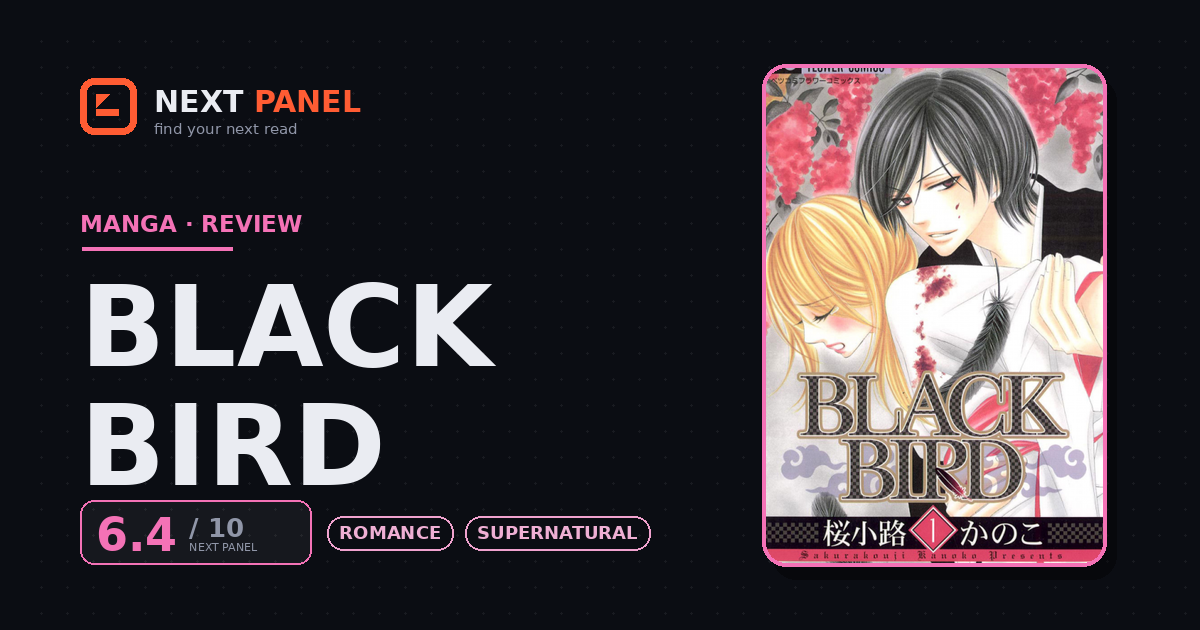
Written and drawn by Kanoko Sakurakouji, the series ran for 18 volumes and won the Shogakukan Manga Award, and it's easy to see why on a purely craft level — the demon-world mythology and art are genuinely accomplished.
What it does well
The worldbuilding is the manga's strongest asset. Sakurakouji builds out a demon society with real internal rules, competing clans, and a mythology around the 'Senka Maiden' role that Misao occupies — it's not just vague supernatural set dressing, it actually structures the plot and pays off as the story progresses. That gives Black Bird a spine a lot of supernatural shoujo series lack, where the mystery of what Misao actually is matters as much as who she ends up with.
The art is a consistent highlight too. Demon designs range from genuinely beautiful to appropriately unsettling, and Sakurakouji's linework stays sharp and expressive across the full run, which is no small feat for an 18-volume series. It's easy to see why this won a major industry award — the atmosphere, the tone, and the sheer visual craft are all a cut above a lot of its genre peers.
Where it falls short
The central romance is where the manga runs into real trouble. Kyo repeatedly crosses lines with Misao in ways the story frames as passionate rather than as the coercive, non-consensual behavior they actually are, and this pattern recurs across the series without ever being meaningfully challenged or reckoned with. It's a genre convention Black Bird leans on more heavily and more often than most of its contemporaries, and it's the single biggest reason to go in with your eyes open. Misao, for a character whose fate the entire plot revolves around, also gets surprisingly little agency — she's the object being fought over more often than she's the one making choices. The middle stretch of the series also loses some momentum as new rival suitors and factions get introduced without always pushing the central plot forward.
Verdict
Black Bird is genuinely well-crafted on the level of atmosphere, mythology, and art, and that craft is exactly why it won the awards it did. But the central relationship leans on coercive, boundary-crossing behavior played as romance in a way that hasn't aged well and isn't addressed by the story itself — that's a real dealbreaker for a lot of readers, and it should be weighed seriously before picking this one up.
Strengths & Weaknesses
Strengths
- The demon-world mythology is genuinely well constructed, with distinct factions, rules, and a sense that the supernatural side of the story has real internal logic rather than existing just to threaten the heroine.
- Sakurakouji's art is consistently striking — the demon character designs range from beautiful to unsettling, and the linework holds up across the full 18-volume run.
- The central mystery around Misao's role as the 'Senka Maiden' gives the plot a clear spine and pays off with real worldbuilding payoffs rather than vague mysticism.
- It won the Shogakukan Manga Award for a reason — the atmosphere and tone are distinctive even against a crowded field of supernatural shoujo.
Weaknesses
- The core romance between Misao and Kyo is built on repeated non-consensual and coercive moments played as romantic rather than as red flags, and it never gets meaningfully addressed within the story.
- Misao herself gets relatively little agency for a lead whose entire fate the plot revolves around — she's fought over more than she actively drives events.
- The pacing sags in the middle volumes as rival suitors and factions get introduced without always advancing the central plot.
Similar Titles
Another supernatural shoujo about a girl entangled with a family of curse-bound men, with a much healthier core relationship.
Similar dark fantasy-romance shoujo tone with political and supernatural stakes.
For readers who want the emotional intensity without the coercive romance elements.
Where to Read Officially
| Platform | Format | Pricing | Region notes | Link |
|---|---|---|---|---|
| VIZ | Digital chapters & print volumes | Paid | Region availability varies | Open |
Frequently Asked Questions
Is Black Bird appropriate for younger readers?
No — it deals with sexual content and repeated non-consensual scenarios and is intended for mature teen and adult readers.
Is the manga complete?
Yes, all 18 volumes were released in Japan and fully translated into English by VIZ.
Did Black Bird get an anime?
No, there's no anime adaptation — the manga is the only version of the story.