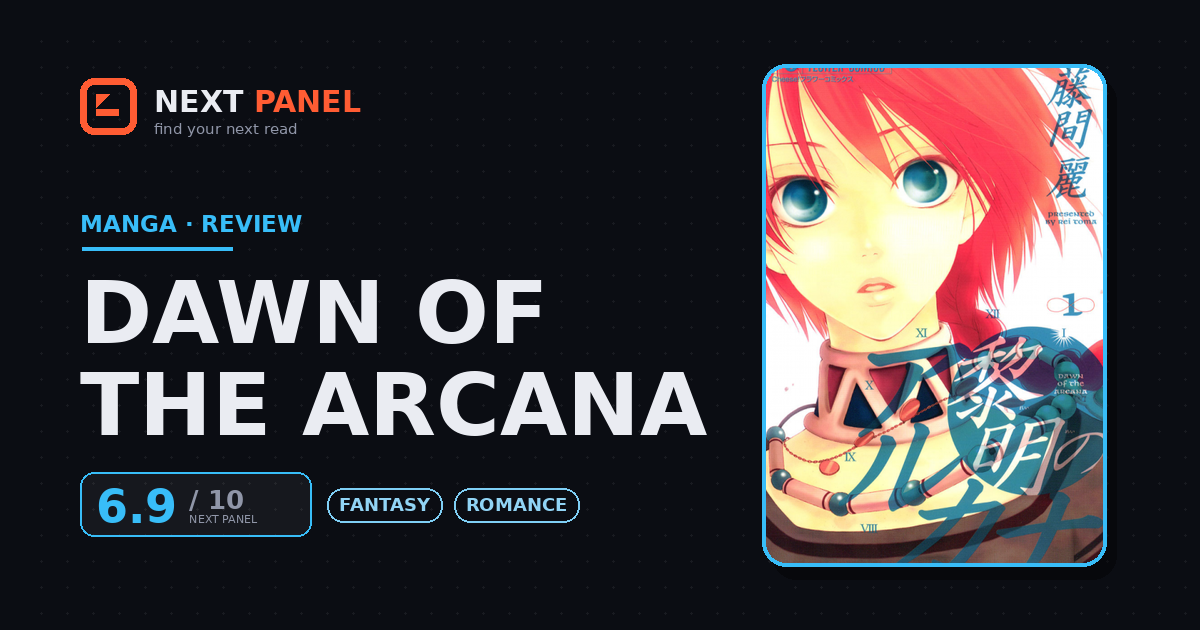
Is Dawn of the Arcana Worth Reading? Review & Where to Read
Quick Answer
Worth reading for the political fantasy backbone and a lead who refuses to just be a pawn — the central marriage starts ugly, but it's given real room to develop into something more equal.
Quick Verdict
“Nakaba's stubborn refusal to play the passive hostage is what carries this past its rocky start, and the fantasy politics around her give the romance actual stakes instead of just melodrama.”
Best for: Readers who want political fantasy with a slow-burn arranged-marriage romance and a heroine who pushes back.
Not for: Readers who want a romance free of possessive, controlling dynamics from the start.
- Type
- Manga
- Genres
- Romance, Fantasy
- Status
- Completed
- This review
- Minor Spoilers
- Author
- Rei Toma
- Publisher
- VIZ Media
- Platform
- VIZ
| Quick facts | |
|---|---|
| Format | Manga, 65 chapters, 13 volumes |
| Run | 2009–2013 · completed |
| Community score | AniList 7.3 · MangaUpdates 8.2 |
| Where to read | VIZ — official |
Overview
Dawn of the Arcana opens with Princess Nakaba of Senan being married off to Prince Caesar of Belquat, the kingdom that's dominated her homeland through generations of war. It's framed less as a romantic union than as a political hostage exchange, and Caesar makes that dynamic explicit early on, telling Nakaba flatly that she's his property. From that uncomfortable starting point, the manga follows Nakaba navigating a hostile new court, an arranged marriage she never wanted, and a fantasy prophecy tied to the region's throne that starts pulling both kingdoms' fates together.
Written and drawn by Rei Toma, the series ran for 13 volumes and became one of VIZ's notable shoujo-fantasy licenses, built as much around court politics as around the central romance.
What it does well
Nakaba is the manga's biggest asset. Rather than accepting her role as a passive hostage-bride, she pushes back against Caesar and the court around her from very early on, which keeps the story from settling into a simple submission arc. That resistance gives the eventual softening of her relationship with Caesar real weight — it reads as something she chooses to allow rather than something done to her.
The political backdrop does a lot of heavy lifting too. The two kingdoms' history of war, the fantasy prophecy surrounding royal succession, and the shifting alliances at court all give the central romance actual external stakes, so the story isn't just two people slowly warming to each other in a vacuum. Rei Toma's art matches that ambition — the courtly costuming and setting details are consistently elegant, and it's easy to track who belongs to which faction visually.
The relationship itself is also allowed to genuinely develop. Caesar doesn't stay the same possessive figure from volume one; the manga takes its time letting both leads grow past their initial dynamic, and that patience pays off in the latter half of the series.
Where it falls short
The opening stretch is a real hurdle. Caesar's blunt "you are my property" framing sets a possessive tone for the central relationship that takes a long time to earn back, and some readers will understandably bounce off before the dynamic starts to shift. The court-intrigue side of the plot also introduces more factions and political players than the manga always has room to develop fully, leaving a few subplots feeling thinner than they should. And the political maneuvering chapters can slow the pacing down compared to the more character-focused scenes.
Verdict
Dawn of the Arcana is a solid political-fantasy shoujo that earns its slow-burn romance through real character development rather than just time passing, even if the starting point asks for some patience. If you want court intrigue with actual stakes wrapped around an arranged-marriage plot, it's worth the investment.
Strengths & Weaknesses
Strengths
- Nakaba is an unusually proactive shoujo lead — she pushes back against Caesar's possessiveness from the start instead of quietly accepting her role as a political hostage, which keeps the story from feeling one-sided.
- The political backdrop, two kingdoms locked in generations of war with a fantasy prophecy tangled into the succession, gives the central relationship real external stakes beyond the romance itself.
- Rei Toma's art is elegant and detail-heavy, especially in costuming and courtly settings, which sells the story's political-fantasy atmosphere.
- The relationship between Nakaba and Caesar is allowed to actually develop and shift over the course of the series rather than staying static.
Weaknesses
- Caesar's opening characterization, openly calling Nakaba his property, is a rough starting point for the central romance and takes real time to earn any goodwill.
- Some of the court-intrigue subplots introduce characters and factions faster than the manga has room to develop them.
- The pacing slows in places where political maneuvering takes over from the more character-driven scenes.
Similar Titles
Another dark shoujo fantasy built around a heroine caught between possessive suitors and supernatural politics.
Shares the political-marriage-in-a-fantasy-kingdom setup with a heroine who has to fight for agency.
A gentler take on court politics and a heroine who earns respect on her own terms.
Where to Read Officially
| Platform | Format | Pricing | Region notes | Link |
|---|---|---|---|---|
| VIZ | Digital chapters & print volumes | Paid | Region availability varies | Open |
Frequently Asked Questions
Is Dawn of the Arcana appropriate for younger teens?
It's aimed at older teen and adult shoujo readers given its themes of political hostage-taking and a possessive early relationship dynamic.
Is the manga complete?
Yes, it ran for 13 volumes and is fully available in English from VIZ.
Does the story stay focused on the romance?
The romance is central, but the manga spends significant time on the kingdoms' political conflict and a fantasy prophecy tied to the throne.