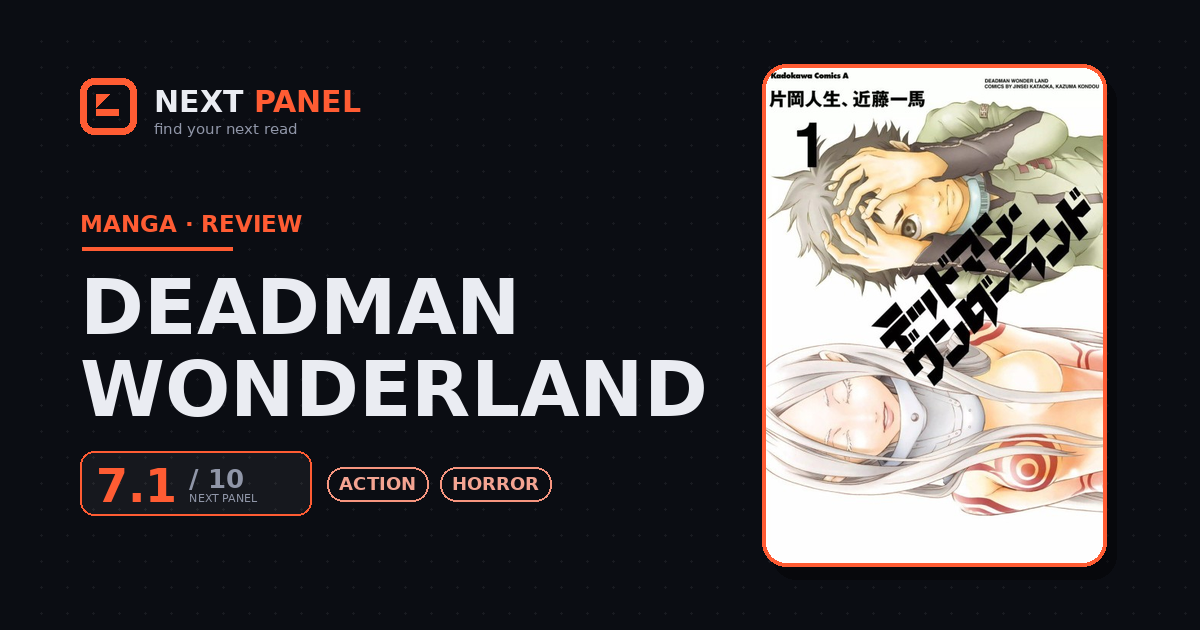
Is Deadman Wonderland Worth Reading? Review & Where to Read
Quick Answer
Yes, if extreme violence doesn't put you off. Deadman Wonderland backs its shock value with a genuinely unsettling premise about spectacle and institutional cruelty, even when its plotting gets shakier in the later volumes.
Quick Verdict
“Watching people fight to the death for a paying audience shouldn't feel like real social commentary, but Deadman Wonderland mostly earns that weight even as its plot logic frays late.”
Best for: Readers who want dark, blood-soaked survival horror with real thematic teeth about spectacle and institutional cruelty.
Not for: Readers who want restrained violence, since gore here is constant and often extreme rather than occasional.
- Type
- Manga
- Genres
- Horror, Action
- Status
- Completed
- This review
- Minor Spoilers
- Author
- Jinsei Kataoka
- Artist
- Kazuma Kondou
- Publisher
- Kadokawa Shoten
- Platform
- VIZ
| Quick facts | |
|---|---|
| Format | Manga (seinen), 58 chapters, 13 volumes |
| Run | 2007–2013 · completed |
| Community score | AniList 7.4 · MangaUpdates 8.0 |
| Content | Extreme violence, gore, disturbing content |
| Where to read | VIZ — official |
Overview
Ganta Igarashi is an ordinary middle schooler until a mysterious figure known as the Red Man slaughters his entire class in front of him and frames Ganta for the massacre. Wrongly convicted, Ganta is sent to Deadman Wonderland — a privatized prison built as a working amusement park, where inmates fight each other in gladiatorial "Carnival Corpse" duels for a paying public. Discovering he has the Branch of Sin, a power that lets him manipulate his own blood as a weapon, Ganta has to survive the prison's brutal internal politics while hunting for the real killer. Jinsei Kataoka and Kazuma Kondou's Deadman Wonderland ran in Monthly Shōnen Ace from 2007 to 2013 and is complete at 13 volumes, fully available in English from Viz Media.
What it does well
The central premise carries real weight beyond its shock value. A prison that's also a for-profit theme park, where the public pays to watch inmates fight for survival, is a sharp piece of dystopian commentary about spectacle and institutional cruelty, and the manga stays genuinely interested in that idea rather than treating it as backdrop for violence. The Branch of Sin power system gives that violence real visual identity too — different inmates manipulate their blood in distinct, inventive ways, so fights stay visually varied even as the body count climbs.
Shiro, the strange, erratic girl who attaches herself to Ganta almost immediately, is the series' best asset. Her odd behavior initially reads as comic relief, but the mystery underneath her character gives Deadman Wonderland genuine emotional stakes beneath its chaos, and that mystery pays off in ways that recontextualize a lot of the earlier volumes. The series is also unafraid to sit in genuinely uncomfortable territory — trauma, complicity, institutional cruelty — in a way that gives its horror more substance than pure gore-for-gore's-sake.
Where it falls short
The violence is the first thing anyone should know going in: it's extreme, frequent, and often deliberately grotesque, and while a lot of it serves the story's themes, some of it reads as gratuitous rather than purposeful. This is not a series to hand to a squeamish reader.
The plotting also gets shakier as it goes. Worldbuilding elements introduced early get stretched to justify increasingly convenient later reveals, and the story's internal logic frays under the weight of its own escalation. The final volumes in particular feel rushed, juggling multiple plot threads that don't all get the space they need to land as well as the earlier, more focused chapters did.
Verdict
Deadman Wonderland backs up its brutal premise with a genuinely unsettling idea and real emotional stakes in Shiro's mystery, even if its plotting loses some control by the end. If extreme violence doesn't put you off, it's a distinctive, uncomfortable read that earns most of its reputation.
Strengths & Weaknesses
Strengths
- The premise itself is genuinely unsettling in a way that goes beyond shock value — a privatized prison that doubles as a for-profit gladiatorial amusement park is real commentary on spectacle and institutional cruelty, not just an excuse for violence.
- The blood-based 'Branch of Sin' power system is visually inventive, giving different inmates distinct, memorable ways to fight rather than interchangeable abilities.
- Shiro, Ganta's strange and seemingly unhinged companion, anchors real emotional mystery beneath the story's surface-level chaos.
- The series is willing to go to genuinely dark, uncomfortable thematic places — institutional cruelty, trauma, complicity — that a lot of action manga steer around.
Weaknesses
- Gore and violence are extreme and near-constant, and some of it lands as gratuitous rather than earned by the story around it.
- Plot logic and worldbuilding get increasingly strained as the story escalates, with some later reveals feeling arbitrary rather than built up to.
- Pacing suffers in the later volumes as the manga rushes to resolve multiple plot threads before ending.
Similar Titles
Where to Read Officially
| Platform | Format | Pricing | Region notes | Link |
|---|---|---|---|---|
| VIZ | Print & digital volumes | Paid | Region availability varies | Open |
Frequently Asked Questions
Is Deadman Wonderland finished?
Yes, it's complete at 13 volumes (2007-2013), fully available in English from Viz Media.
Is the manga different from the anime?
Yes — the anime only adapts a portion of the story and ends well before the manga's conclusion, so the manga is the only way to get the full narrative.
How violent is Deadman Wonderland?
Very. Gore and graphic violence are constant throughout, so it's not a good fit for readers sensitive to that content.