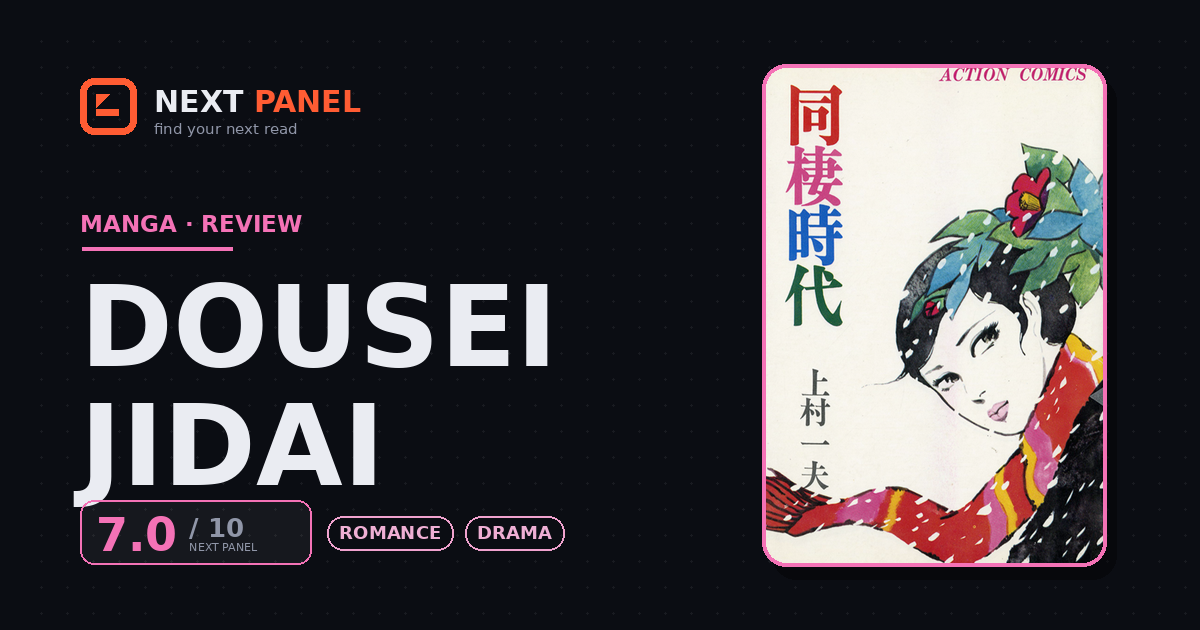
Is Dousei Jidai Worth Reading? Review & Where to Read
Quick Answer
Yes, if you're interested in manga history or want a grounded, unglamorous relationship drama. It's a product of its era and reads that way, but it's a genuinely important, well-observed piece of work.
Quick Verdict
“This works better as a time capsule than as a romance — worth reading for what it captures about its era, even where the storytelling itself feels dated.”
Best for: Readers curious about manga history or a realistic, unglamorous relationship drama set outside genre conventions.
Not for: Readers who want a modern pace, modern relationship dynamics, or a story built around plot momentum.
- Type
- Manga
- Genres
- Romance, Drama
- Status
- Completed
- This review
- Minor Spoilers
- Author
- Kazuo Kamimura
- Publisher
- Shogakukan
| Quick facts | |
|---|---|
| Format | Manga (seinen), 80 chapters, 6 volumes |
| Run | 1972–1973 · completed |
| Community score | AniList 7.9 · MangaUpdates 6.3 |
| Content | Mature themes, depictions of a couple's sexual relationship |
Overview
Dousei Jidai — roughly "The Cohabitation Era" — follows Kyoko, a young graphic designer, and Jiro, an illustrator just starting his career, as they move in together in early-1970s Tokyo without getting married. That single premise, unremarkable by today's standards, was genuinely provocative when Kazuo Kamimura serialized it in 1972, at a moment when Japan's attitudes toward sex, marriage, and cohabitation were visibly shifting.
The manga isn't built around a dramatic hook or a twist-driven plot. It's a slice-of-life relationship drama, following Kyoko and Jiro's daily friction over money, work, family, and each other, in a style that reads more like a serialized newspaper column than a tightly plotted story.
What it does well
What makes Dousei Jidai worth seeking out is how plainly it treats its premise. Kamimura doesn't frame Kyoko and Jiro's living arrangement as scandalous or tragic — it's just how they've chosen to live, and the manga spends its time on the ordinary texture of that choice: rent, ambition, jealousy, the small compromises of sharing a life with someone. For 1972, that matter-of-fact treatment of an unmarried couple was itself a statement, and the manga's historical value comes through clearly even decades later.
The relationship itself is grounded in real adult stakes rather than romantic fantasy. Jiro's career frustrations and Kyoko's own ambitions both get real weight, and their conflicts tend to come from believable pressures rather than manufactured misunderstandings. Kamimura's art, the same sensibility that would later define the far bloodier Lady Snowblood, gives even a quiet apartment scene a real sense of atmosphere.
Taken as a document of its moment — Japan's sexual revolution, changing ideas about marriage, a generation figuring out new rules for old questions — Dousei Jidai has a value that goes beyond whether any individual chapter is gripping on its own.
Where it falls short
The pacing is the biggest hurdle for a modern reader. This reads like a serialized column more than a story building toward anything, and chapters can feel loose and meandering compared to the tighter plotting most contemporary manga readers are used to.
The gender dynamics between Jiro and Kyoko are also plainly of their era, and some of what the manga presents as normal will land as dated to a reader today rather than merely period-flavored. It's worth going in expecting a snapshot of 1972 attitudes, not a story that's been updated for modern sensibilities.
Practically, this is also just a hard manga to get hold of. There's no official English release, and even unofficial scanlations are thin on the ground, which makes it a much bigger ask to track down than most titles on this list.
Verdict
Dousei Jidai is worth reading as a historical document first and a romance second — a genuinely notable snapshot of a couple choosing to live outside convention at a moment when that choice meant something. It's slow and dated in places, but there's real substance underneath, especially for anyone interested in where manga's take on adult relationships came from.
Strengths & Weaknesses
Strengths
- Kamimura treats Kyoko and Jiro's unmarried cohabitation as ordinary rather than scandalous, which was a genuinely bold choice for 1972 Japan and gives the manga real historical weight.
- The day-to-day texture of their relationship — money troubles, career frustration, small domestic friction — feels observed rather than invented, grounding the romance in real adult concerns instead of melodrama.
- Kamimura's linework, the same sensibility he'd bring to Lady Snowblood a few years later, gives even quiet domestic scenes a real sense of atmosphere and mood.
- As a document of Japan's early-1970s shift in attitudes toward sex and relationships outside marriage, it's a genuinely valuable snapshot of its time.
Weaknesses
- The pacing and structure feel distinctly of their era — chapters unfold more like a serialized slice-of-life column than a plotted story with momentum, which can test the patience of a modern reader.
- Jiro and Kyoko's relationship dynamics reflect early-1970s gender expectations pretty plainly, and some of that will read as dated rather than merely period-appropriate.
- With no official English release and a small circulating scanlation base, this is a genuinely hard manga to track down, which limits how easily it can be recommended day to day.
Similar Titles
A much later, gentler take on cohabitation before marriage as the emotional core of a relationship.
Shares the same interest in ordinary, lived-in romance grounded in daily routine rather than melodrama.
Another Japanese seinen classic more interested in believable adult life than genre spectacle.
Frequently Asked Questions
Is Dousei Jidai related to Lady Snowblood?
Not narratively, but it's by the same artist, Kazuo Kamimura, who illustrated Lady Snowblood a few years after this series.
Is Dousei Jidai finished?
Yes, it's a complete six-volume series originally published in 1972 and 1973.
Is there an official English translation of Dousei Jidai?
No, there's currently no official English release. It hasn't been picked up by an English-language publisher, so there's no legal digital or print edition to point to right now.