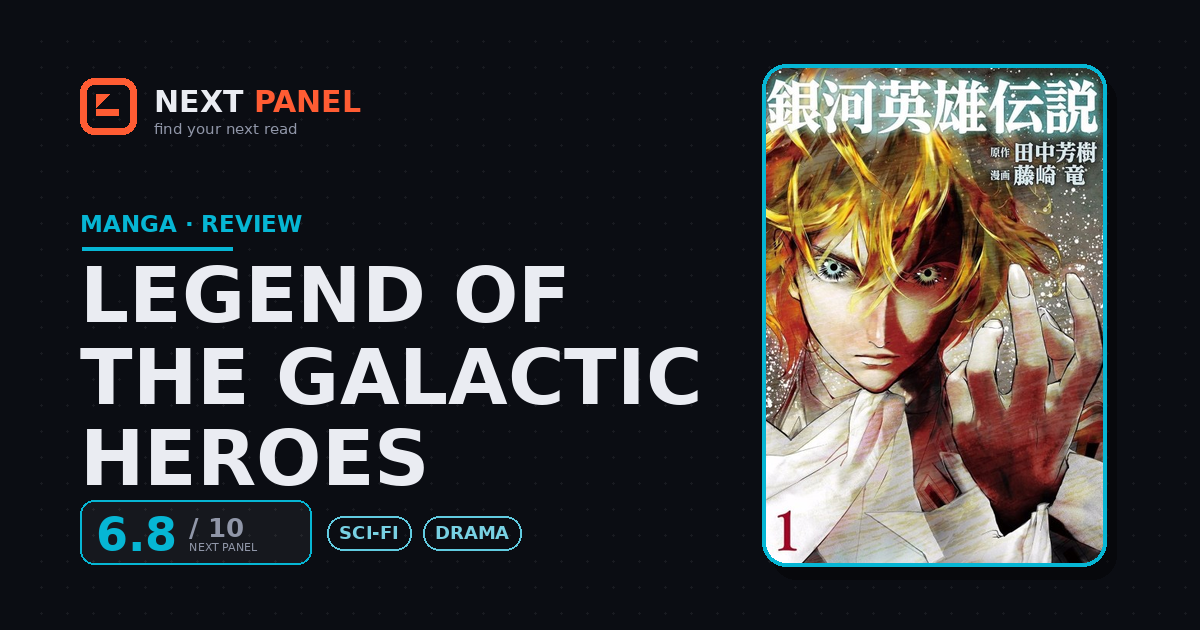
Is Legend of the Galactic Heroes Worth Reading? Review & Where to Read
Quick Answer
If you already like the Legend of the Galactic Heroes story, yes — this manga version is a genuinely strong, beautifully drawn take on the early and middle parts of the saga, even though the last stretch feels rushed. If you're brand new to the franchise, it's a big commitment to start cold.
Quick Verdict
“Gorgeous, politically dense, and clearly running out of room by the end — this is a companion piece for fans more than a first stop for newcomers.”
Best for: Readers who already enjoy the Legend of the Galactic Heroes franchise and want a distinct, visually striking take on it.
Not for: Readers who want a self-contained story with a small, easy-to-track cast and no political maneuvering.
- Type
- Manga
- Genres
- Drama, Sci-Fi
- Status
- Completed
- Author
- Yoshiki Tanaka (original story)
- Artist
- Ryu Fujisaki
- Publisher
- Shueisha (Weekly Young Jump / Ultra Jump)
| Quick facts | |
|---|---|
| Format | Manga (seinen), 238 chapters, 35 volumes |
| Run | 2015–2026 · completed |
| Community score | AniList 6.2 |
Overview
Ryu Fujisaki's Legend of the Galactic Heroes adapts Yoshiki Tanaka's sprawling space-opera novels (and the beloved OVA anime built from them) into manga form, running from 2015 until wrapping up around the end of 2025. The story follows two rival military geniuses — Reinhard von Lohengramm on the side of the authoritarian Galactic Empire, Yang Wen-li on the side of the democratic Free Planets Alliance — as their fleets fight a war that's really about which kind of government deserves to survive. It's political and strategic first, action second: fleet tactics, backroom coups, and a huge ensemble of officers matter as much as any individual duel.
What it does well
Fujisaki's art is the reason to pick this up over just watching the anime or reading the novels cold. He draws the cast in a lush, almost shoujo-adjacent style — long limbs, flowing hair, dramatic lighting — that makes officers who'd otherwise blur together in a wall of military uniforms instantly readable and, frankly, gorgeous to look at. The early volumes in particular are a genuinely strong adaptation: the political maneuvering lands, the big fleet battles are staged clearly instead of turning into an unreadable mess of ship silhouettes, and Reinhard's rise from ambitious noble to something close to an emperor gets real room to build.
The scale is also impressive on its own terms. This is a war story where you're tracking dozens of named officers across two governments, and the manga does a better job than you'd expect of keeping who's who straight, using distinct character designs to carry information the dialogue doesn't have room for. The politics stay the actual point throughout — this never turns into a shonen power fantasy with a war as set dressing.
Where it falls short
The later chapters show real strain. Adapting a decade-spanning saga in a decade-long serialization means the pacing tightens noticeably by the end, and several plot threads that got careful setup earlier get resolved in a hurry. Readers who followed it as it came out have pointed out that the later arcs feel compressed compared to the patient, faithful early volumes, and that drop in care is noticeable if you read the whole thing back to back. It also leans hard on the assumption you're either already invested in the franchise or willing to keep a mental scorecard of characters and factions — newcomers with zero patience for political drama will bounce off fast. And right now there's no official English release, so it's Japanese-only.
Verdict
If you already know and like the Legend of the Galactic Heroes story, Fujisaki's manga is a beautifully drawn companion piece that nails the early and middle stretch of the saga and only stumbles bringing it home. If you've never touched this franchise, it's a genuinely big ask as a starting point — but the version of Reinhard and company you get here is worth it for the art alone.
Strengths & Weaknesses
Strengths
- Fujisaki's art is the reason to read this over just watching the anime — a lush, almost shoujo-adjacent style with long limbs and dramatic lighting that makes a huge cast of officers instantly readable instead of blurring together in uniforms.
- The early volumes are a genuinely careful adaptation: the political maneuvering lands, the big fleet battles are staged clearly instead of collapsing into a mess of ship silhouettes, and Reinhard's rise gets real room to build.
- It handles scale better than most war stories try to — dozens of named officers across two governments, and distinct character designs carry information the dialogue doesn't have space for.
- The politics are the actual point, not a backdrop for action, and the series never dumbs that down to make the fights punchier.
Weaknesses
- The later chapters show real strain — adapting a decade-spanning saga in a decade-long serialization means the pacing tightens up noticeably by the end, and threads that got careful setup earlier get resolved in a rush.
- It leans hard on the assumption you're either already invested in the franchise or willing to keep track of a large cast of names and factions; newcomers with no patience for political drama will bounce off quickly.
- There's no official English release yet, so right now it's only readable in the original Japanese.
Similar Titles
Different setting, same interest in war and politics as the real subject rather than just an excuse for battles.
Another manga that spends real time on ideology and consequence between its action.
Same space-opera-as-political-drama territory, with a similarly huge cast to track.
Frequently Asked Questions
Is Legend of the Galactic Heroes available in English?
Not the manga. The original novels are licensed in English by Viz's Haikasoru imprint and the anime has official streaming releases, but Ryu Fujisaki's manga adaptation currently has no official English publisher.
Do I need to have seen the anime or read the novels first?
No, but it helps. The manga tells the same story from scratch, but it moves fast and assumes some patience with a large cast, which is easier if you already know the broad shape of the plot.
Is the manga a faithful adaptation?
Mostly, especially early on. The later chapters compress more of the source material than the earlier ones do, so some readers find the ending feels rushed compared to how carefully the first stretch was handled.