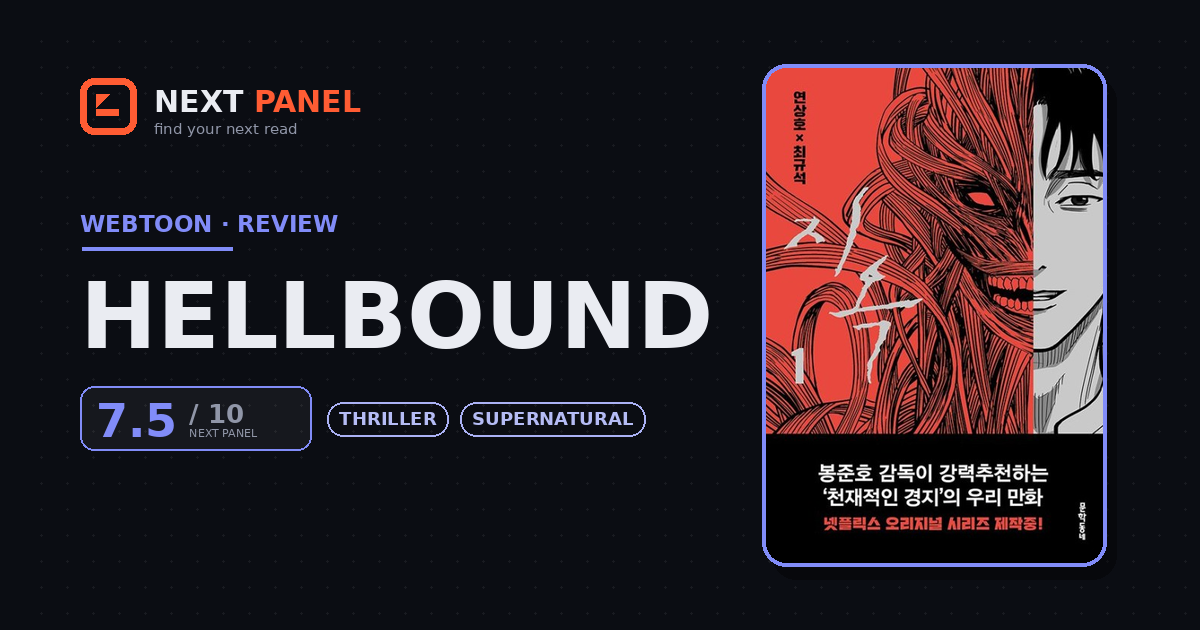
Is Hellbound Worth Reading? Review & Where to Read
Quick Answer
If you want a short, sharp supernatural thriller that's really about people rather than monsters, Hellbound is a strong, unsettling read. Its ideas about faith, guilt, and mob panic hit hard. The catch is rough art and thin characterization — it's concept-first, and proudly so.
Quick Verdict
“Short, sharp, and genuinely disturbing — a supernatural thriller less about the monsters than about how people lose their minds over them.”
Best for: Readers who want a tense, idea-driven supernatural thriller about faith, guilt, and mob mentality.
Not for: Readers who want polished art, deep characters, and a long, fleshed-out story.
- Type
- Webtoon
- Genres
- Thriller, Supernatural
- Status
- Completed
- This review
- Minor Spoilers
- Author
- Yeon Sang-ho
- Artist
- Choi Gyu-seok
- Publisher
- Dark Horse Comics
- Platform
- WEBTOON
| Quick facts | |
|---|---|
| Format | Webtoon, 57 chapters, 2 volumes |
| Run | 2019–2020 · completed |
| Community score | AniList 6.3 · MAL 6.9 · MangaUpdates 6.7 |
| Content | Graphic violence, disturbing imagery |
| Where to read | WEBTOON — official |
Overview
Hellbound starts with one of the eeriest hooks in horror. In modern Seoul, a spectral figure appears to certain people and tells them, to the second, when they will die — and at that moment, hulking demonic entities materialize, beat them, and drag them screaming to what everyone assumes is hell. No explanation, no appeal. As these public "demonstrations" mount, a religious movement called the New Truth Society rises to interpret them as God's judgment on sinners, and society begins to reshape itself around fear. Written by Yeon Sang-ho — the director of Train to Busan — and drawn by Choi Gyu-seok, this webtoon is the source for the 2021 Netflix series, and it's far more interested in people than in the monsters.
What it does well
The premise alone carries you a long way, and Yeon knows it. The opening is immediate and dread-soaked, and the central question — what would actually happen to a society if divine punishment became a visible, undeniable fact — is genuinely fascinating. Crucially, the story uses the supernatural as a lens rather than a subject. The demons are almost beside the point. What Hellbound really examines is how frightened people respond: how guilt, grief, and uncertainty get channeled into zealotry, scapegoating, and mob violence, and how a cult can weaponize all of it. That focus gives the book a sharp, uncomfortable relevance.
It's also commendably lean. Where a lot of supernatural thrillers sprawl, Hellbound is short and tightly wound, moving from one gut-punch to the next without padding. The brevity keeps the tension high and the ideas front and center; you're never waiting around. Yeon's thematic interests — faith versus institution, justice versus vengeance, the ease with which a crowd turns cruel — are woven right into the plot rather than tacked on, and they linger after you finish.
The structure is smart too, shifting perspectives and time in ways that keep the central mystery alive while widening the social picture. By the end, it has grown from a creepy procedural into something closer to a parable about belief and control.
Where it falls short
The most divisive thing is the art. Choi Gyu-seok's style is loose, sketchy, and muted, and it's a deliberate choice that suits the grim mood — but it's a long way from the glossy polish many webtoon readers expect, and some will bounce off it. The other limitation is characterization. Because Hellbound is so concept-driven and so short, its people can feel more like positions in an argument than fully realized individuals; you engage with their dilemmas more than with them. And the compressed length, a strength for pacing, occasionally works against the ideas, raising provocative questions it doesn't have room to fully chase down.
Verdict
Hellbound is a smart, bleak, genuinely unsettling supernatural thriller that uses a horror premise to ask hard questions about faith and human nature. The rough art and thin characters keep it from greatness, and it's clearly more interested in ideas than in people. But it's short, gripping, and hard to forget, and it does what the best speculative fiction does: it makes you sit with an uncomfortable "what if." If that appeals — and especially if you liked the Netflix series — the original is well worth the read.
Strengths & Weaknesses
Strengths
- The central premise is gripping and genuinely unsettling, and the story wastes no time getting into it.
- It's really about people, not demons — how fear and guilt curdle into fanaticism and mob justice.
- It's lean and fast; the short length keeps the dread tight with no filler.
- Yeon Sang-ho's ideas about religion, punishment, and crowd hysteria give it real bite.
Weaknesses
- The art is rough and muted, and it won't win over readers who want polish.
- It's more concept than character, so people can feel like vehicles for the theme.
- The short length means some big ideas get raised faster than they get explored.
Similar Titles
Another bleak Korean supernatural horror about a world quietly breaking down.
A sprawling thriller about a doomsday cult and slow-building dread.
A supernatural thriller about death, judgment, and the people who appoint themselves its arbiters.
Where to Read Officially
| Platform | Format | Pricing | Region notes | Link |
|---|---|---|---|---|
| WEBTOON | Digital episodes | Free | Region availability varies | Open |
Frequently Asked Questions
Where can I read it in English?
It's officially available in English on WEBTOON for free, and Dark Horse Comics publishes a collected print edition titled The Hellbound.
Is this the same as the Netflix show?
Yes. Director Yeon Sang-ho adapted his own webtoon into the 2021 Netflix series Hellbound, so the comic is the original source.
Is it finished?
Yes, the original story is complete and fairly short. A sequel, Hellbound 2: The Resurrected, continues it.