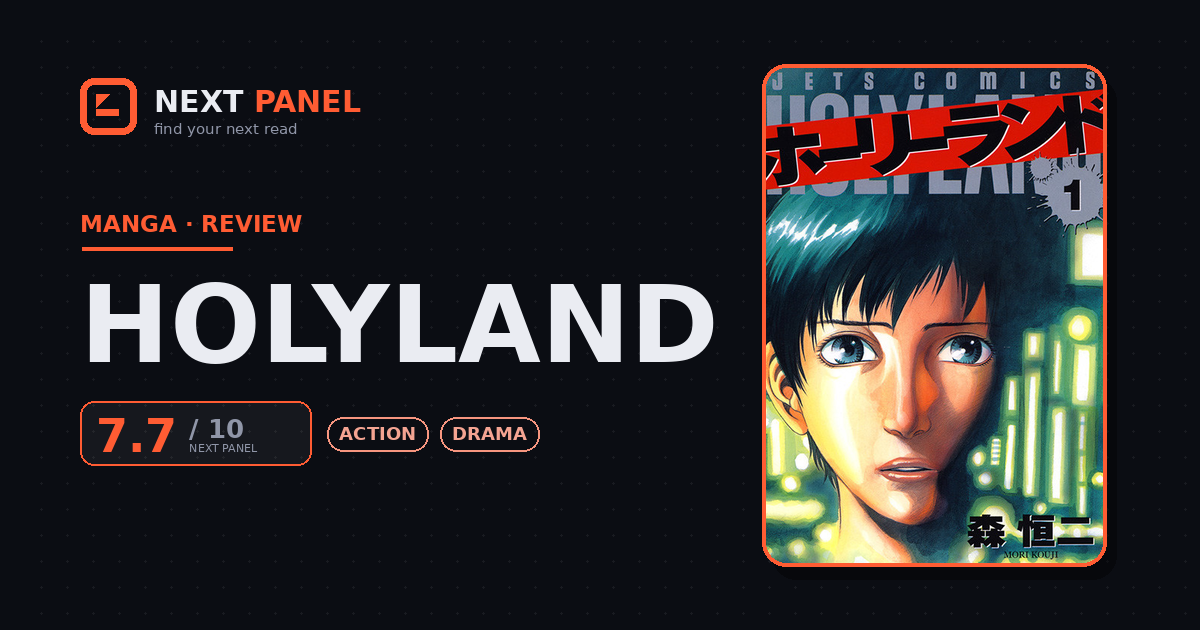
Is Holyland Worth Reading? Review & Where to Read
Quick Answer
With caveats. Holyland is a grounded, almost documentary take on street fighting and the bullied kid who falls into it, and it's unlike anything else in the action genre. The art is rough and there's no official English release, so go in knowing that.
Quick Verdict
“Grounded, almost documentary street-fighting wrapped around the psychology of bullying — rough-drawn, but unlike anything else in the genre.”
Best for: Readers who want realistic fighting and a story about belonging more than flashy action.
Not for: Readers who want polished art or a fast, tournament-style action plot.
- Type
- Manga
- Genres
- Drama, Action
- Status
- Completed
- This review
- Minor Spoilers
- Author
- Kouji Mori
- Publisher
- Hakusensha
| Quick facts | |
|---|---|
| Format | Manga (seinen), 182 chapters, 18 volumes |
| Run | 2000–2008 · completed |
| Community score | AniList 8.2 · MAL 8.4 · MangaUpdates 8.6 |
Overview
Holyland is a seinen action manga by Kouji Mori. Yuu Kamishiro is a high schooler who's been bullied so badly he can barely function at school, so he starts teaching himself to fight and takes to the streets at night. He becomes a kind of urban legend — the "Thug Hunter" — knocking down the delinquents who prey on the weak, and slowly finds, in the dangerous world of street fighting, the sense of belonging he never had anywhere else. It's an action series, but its real subject is what fighting does to a person and why someone would choose it.
What it does well
The fighting is the obvious hook, and it's handled unlike almost anything else in the genre. Mori is interested in real technique — how a jab actually works, why range and timing matter, what fear does to your body — and the book often pauses to explain the mechanics of a move. There are no super-powers and almost no exaggeration; a good punch is a good punch, and getting hit hurts. For readers who find most action manga too cartoonish, this is bracingly grounded.
What gives it staying power is the psychology underneath. Holyland is really about belonging. Yuu doesn't fight because he loves violence; he fights because, for the first time, there's a place where he's seen and respected, even if that place is dangerous and bad for him. The book is honest about how seductive and how harmful that is, and it keeps asking whether the thing saving Yuu is also ruining him.
Because the violence is real, the tension is real too. There are no stakes-free fights here — anyone can get seriously hurt, reputations matter, and a small scuffle on a quiet street can carry more dread than a big tournament bout in a flashier series.
Where it falls short
The art is the clearest weakness. It's rough and stiff, especially early, and it never becomes a strength; this is a book you read for ideas and tension, not for the visuals. The instructional asides, useful as they are, can also stop the story dead while a panel explains the theory behind a strike.
It's repetitive, too. Over a long run the rhythm of fight, reflection, and the next fight starts to feel familiar, and the later chapters don't escalate as cleanly as it could. One practical note: there's no official English release, so reading it legally in English isn't an option right now.
Verdict
Holyland is a cult favorite for a reason — a grounded, thoughtful action manga that treats street fighting as a real, dangerous thing and uses it to tell a story about a kid looking for somewhere to belong. The rough art, the lecture breaks, and the lack of an official English version are real hurdles. But if you want fighting with actual weight and a story with something on its mind, there's little else like it.
Strengths & Weaknesses
Strengths
- The fighting is unusually realistic — it's about technique, fear, and the real toll of violence, with almost none of the genre's fantasy.
- It's really a story about belonging: why a bullied kid would seek out a dangerous place where he finally matters, which gives the fights weight.
- The tension is genuine; because anyone can get badly hurt, even a small street scuffle feels high-stakes.
Weaknesses
- The art is rough and stiff, particularly in the early volumes, and it stays plain throughout.
- The instructional asides that break down each technique can stop the story cold.
- It gets repetitive over a long run — a cycle of fight, reflect, and repeat that can feel samey.
Similar Titles
Frequently Asked Questions
Can I read it in English officially?
Not right now — there's no official English release of Holyland. We don't link unofficial scans, and we'll update this if a licensed English edition appears.
Is it finished?
Yes. The manga is complete, so the story reaches a full ending.
Is it a tournament fighting manga?
No. Holyland is about street fights and the people drawn into them, not an organized tournament, which is a big part of why it feels different.