Is I Got a New Skill Every Time I Was Exiled Worth Reading? Review & Where to Read
Quick Answer
Yes, if you want a narou-style isekai with a genuinely clever structural hook. Turning exile itself into the source of power, aimed at saving one specific person, gives the formula real direction.
Quick Verdict
“One hundred worlds, one hundred exiles, one very specific reason to keep going back -- this isekai gimmick actually earns its premise.”
Best for: Readers who want isekai power fantasy with a clear emotional goal driving the power-gaining structure.
Not for: Readers who want prose-first light novel adaptations to feel fully native to the manga format rather than compressed.
- Type
- Manga
- Genres
- Romance, Isekai
- Status
- Ongoing
- This review
- Minor Spoilers
- Author
- Takumi Hinoura
- Artist
- Tsukasa Jinmori
- Publisher
- Akita Shoten
| Quick facts | |
|---|---|
| Format | Manga (seinen), 1 chapters, 5 volumes |
| Run | 2022–present · ongoing |
| Community score | AniList 8.1 · MangaUpdates 8.0 |
Overview
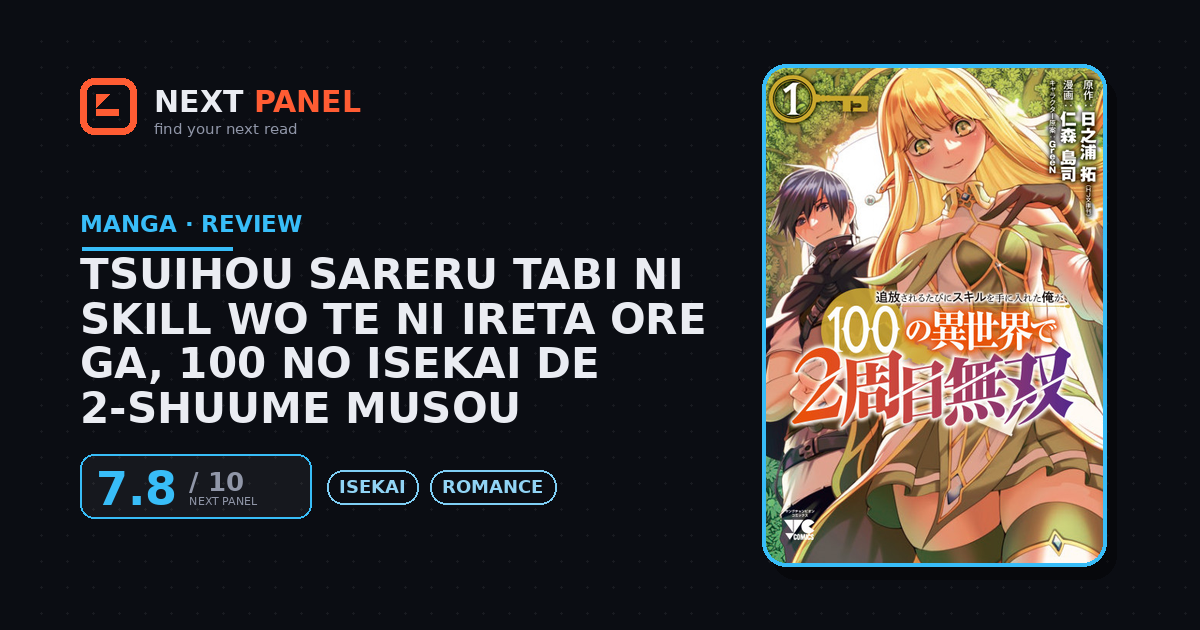
I Got a New Skill Every Time I Was Exiled, and after 100 Different Worlds, I Was Unmatched adapts Takumi Hinoura's light novel, with manga art by Tsukasa Jinmori, serializing in Young Champion Comics since 2022. Ed gets exiled from his adventuring party for being useless -- and discovers he's oddly fine with it, because a mysterious entity has bound him to a condition: get kicked out of a hero's party in 100 different worlds, gaining a new skill each time, before he can return home. When he finally completes the challenge and learns that the world he left behind -- and Tia, the elf friend he cares about -- met a tragic end, he sets out to redo the whole journey properly, now armed with everything he's learned.
What it does well
The premise takes a stock isekai beat -- the hero unfairly kicked out of the party -- and turns it into the entire engine of the story instead of a one-time setup to move past. Every exile is a fresh skill, a fresh world, and a fresh reason things went wrong, which keeps what could be a repetitive gimmick feeling more like a puzzle box than a formula on repeat.
What elevates it above a pure numbers game is Tia. Ed isn't grinding through a hundred worlds just to prove himself or collect power for its own sake -- he's doing it because he has a specific person he failed to protect and wants to go back for. That gives every skill and every exile a destination, which matters a lot in a genre that can otherwise feel aimless once the power fantasy kicks in.
The redo structure adds another layer worth noting: because Ed already knows how his first attempt ended, the story gets to revisit familiar isekai beats -- party dynamics, monster threats, court politics -- with a character who already has the benefit of hindsight, rather than a blank-slate hero encountering everything for the first time.
Where it falls short
As an adaptation of a prose-first light novel, some of the manga's pacing shows its origins -- party introductions, power reveals, and worldbuilding details sometimes move faster than they might if the story had been built for a visual medium from the start, which can make early chapters feel a little compressed.
The 100-world structure is also a genuine long-term risk. It's a great hook, but sustaining a hundred distinct, memorable exiles without them blurring into a repeating pattern is a hard needle to thread, and it's still an open question how well the series manages that as it continues.
Verdict
I Got a New Skill Every Time I Was Exiled takes one of isekai's most common beats and builds an entire, genuinely clever structure out of it, anchored by a real emotional goal instead of open-ended power accumulation. It's not without the genre's usual pacing quirks, but the premise alone makes it worth checking out.
Strengths & Weaknesses
Strengths
- Turning 'getting exiled' into the actual mechanism of power growth, instead of a one-time humiliation to overcome, gives the premise a genuinely clever structural gimmick -- 100 different worlds means 100 different reasons to get kicked out, and 100 different skills to show for it.
- The emotional core -- wanting to go back and actually save Tia, instead of just accumulating power for its own sake -- gives the power fantasy a specific goal rather than an open-ended one.
- The redo structure lets the story revisit and reframe earlier exiles with the benefit of hindsight, adding a layer most straightforward power-fantasy isekai don't bother with.
Weaknesses
- As a narou-style light novel adaptation, the prose-to-panel translation leans on some familiar isekai shorthand -- fast party dynamics, quick power reveals -- that can feel rushed compared to series built for the manga format from the start.
- With 100 worlds as the structural gimmick, individual exiles risk blurring together if the manga doesn't keep finding fresh angles on the formula over the long run.
Similar Titles
shares the interest in a party's rejection becoming the foundation of the protagonist's whole arc
Banished from the Hero's Party
same 'exile turns out to be the good thing that happened' isekai structure
similar interest in redoing a journey with hard-earned knowledge from having failed before
Frequently Asked Questions
Is this finished?
No, it's ongoing, serializing in Young Champion Comics since 2022.
Is there an official English release?
Not currently. There's no official English release, so it's one to watch for rather than track down through unofficial means.
Is this based on a light novel?
Yes, it adapts Takumi Hinoura's light novel, with manga art by Tsukasa Jinmori.