Is Re:Zero Worth Reading?
Quick Answer
Worth reading arc by arc if you're already invested in the story and want it in manga form, but the manga is split into separate, differently-illustrated chapter-arc adaptations rather than one continuous series, so new readers are probably better served starting with the anime or light novels.
Quick Verdict
“Genuinely strong psychological isekai story hobbled, on the manga side specifically, by a fragmented publishing structure spread across separate arc-based adaptations.”
Best for: Existing Re:Zero fans who want the story's key arcs in manga form and don't mind piecing together which volume covers what.
Not for: New readers looking for one continuous manga to start the story from volume one.
- Type
- Manga
- Genres
- Fantasy, Thriller, Isekai
- Status
- Ongoing
- Author
- Tappei Nagatsuki
- Artist
- Daichi Matsuse
- Publisher
- Yen Press
- Platform
- Yen Press
| Quick facts | |
|---|---|
| Format | Manga, published as separate arc adaptations (Chapter 1: 2 volumes; Chapter 3: Truth of Zero: 11 volumes; more ongoing) |
| Run | 2014-present . ongoing |
| Community score | Not separately tracked; source light novel rated 8.8 on AniList |
| Content | intense psychological violence and repeated character death (death-loop premise) |
| Where to read | Yen Press - official |
Overview
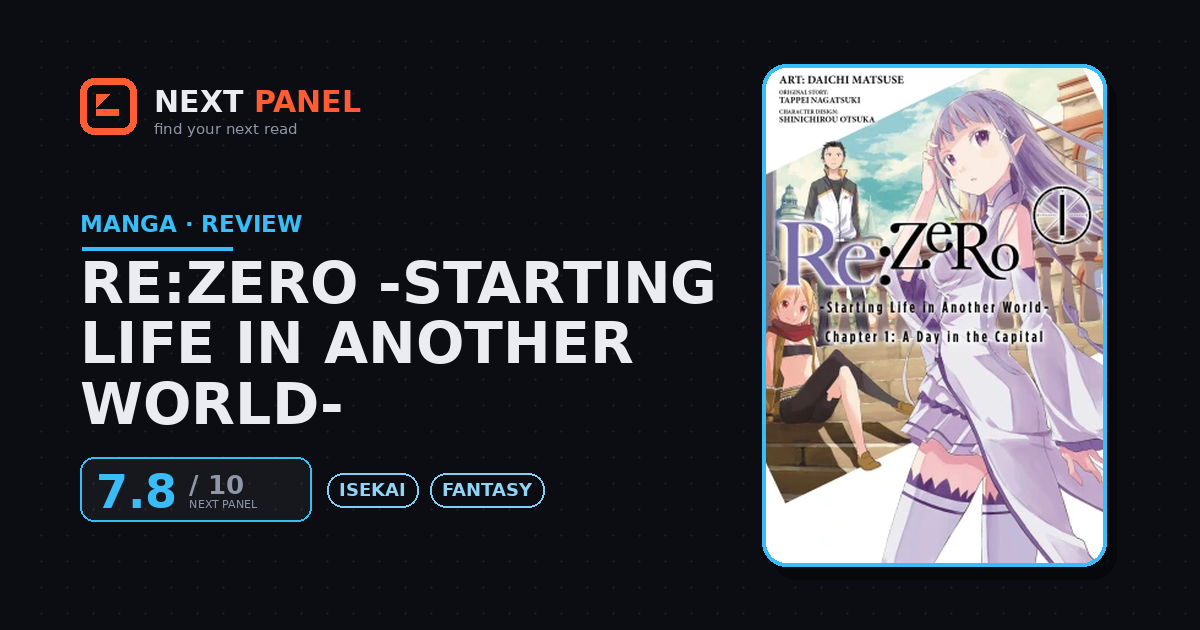
Subaru Natsuki gets pulled from a convenience store parking lot into a fantasy world with no warning, no tutorial, and no obvious power beyond one: when he dies, he rewinds to an earlier point and does it again, remembering everything while nobody else does. Tappei Nagatsuki's light novel turned that premise into one of the most influential isekai stories of the last decade, and Yen Press publishes the manga side of it as a set of separate arc-based adaptations rather than one continuous series. Chapter 1: A Day in the Capital covers the opening arc, Chapter 3: Truth of Zero covers a later one, and so on, each illustrated primarily by Daichi Matsuse working through the story a section at a time.
What it does well
The "Return by Death" premise is handled with real teeth. Subaru's loops aren't a cheat code, they cost him actual psychological damage each time, and the story is upfront about how much watching people he cares about die repeatedly warps him, which gives Re:Zero's darker turns real weight instead of treating the reset button as consequence-free. The manga adaptations translate that tension well panel to panel: the horror beats land, and the mystery of not knowing exactly what triggers a reset or how to avoid the next one keeps the arcs propulsive.
Emilia, Rem, and the rest of the cast also get enough distinct interiority that the series' reputation as more than just a harem with a gimmick attached holds up on the page. The manga format in particular gives some of the story's tensest confrontations room to breathe panel by panel in a way the anime's pacing sometimes rushes past.
Where it falls short
Splitting the manga into separate numbered chapter-arcs instead of one continuous run is genuinely confusing for new readers. There's no single volume one that covers the whole story, and figuring out which arc adaptation to start with, or whether you're better off just reading the light novel or watching the anime instead, takes more research than it should for a series this popular.
The different art across arcs also means visual consistency varies more than you'd expect from a single ongoing series, and some arcs have released far more slowly than others, so a smooth, continuous reading experience isn't guaranteed the way it would be with a normal single-run manga.
Verdict
Genuinely strong psychological isekai story hobbled, on the manga side specifically, by a fragmented publishing structure spread across separate arc-based adaptations. Worth reading arc by arc if you already know the story and want it in manga form, but new readers are probably better served starting with the anime or light novels and treating the manga as a supplement rather than the entry point.
Strengths & Weaknesses
Strengths
- Return by Death premise carries real psychological cost instead of being a consequence-free reset button
- Manga format gives tense confrontations room to breathe panel by panel
- Main cast gets real interiority beyond harem-isekai archetypes
- Faithfully translates one of the more influential recent isekai stories to the page
Weaknesses
- Split into separate numbered chapter-arc adaptations instead of one continuous series, confusing for new readers
- No single volume one covers the full story; figuring out where to start takes real research
- Visual consistency varies across arcs since different art teams handle different sections
- Some arcs release far more slowly than others, disrupting a smooth reading experience
Similar Titles
Another isekai willing to make its protagonist suffer genuinely before any payoff.
A similarly acclaimed, weightier isekai for readers who want the genre taken seriously.
A comedic palate cleanser if Re:Zero's darker turns are too heavy back to back.
Where to Read Officially
| Platform | Format | Pricing | Region notes | Link |
|---|---|---|---|---|
| Yen Press | Print & Digital | Paid | Region availability varies | Open |
Frequently Asked Questions
Is the Re:Zero manga finished?
Not as a whole. The manga is split into separate story-arc adaptations, including Chapter 1 and Chapter 3: Truth of Zero, published individually by Yen Press, with some complete and others still ongoing as the light novel continues.
Where do I start with the Re:Zero manga?
Chapter 1: A Day in the Capital covers the opening arc and is the most natural starting point, though many readers prefer starting with the anime or light novels since the manga doesn't run as one continuous series.
Where can I read it in English?
Yen Press publishes the manga adaptations, and the light novels, in English, in print and digitally.