Is Junji Ito Story Collection Worth Reading? Review & Where to Read
Quick Answer
Yes, if you already know you like Junji Ito's specific brand of dread. This isn't one continuous story — it's an ongoing line of anthology volumes collecting his standalone short horror — and the format suits his best work perfectly.
Quick Verdict
“Any given volume is a mixed bag by design, but even the weaker stories are carried by art that makes skin crawl in ways few other horror manga manage.”
Best for: Readers who want bite-sized horror stories they can read one at a time rather than a single ongoing plot.
Not for: Readers who want a unified narrative or consistently strong hits across every story in a volume.
- Type
- Manga
- Genres
- Horror, Supernatural
- Status
- Ongoing
- This review
- Minor Spoilers
- Author
- Junji Ito
- Publisher
- VIZ Media
- Platform
- VIZ
| Quick facts | |
|---|---|
| Format | Manga (seinen), 119 chapters, 11 volumes |
| Run | 2011–2013 · ongoing |
| Community score | AniList 8.1 |
| Content | Body horror, disturbing imagery, graphic violence |
| Where to read | VIZ — official |
Overview
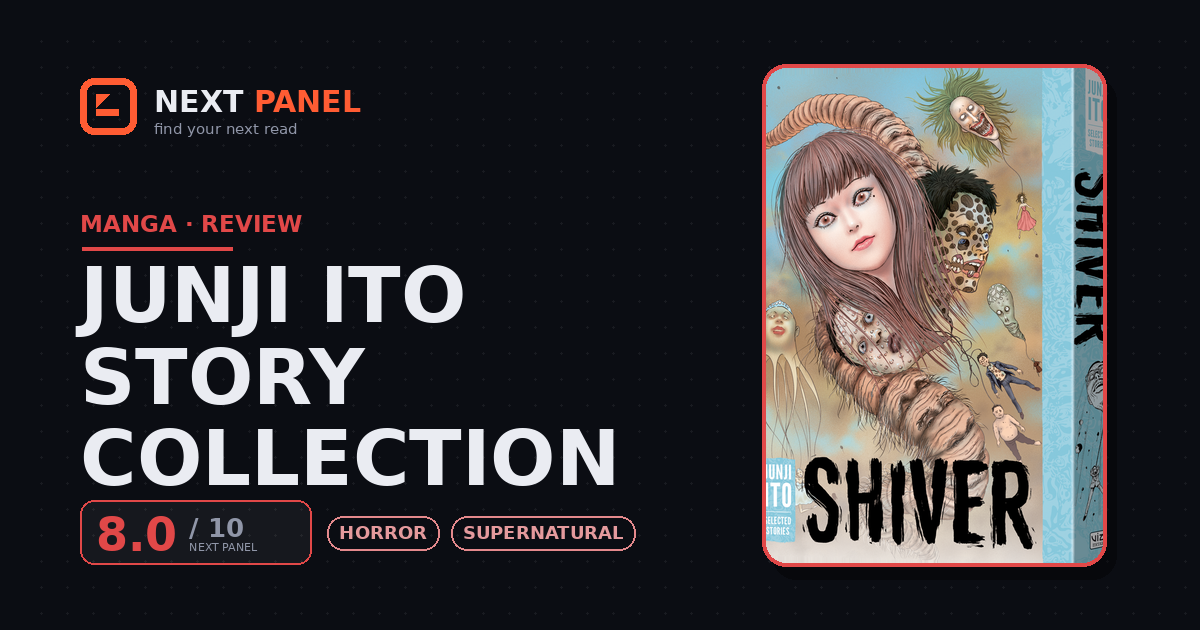
Junji Ito Story Collection isn't a single story — it's VIZ's ongoing English-language line collecting Junji Ito's standalone short horror manga into themed volumes: Shiver, Smashed, Deserter, Fragments of Horror, Tombs, Lovesickness, Alley, Soichi, Venus in the Blind Spot, Moan, and more, with new volumes still being released. These are separate from his longer continuous works like Uzumaki and Tomie, which already have their own dedicated collections. What ties the line together isn't plot but sensibility: Ito's specific talent for making the mundane curdle into cosmic dread, one self-contained chapter at a time.
What it does well
Ito's art is the reason this format works as well as it does. His horror rarely relies on shock gore for its own sake — it's built on the slow, patient wrongness of a face, a spiral, a swollen body part that just keeps growing past where it should stop. That specific visual language translates perfectly into short-story form, because a lot of his best ideas are exactly one concept executed relentlessly, and a 30-page chapter is often the ideal length to let a single image detonate without overstaying its welcome.
The anthology structure also means the format is forgiving. If one story in a volume doesn't land for you, the next one is a fresh idea entirely, and Ito has an unusually deep well of genuinely inventive horror concepts to draw from across a decades-long career. The themed groupings (Soichi's story cycle, the Deserter volume's darker war-adjacent material, and so on) give each book a loose identity without pretending there's a continuous plot holding it together.
For readers who already know they like Ito's specific style — atmospheric, patient, more disturbing than gory — this is close to an ideal format: pick a volume, read a story before bed, and get a complete, self-contained nightmare in one sitting.
Where it falls short
The unevenness is real and by design. Some stories lean entirely on one unsettling image without much idea development behind it, and because each entry wraps up quickly, there's rarely room for the kind of character investment that makes horror hit harder. Readers new to Ito specifically looking for his strongest single work are better served starting with Uzumaki or Tomie, both of which sustain a story over a full arc rather than delivering horror in short bursts. This anthology line is closer to a deep cut for people who already know his style works on them.
Verdict
As an ongoing showcase for one of horror manga's most distinctive visual imaginations, the Story Collection line delivers consistently strong atmosphere even when individual stories miss. It's not the place to start with Junji Ito, but once you're hooked, it's a reliable well to keep coming back to.
Strengths & Weaknesses
Strengths
- Ito's linework is uniquely suited to horror — the way ordinary faces and objects curdle into something wrong panel by panel is more unsettling than almost anything achieved with gore alone.
- The anthology format means a weak story is never more than a chapter long, and the next one might be one of his best.
- Themed volumes (Shiver, Smashed, Soichi, Deserter, and others) group stories loosely enough to give each book its own flavor without forcing a false continuity.
- Ito is genuinely inventive with horror concepts — few writers generate this many distinct, memorable nightmare images across a career.
Weaknesses
- Quality varies noticeably story to story and volume to volume; some entries lean on a single unsettling image rather than a fully developed idea.
- Because each story resolves in a chapter or two, character work is necessarily thin — this is concept-and-atmosphere horror, not character-driven horror.
- New readers looking for his single best work should probably start with Uzumaki or Tomie rather than the anthology line, which is more of a deep cut for readers already sold on his style.
Similar Titles
Another standalone Ito horror work if you want a single sustained story rather than an anthology format.
Shares an interest in body horror and dread rendered with genuinely disturbing visual detail.
Where to Read Officially
| Platform | Format | Pricing | Region notes | Link |
|---|---|---|---|---|
| VIZ | Print & digital volumes | Paid | Region availability varies | Open |
Frequently Asked Questions
Is Junji Ito Story Collection one continuous story?
No — it's an ongoing line of anthology volumes (Shiver, Smashed, Soichi, Deserter, and more) collecting standalone short horror stories, not a single plot.
Where should I start with Junji Ito if I'm new to his work?
Uzumaki or Tomie are usually the better entry points for his sustained, single-story horror. The Story Collection line is a good next step once you know you like his style.
Is this the same as Uzumaki or Tomie?
No, those are separate, self-contained series. The Story Collection line covers his other standalone short stories that don't belong to a longer series.