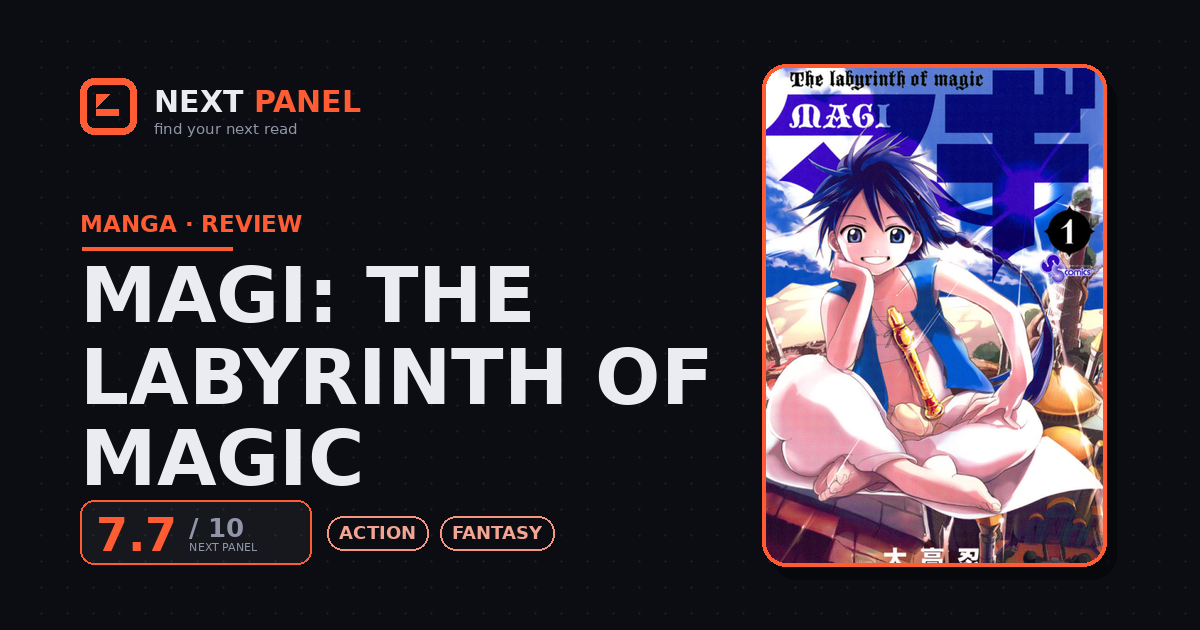
Is Magi: The Labyrinth of Magic Worth Reading? Review & Where to Read
Quick Answer
Yes, especially for readers willing to follow it as it deepens. Magi starts as a fun, breezy dungeon-crawling adventure and grows into a genuinely thoughtful story about empire and power, and both halves work on their own terms.
Quick Verdict
“Few shonen series make the jump from breezy dungeon-crawl to genuine political epic this convincingly, even if the tonal shift catches some readers off guard.”
Best for: Readers who want a fantasy adventure that grows in scope and moral complexity, set in an Arabian Nights-inspired world instead of the usual medieval-European default.
Not for: Readers who want a consistent tone from start to finish instead of a story that deepens and darkens as it goes.
- Type
- Manga
- Genres
- Fantasy, Action
- Status
- Completed
- This review
- Minor Spoilers
- Author
- Shinobu Ohtaka
- Publisher
- Shogakukan
- Platform
- VIZ
| Quick facts | |
|---|---|
| Format | Manga (shōnen), 369 chapters, 37 volumes |
| Run | 2009–2017 · completed |
| Community score | AniList 8.1 |
| Content | Violence, war and slavery themes |
| Where to read | VIZ — official |
Overview
Aladdin is a young magi — a rare kind of magician who can grant extraordinary power to those he chooses — traveling the world with his djinn companion Ugo in search of purpose. He falls in with Alibaba Saluja, a young man hoping to conquer one of the world's magical Dungeons for the wealth and freedom it promises. From that fairly simple hook, Shinobu Ohtaka builds an Arabian Nights-inspired fantasy world of rival kingdoms, ancient magic, and political intrigue, following the two friends as their adventure grows into something much bigger than either of them expected. Magi ran in Weekly Shōnen Sunday from 2009 to 2017 and is complete at 37 volumes, fully available in English from Viz Media.
What it does well
The setting alone sets Magi apart from most shonen fantasy. Instead of the usual medieval-European template, Ohtaka builds a world drawing on Arabian Nights and Middle Eastern-inspired mythology — djinn bound to magical items, towering Dungeons to conquer, kingdoms with their own distinct cultures and politics — and commits to that world with real specificity rather than treating it as set dressing.
What really elevates the series, though, is how much its ambitions grow. The early volumes are a fun, fairly breezy dungeon-crawling adventure, but Magi steadily deepens into a story genuinely interested in the costs of empire and conquest — slavery, colonization, and the difference between a "hero" and a conqueror become central questions rather than backdrop. Aladdin and Alibaba's friendship holds the emotional core together even as the cast expands across multiple kingdoms and warring factions, and morally complicated figures like the sorcerer Judar and the king Sinbad give the story real texture instead of a clean good-versus-evil split.
Where it falls short
That same growth in ambition is also where some readers will bounce off. The shift from lighthearted adventure to much heavier political and wartime content is a real tonal jump, and if you came in for the former, the latter volumes can feel like a different series wearing the same character designs.
The cast size becomes a genuine liability in the later volumes — with so many kingdoms, factions, and named characters in play, some get a fraction of the development others receive, and it can be hard to keep track of who matters to the plot at any given point. The cosmology underpinning the Magi and the Rukh (the setting's guiding spiritual force) also gets more abstract and dependent on dialogue-heavy explanation as the series heads toward its ending, which slows the pace right when the stakes are highest.
Verdict
Magi takes real risks by letting its story grow up alongside its cast, trading a breezy dungeon-crawl for a genuinely thoughtful epic about power and empire — and mostly, that gamble pays off. If you're willing to follow it as it deepens, it's one of the more distinctive long-running shonen fantasy series out there.
Strengths & Weaknesses
Strengths
- The Arabian Nights-inspired setting is a genuine change of pace from the usual medieval-European fantasy default, and Ohtaka commits to it with real worldbuilding around djinn, magical dungeons, and rival kingdoms.
- The story's growth in moral and political complexity is real: what starts as breezy dungeon-crawling adventure gradually becomes a thoughtful examination of empire, slavery, and the cost of 'heroic' conquest.
- Aladdin and Alibaba's core friendship anchors an enormous ensemble cast spread across multiple kingdoms and factions without losing its emotional center.
- Characters like Judar and Sinbad complicate the story's early good-versus-evil framing in genuinely compelling, morally ambiguous ways.
Weaknesses
- The tonal shift from the light early dungeon-adventure volumes to much darker political and war content later can feel jarring if you came in expecting the former to continue.
- The cast sprawls significantly in the back half, and some kingdoms and factions get noticeably less development than others.
- The cosmology around Magi and the Rukh gets increasingly abstract and exposition-heavy as the series builds toward its ending.
Similar Titles
shares a similar found-family squad structure inside a larger magical world
similar warmth and adventure-party structure, if in a different setting
shares an interest in myth and legend reimagined at a huge, world-spanning scale
Where to Read Officially
| Platform | Format | Pricing | Region notes | Link |
|---|---|---|---|---|
| VIZ | Digital chapters | Print & digital volumes | Paid | Region availability varies | Open |
Frequently Asked Questions
Is Magi finished?
Yes, it's complete at 37 volumes (2009-2017), fully available in English from Viz Media.
Is Magi related to actual Arabian Nights stories?
Loosely — it reimagines figures like Aladdin, Ali Baba, and Sinbad in an original fantasy world rather than retelling the original tales directly.
Does Magi stay a lighthearted adventure story throughout?
No. It starts that way but grows steadily darker and more politically complex as it goes, particularly once slavery and empire become central themes.