Is Mononoke Worth Reading? Review & Where to Read
Quick Answer
Worth it if you want atmospheric horror built on mystery-solving rather than jump scares, though it's a short, unofficial-translation-only read right now since there's no English license.
Quick Verdict
“The Medicine Seller never raises his voice and never needs to — the horror here comes from what each spirit is hiding, not from how loudly it screams.”
Best for: Readers who want slow-burn, mystery-driven horror with a striking, unconventional art style.
Not for: Readers who want fast-paced action or a story available through an official English release right now.
- Type
- Manga
- Genres
- Horror, Supernatural
- Status
- Completed
- This review
- Minor Spoilers
- Author
- Ninagawa Yaeko
- Publisher
- Square Enix
| Quick facts | |
|---|---|
| Format | Manga (seinen), 19 chapters, 2 volumes |
| Run | 2007–2008 · completed |
| Community score | AniList 7.4 · MangaUpdates 7.8 |
| Content | Disturbing imagery, themes of abuse and death |
Overview
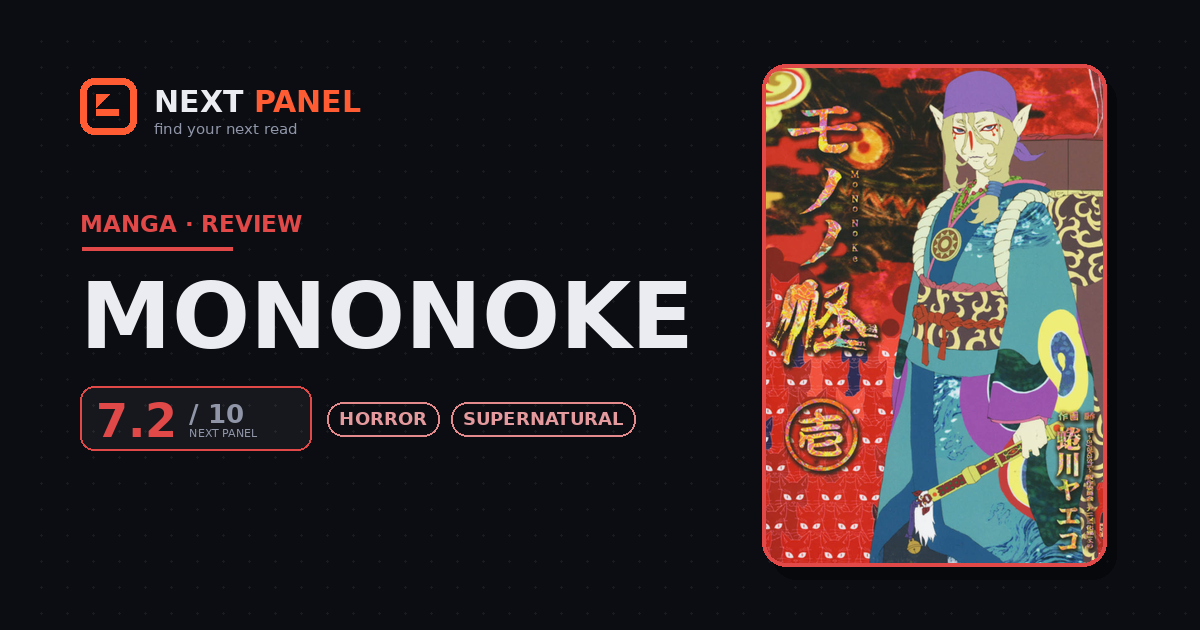
Mononoke follows the Medicine Seller, a nameless, enigmatic exorcist who hunts malevolent spirits called mononoke. He can't simply banish one on sight — first he has to uncover its Form, its Truth, and its Reason for existing, usually by investigating the human tragedy that created it. The manga, illustrated by Yaeko Ninagawa, adapts the concept and character from the acclaimed 2007 anime into two dense volumes of original short stories.
It's horror built on mystery-solving rather than shock. Each case is a self-contained investigation into what's haunting a particular place or person, and why.
What it does well
The Form-Truth-Reason structure gives every story real shape. Rather than a loose parade of scary images, each case builds toward the Medicine Seller identifying exactly what the spirit is and why it exists, which turns the horror into something closer to a mystery being solved than a haunting being survived. That structure rewards paying attention rather than just waiting for the next scare.
The Medicine Seller himself is the strongest element. He's deliberately withholding — calm, cryptic, seemingly amused by circumstances that terrify everyone around him — and that opacity makes him compelling to watch operate rather than frustrating. He never explains more than the story needs him to.
The art is trying something genuinely unusual, carrying over the anime's flat, ukiyo-e-inspired visual approach rather than defaulting to standard horror-manga conventions. It won't be to everyone's taste, but it gives the book a distinct identity you don't get from most horror manga.
Underneath the ghost stories, each case is really about a specific human failure — grief that curdled, exploitation that went unchecked, repression that festered — and that grounding gives the supernatural elements actual emotional stakes instead of empty spookiness.
Where it falls short
Two volumes isn't much to work with, and it shows: this reads more like a companion piece to the anime than something that stands fully on its own. If you haven't seen the show, some of the shorthand may feel thinner than intended.
There's currently no official English release, so accessing it means relying on fan translations rather than a licensed edition — worth knowing if you only read officially published work.
Some of the anime's density translates awkwardly to a static page. Sequences that work through motion, color shifts, and sound design in the show can read as merely confusing rather than unsettling without those tools.
Verdict
Mononoke is a strong companion piece for fans of the source anime, built around a genuinely well-constructed investigative horror structure and a compellingly opaque lead. It's short and currently unlicensed in English, but for readers drawn to slow, mystery-driven horror, it's worth seeking out.
Strengths & Weaknesses
Strengths
- Every case follows a clear, satisfying ritual — uncovering a spirit's Form, Truth, and Reason — which gives each short story real structure instead of loose vignette horror.
- The Medicine Seller is a compelling lead precisely because he stays unreadable; his calm never breaks even as the stories around him get devastating.
- The art translates the anime's distinctive, ukiyo-e-influenced visual style onto the page in a way that still feels genuinely unusual for the medium.
- Each arc tackles a real human horror — grief, exploitation, repression — underneath its supernatural mystery, giving the scares actual weight.
Weaknesses
- At only two volumes, it covers just a couple of cases, so it functions more as a companion piece to the anime than a substitute for it.
- There's no official English release, so reading it currently means relying on fan translation rather than a licensed edition.
- The dense, symbolic presentation that makes the anime so striking is harder to fully translate to a static page, and some sequences read as more confusing than eerie without motion and sound.
Similar Titles
Similar slow-building, image-driven horror that lingers on dread rather than jump scares.
Another short, atmosphere-heavy horror manga if you want more of that concentrated, unsettling format.
Shares the case-of-the-week spirit encounters structured around uncovering a hidden truth, in a gentler register.
Frequently Asked Questions
Is Mononoke the manga the same story as the anime?
It adapts the same concept and the same Medicine Seller character, but tells its own original cases rather than directly retelling the anime's episodes.
Is there an official English release?
Not currently. It's only been officially published in Japanese by Square Enix; English readers have relied on fan translations so far.
Do I need to watch the anime first?
No, but the anime is more fully realized and often considered the definitive version of this concept — the manga works best as a companion rather than a replacement.