Is Saint Seiya Worth Reading? Review & Where to Read
Quick Answer
If you want the shonen template a huge chunk of the genre still borrows from, yes. It's dated in places, but the core formula still hits.
Quick Verdict
“Every fight ends with someone getting up from something that should have killed them, and somehow it never stops working.”
Best for: Readers who want big, dramatic, willpower-over-everything shonen battles and an interest in seeing where a lot of the genre's DNA comes from.
Not for: Readers who want nuanced characterization or restraint — the drama here is loud, sincere, and turned up to eleven at all times.
- Type
- Manga
- Genres
- Fantasy, Action
- Status
- Completed
- This review
- Minor Spoilers
- Author
- Masami Kurumada
- Publisher
- Shueisha
- Platform
- Viz
| Quick facts | |
|---|---|
| Format | Manga (shōnen) |
| Run | completed |
| Community score | MangaUpdates 7.0 |
| Where to read | Viz — official |
Overview
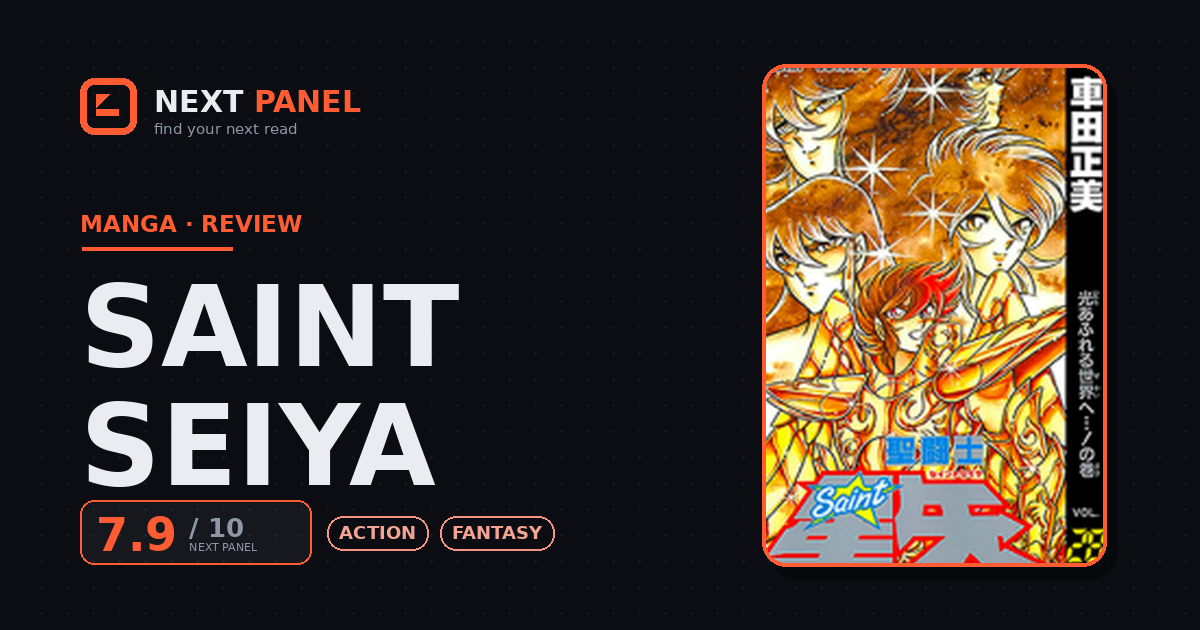
Saint Seiya follows Seiya and his fellow Bronze Saints, warriors who wear constellation-themed armor and fight to protect the reincarnation of the goddess Athena. Masami Kurumada built the whole series around a simple, extremely effective formula: put an underdog against a wildly more powerful opponent, let him get beaten to the edge of death, and then have him win anyway through pure refusal to quit. It's melodramatic, sincere, and unapologetically over the top, and that combination is exactly why it became one of the most influential shonen manga of its era.
What it does well
The central appeal here is simple but genuinely well-executed: watching a supposedly weaker Bronze Saint out-will a stronger Gold or Silver opponent never really stops being satisfying, because Kurumada commits fully to the drama of it. Every major fight escalates the stakes and the spectacle, and the constellation-based armor designs give each knight a strong visual identity that makes even one-off characters memorable. By the time the story reaches its bigger arcs, the scale and intensity have grown enough that earlier fights feel like a warm-up for genuinely dramatic set pieces.
It's also worth reading as a piece of shonen history — a huge amount of what became standard in the genre (power scaling through willpower, tournament-style escalating opponents, dramatic mid-fight declarations of resolve) either started here or was massively popularized by this series. Reading it now, you can trace a direct line to plenty of shonen that came decades later.
Where it falls short
The characterization is broad by design — these are archetypes built to embody specific virtues (loyalty, rage, cunning) rather than complex people, and if you want subtler writing, this isn't where to find it. The formula, while satisfying, does repeat: beating, monologue, comeback, victory, again and again across the run, and reading too much at once can expose how mechanical that rhythm is. And being a product of 1986, some of its humor and its handling of gender don't hold up especially well by modern standards.
Verdict
Saint Seiya earns its status as a genre landmark — sincere, dramatic, and packed with fights that still work emotionally even when you can predict the shape of them. If you want to understand where a big chunk of shonen's DNA comes from, or just want big, earnest battles, it holds up.
Strengths & Weaknesses
Strengths
- The core hook — bronze-class "saints" repeatedly outlasting far stronger gold and silver opponents through sheer refusal to stay down — is executed with real conviction and still lands emotionally.
- The armor and constellation designs are iconic for a reason; Kurumada gives every knight a distinct silhouette and a personality to match.
- Fights build in genuine escalation, arc to arc, with higher-ranked opponents and bigger stakes that keep raising the ceiling.
- It's easy to see the DNA it passed down to decades of shonen that followed, which makes it a genuinely interesting read as a genre foundation, not just nostalgia.
Weaknesses
- The character writing is broad and archetypal by design, so don't expect much subtlety or slow-burn development.
- The formula of "take a beating, monologue about willpower, win anyway" repeats often enough that it can feel predictable if you binge large chunks.
- Some of the humor and gender politics of its 1986 origins haven't aged gracefully.
Similar Titles
Another foundational 80s shonen built on stylized, over-the-top combat and larger-than-life masculinity.
Shares the tournament-style escalation and the emphasis on willpower carrying a fighter past raw power gaps.
A later shonen that inherited the same love of increasingly absurd power escalation and dramatic declarations mid-fight.
Where to Read Officially
| Platform | Format | Pricing | Region notes | Link |
|---|---|---|---|---|
| Viz | Print & digital volumes | Paid | Region availability varies | Open |
Frequently Asked Questions
Do I need to watch the anime first?
No — the manga tells the same core story and is where the anime draws from, so you can start with either.
Are the Lost Canvas and Saint Seiya Omega connected?
They're spin-offs and sequels by other creators exploring the same universe; the original Kurumada manga stands complete on its own.
How long is the original Saint Seiya?
28 volumes, and it's complete, telling one full story from the Galaxian Wars through the Hades arc.