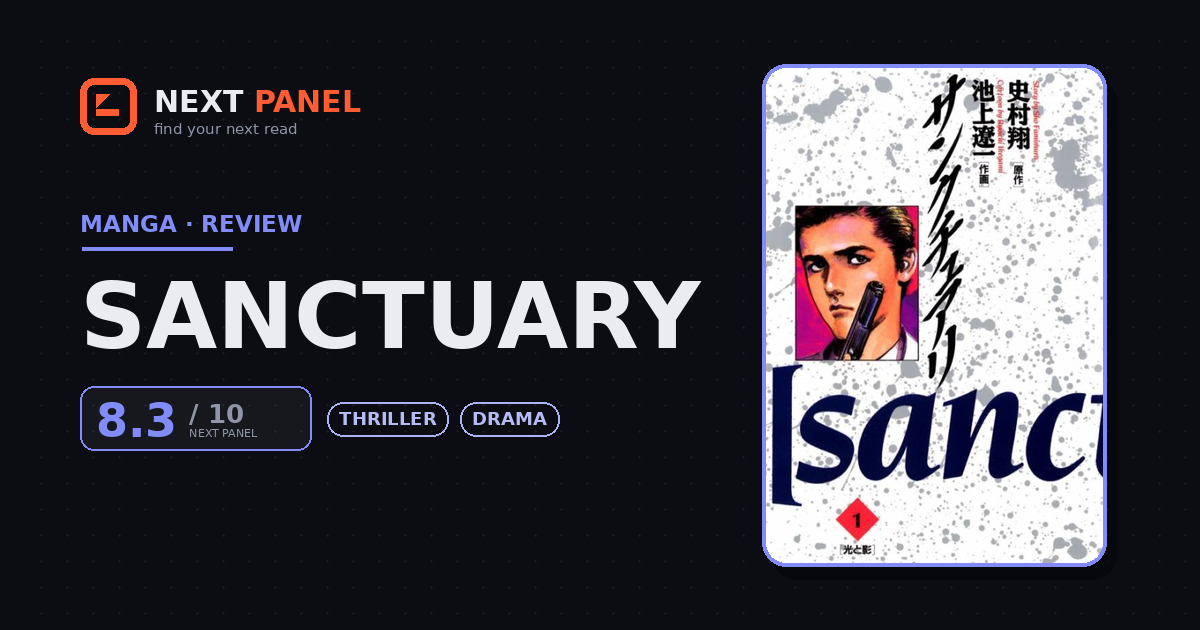
Is Sanctuary Worth Reading? Review & Where to Read
Quick Answer
Yes, if you want a dead-serious political and crime thriller with real teeth. It's a product of its early-90s moment in places, but the central premise still hits hard.
Quick Verdict
“Two men trying to remake a country from the underworld and the parliament floor at the same time — it's as tense as that sounds, and it mostly earns it.”
Best for: Readers who want a mature, dead-serious crime and political thriller with real ideas behind the violence.
Not for: Readers looking for a fast, disposable action read, or anything with a hopeful, easy resolution.
- Type
- Manga
- Genres
- Drama, Thriller
- Status
- Completed
- This review
- Minor Spoilers
- Author
- Sho Fumimura (Buronson)
- Artist
- Ryoichi Ikegami
- Publisher
- Shogakukan
| Quick facts | |
|---|---|
| Format | Manga (seinen), 108 chapters, 12 volumes |
| Run | 1990–1995 · completed |
| Community score | AniList 8.0 · MangaUpdates 8.5 |
| Content | Graphic violence, sexual content, war trauma |
Overview
Sanctuary follows two childhood friends, Akira Hojo and Chiaki Asami, who survived the Khmer Rouge killing fields together as children. Back in Japan as adults, they've made a pact: Hojo will climb to the top of the yakuza underworld, Asami will climb to the top of Japanese politics, and together — one from the shadows, one from the floor of parliament — they'll tear down a country they see as rotten and rebuild it into something worth surviving for. It's a premise with real scope, and the manga spends its twelve volumes taking that scope seriously.
What it does well
The dual-track structure is the smartest choice Sanctuary makes. Instead of picking one lane, it runs two parallel stories — organized crime and electoral politics — that constantly inform and complicate each other. Hojo's yakuza chapters deliver the violence and immediate danger you'd expect from the genre, but Asami's political chapters are just as tense in their own register, built on leverage, reputation, and information instead of knives. Watching both men apply the same ruthless clarity to completely different battlefields is what makes the book distinct from a standard crime manga.
Both leads are written as genuinely smart. Their plans have real logic, their setbacks come from believable miscalculations rather than plot convenience, and the manga trusts its reader to follow multi-step schemes without over-explaining them. That trust pays off in a story that rewards attention.
Ryoichi Ikegami's art deserves a lot of credit for how well this all lands. His dense, photorealistic linework gives every scene — a boardroom negotiation as much as a knife fight — real physical presence. Combined with the shared backstory of Hojo and Asami's trauma in Cambodia, the story earns a weight that a simpler crime thriller wouldn't have; their ruthlessness reads as scar tissue, not a personality quirk.
Where it falls short
This is very much a manga of its time. Some of the sexual politics and how female characters are used across the story haven't aged well by modern standards, and a few scenes lean into shock value in ways that feel dated rather than purposeful. The political half of the story, while strong overall, occasionally slows into dense procedural detail that asks more patience than the yakuza chapters do. A handful of antagonists on both sides exist mainly to give Hojo or Asami something to overcome rather than standing as fully drawn characters themselves.
Verdict
Sanctuary is a serious, ambitious crime-and-politics thriller that mostly lives up to its premise, carried by two sharply written leads and some of the best art in the genre. It shows its age in places, and it demands patience during its political stretches, but the core idea — rebuilding a country from both the underworld and the parliament floor at once — is still a genuinely compelling hook almost thirty years later.
Strengths & Weaknesses
Strengths
- The dual-track structure — one friend rising through the yakuza, the other through parliament — gives the story two completely different arenas to build tension in at once, and both stay gripping.
- Hojo and Asami are drawn as genuinely intelligent operators; their plans are satisfying to watch unfold because the manga trusts you to follow real strategy instead of simplifying it.
- Ryoichi Ikegami's art is exceptional — his photorealistic, heavily-shaded style gives every negotiation and confrontation real physical weight.
- The shared trauma underneath both men's ambition (their survival of the Cambodian killing fields) gives their ruthlessness an actual foundation instead of making them cartoonish schemers.
Weaknesses
- Some of the sexual and gender politics in the story read as very much a product of the early 1990s and haven't aged gracefully.
- The political-maneuvering chapters occasionally slow down into dense exposition that asks a lot of patience compared to the yakuza half's more immediate tension.
- A few supporting antagonists exist mainly to be obstacles for Hojo or Asami rather than characters with their own real weight.
Similar Titles
Frequently Asked Questions
Is Sanctuary currently available in English?
Viz Media published an English edition in the 1990s, but it's long out of print — used physical copies are the realistic way to read it in English today; there's no active digital release.
Is this connected to the anime/game Sanctuary?
No, this is unrelated to other unrelated media that share the title — it's the Fumimura/Ikegami manga about a yakuza boss and a politician.
Is Sanctuary a sequel or spinoff of anything?
No, it's a standalone story, complete in 12 volumes.