Is Tsurezure Children Worth Reading? Review & Where to Read
Quick Answer
Yes, if you want a low-commitment romance comic you can read a few pages of at a time. It's built entirely out of short, funny, occasionally sweet confession scenes with almost no serialized plot to track.
Quick Verdict
“Fourteen-plus couples, one shared problem: nobody in this book can just say how they feel. It's slight by design, and it works because it never pretends to be more than that.”
Best for: Readers who want quick, funny hits of romantic awkwardness they can read in any order without keeping track of a plot.
Not for: Readers who want one couple, one arc, and a story that builds toward something bigger.
- Type
- Manga
- Genres
- Romance, Comedy
- Status
- Completed
- This review
- Minor Spoilers
- Author
- Toshiya Wakabayashi
- Publisher
- Kodansha
- Platform
- Kodansha Comics / INKR / Azuki
| Quick facts | |
|---|---|
| Format | Manga, 212 chapters, 12 volumes |
| Run | 2012–2018 · completed |
| Community score | AniList 8.0 · MangaUpdates 8.3 |
| Where to read | Kodansha Comics / INKR / Azuki — official |
Overview
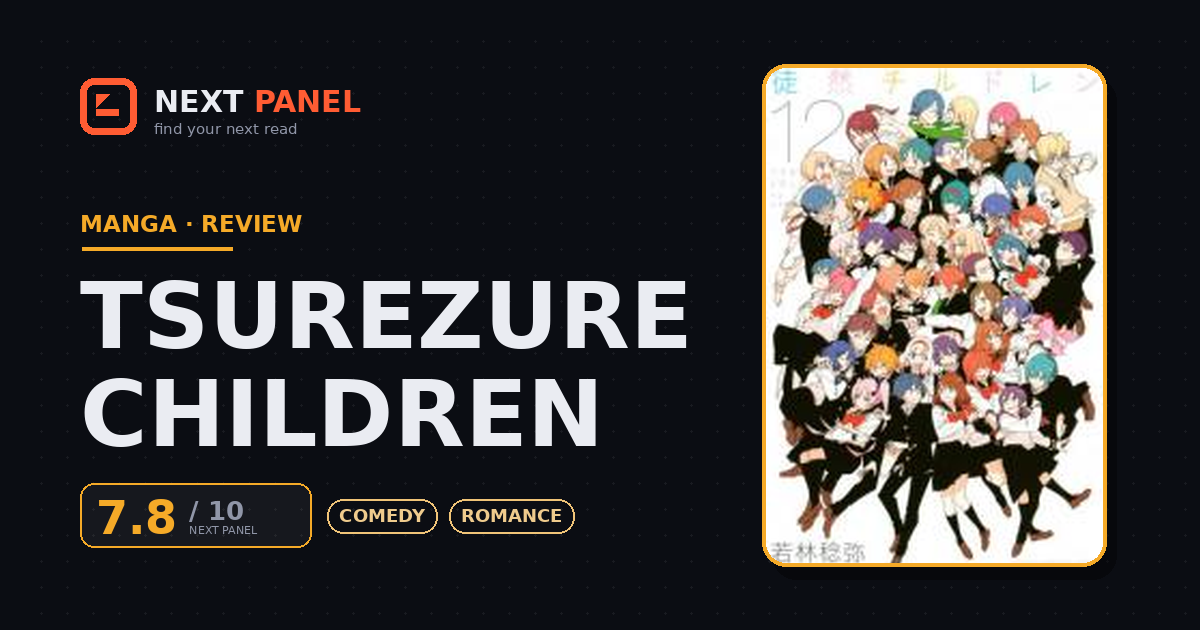
Tsurezure Children isn't one story about one couple -- it's a rotating cast of more than a dozen, each pair getting a handful of pages at a time, almost always centered on the same moment: someone trying (and often failing) to say how they feel. Toshiya Wakabayashi built the whole book out of 4-panel vignettes, which sounds like a gimmick until you notice how well it fits the subject. A crush confession is already a tiny, panicked, over-in-seconds event. Telling it in four panels doesn't shortchange it -- it matches the pacing of what actually happens in your chest when you're about to say something you can't take back.
What it does well
The range of couples is the best thing about it. There's the loudmouth who blurts out a confession in front of the whole class and immediately regrets it, the two best friends who've clearly liked each other for a year and can't get past 'so, um', the already-dating couple who are somehow worse at communicating than the people who haven't confessed yet. Wakabayashi isn't interested in one flavor of romantic awkwardness -- he's cataloguing all of them, and most land because they're specific rather than broad. Nobody here panics in a generic way; they panic in a way you recognize from your own worst conversations.
The format also means the book never overstays a joke. Four panels forces a setup, an escalation, and a punchline with zero room for filler, so even the couples who don't get much page time still land a real beat before moving on. And because you're bouncing between a dozen-plus relationships instead of committing to one, the book has an easy in-and-out rhythm -- read two pages or twenty, it doesn't ask much of you either way.
Where it falls short
The tradeoff for that structure is depth. A handful of couples -- the ones Wakabayashi clearly likes best -- get enough chapters to actually develop, complete with a real arc and a satisfying capstone. Most of the rest get a joke or two and then vanish, which is fine as a formal choice but means a lot of the cast reads more like a sketch than a relationship. If you came in wanting to watch one couple grow over time, you'll have to pick a favorite and hope they get enough page count, because the book itself won't commit to just one.
The joke engine also doesn't evolve much. It's the same core gag -- someone almost says the thing, doesn't, tries again next chapter -- for all twelve volumes. It never gets bad, but by the second half it's comfortable rather than surprising, and you can feel Wakabayashi leaning on variations of a formula he already knows works.
Verdict
Tsurezure Children is a low-stakes, high-hit-rate romantic comedy that works precisely because it doesn't ask for much from you. It won't give you the sustained relationship arc of a normal shoujo romance, but it's rarely trying to. What it offers instead is a big, funny, occasionally tender collection of the specific, universal panic of liking someone and not knowing how to say so -- and it nails that feeling often enough to be worth the read.
Strengths & Weaknesses
Strengths
- The 4-panel format keeps every joke tight -- setup, escalation, punchline, done, so there's no padding between the funny parts.
- Rotating through a dozen-plus couples means there's a type of awkward for almost everyone: the loud confession that goes wrong, the slow-burn best friends, the couple who's already dating and still can't talk to each other.
- It's genuinely observant about how dumb and specific real romantic panic feels -- the humor comes from recognition, not exaggeration.
- Low commitment by design: you can pick it up for five pages or fifty and lose nothing either way.
Weaknesses
- Some couples get way more page time than others, so a few threads pay off nicely while several just stop without a real ending.
- The 4-panel structure caps how deep any single relationship gets -- if you want emotional follow-through, most pairs don't get enough chapters for it.
- The joke engine is the same for all twelve volumes: someone almost says the thing, doesn't, repeat. It's comforting more than surprising by the back half.
Similar Titles
Same gentle, observant take on teenage relationships, minus the anthology structure.
Wotakoi: Love is Hard for Otaku
Same specific, recognizable brand of romantic awkwardness, aimed at adults instead of teens.
The Kawai Complex Guide to Manors and Hostel Behavior
Same low-stakes, hangout-style romantic comedy energy.
Where to Read Officially
| Platform | Format | Pricing | Region notes | Link |
|---|---|---|---|---|
| Kodansha Comics / INKR / Azuki | Digital chapters & print omnibus volumes | Free + Paid | Region availability varies | Open |
Frequently Asked Questions
Do I need to read the couples' chapters in order?
No. Each couple's chapters are self-contained and can be read in almost any order -- the manga itself jumps between pairs constantly.
Is this the same as the anime?
The 2017 anime adapts a chunk of the manga's cast, but the source has far more couples and volumes than the show covers.
Does every couple get a resolution?
Most of the couples the story spends real time on do. A handful of one-off or background pairs are left open-ended, which fits the anthology format more than it feels like a cheat.