Is H2 Worth Reading?
Quick Answer
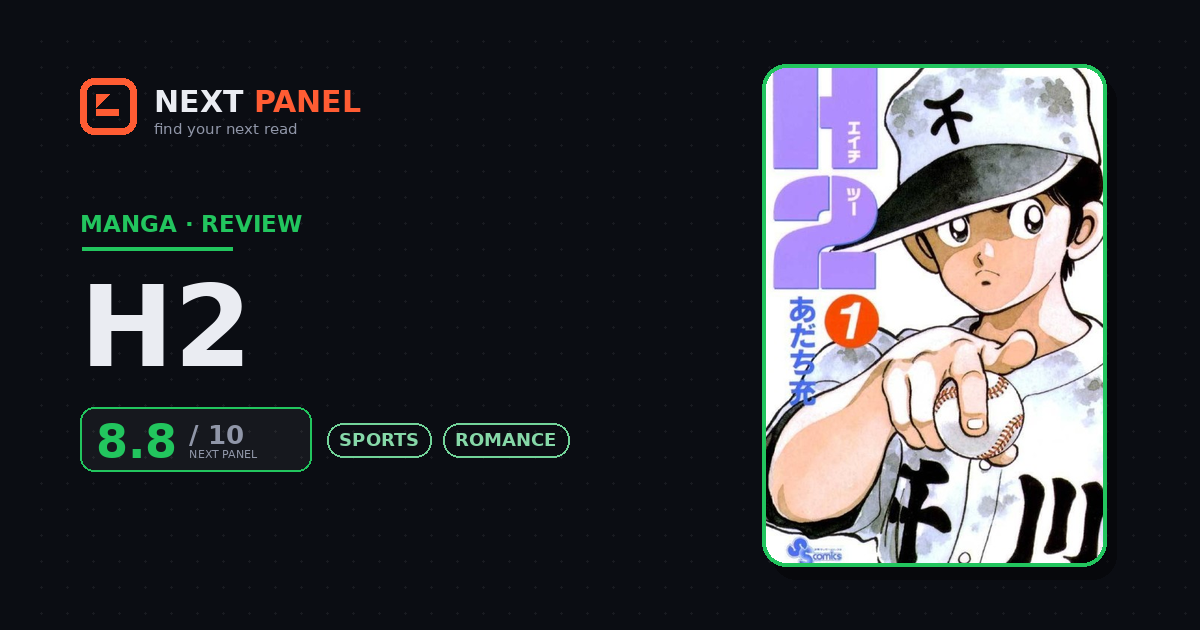
H2 is worth reading for Adachi's fullest take on slow-burn sports romance, currently without an official English release.
Quick Verdict
“Career-best character work from Mitsuru Adachi, wrapped around a slow-burn romantic triangle that asks for real patience across thirty-four volumes.”
Best for: Readers who want Adachi's most fully developed sports-and-romance story and don't mind a long, slow-burn read.
Not for: Readers who want fast-paced game action, or who want a shorter, quicker-resolving romance.
- Type
- Manga
- Genres
- Romance, Sports
- Status
- Completed
- Author
- Mitsuru Adachi
- Publisher
- Shogakukan
| Quick facts | |
|---|---|
| Format | Manga, 338 chapters, 34 volumes |
| Run | 1992–1999 · completed |
| Community score | AniList 8.1 · MangaUpdates 8.5 |
Overview
H2 is Mitsuru Adachi's longest manga, a baseball-and-romance story that ran for thirty-four volumes in Weekly Shonen Sunday through the 1990s. Hiro Kunimi is a pitcher whose arm injury knocks him out of the sport just as he enrolls at a high school with no baseball team, and the story is as much about him circling his way back into the game as it is about the tangled feelings between him, his childhood friend and manager Hikari, and his old rival Hideo, who ends up pitching for the school across town. Adachi had already made his name with Touch by the time this started, and H2 plays like a more patient, more ambivalent rework of that same formula: quiet sports drama layered over unresolved teenage romance, stretched out far longer and given room to actually sit with its characters' contradictions.
What it does well
The character work is the reason people call this Adachi's best. Hiro, Hikari, and Hideo are drawn with real contradictions: everyone in the triangle wants something they can't quite ask for, and Adachi lets that tension sit for volumes at a time instead of rushing toward resolution. His dialogue is famously spare, entire scenes turn on a single line or a panel of silence, and it works because the cast is expressive enough on the page to carry the rest. The supporting characters get the same care; rivals and teammates keep circling back with their own stalled feelings instead of fading into background noise. The baseball side benefits from the same restraint: games matter because of who's pitching and what they're feeling in that moment, not just what the scoreboard says. It ends up a manga about withheld feelings that never actually feels emotionally withholding.
Where it falls short
Adachi reuses the same character types and rhythms across his catalog, and if you've read Touch or Cross Game first, Hiro and Hideo's dynamic will feel familiar rather than surprising. The baseball itself is also played straighter and more procedurally than some readers want from a sports manga; long stretches focus on practice, team politics, and small tactical decisions rather than dramatic game swings. And at thirty-four volumes, the slow-burn romance asks for real patience. Adachi draws out the will-they-won't-they long enough that it can test your goodwill more than once before it actually pays off.
Verdict
One of the best sports-and-romance manga ever made, and arguably Adachi's most fully realized work, provided you're fine with a story that takes its time and doesn't reinvent his usual formula. H2 has never had an official English release, which keeps it under-read outside Japan relative to how good it is; if a licensor ever picks it up, it deserves the same attention Cross Game got.
Strengths & Weaknesses
Strengths
- Genuinely three-dimensional central triangle; Hiro, Hikari, and Hideo all want things they can't easily say out loud.
- Spare, efficient dialogue that lets small gestures and silences carry major emotional beats.
- Baseball sequences that matter emotionally, not just competitively, because of who's on the mound.
- Widely considered Adachi's most complete and fully realized work.
Weaknesses
- Reuses character archetypes and rhythms familiar from Adachi's other manga, like Touch and Cross Game.
- Thirty-four volumes of slow-burn romance demands real patience before the triangle resolves.
- Baseball is handled procedurally, with long stretches on practice and team politics rather than dramatic game swings.
Similar Titles
Adachi's earlier, more famous baseball-and-romance manga, with a similar slow-burn structure.
Adachi's Viz-licensed series, with the same restrained dialogue and sports-romance blend.
A more conventional, action-forward baseball manga if you want the sport pushed further to the front.
Frequently Asked Questions
Is H2 available in English?
Not officially. Viz has published other Adachi works like Cross Game and the Short Program collections, but H2 itself has never gotten an official English release.
Is H2 finished?
Yes. It ran in Weekly Shonen Sunday from 1992 to 1999 and is complete at thirty-four volumes.
Do I need to read Touch first?
No, H2 is a separate, standalone story. It just shares Adachi's usual sports-and-romance approach.