Is Sayonara Zetsubou-Sensei Worth Reading?
Quick Answer
Sayonara Zetsubou-Sensei is worth reading for Kumeta's dense satire and surprisingly dark ending, with the caveat that the official English release stops at volume fourteen of thirty.
Quick Verdict
“Dense, visually inventive satire that turns a gag-a-page structure into something much sadder than it first lets on.”
Best for: Readers who want sharp, reference-heavy satire and don't mind a gag-a-page structure that rewards close reading.
Not for: Readers who want a complete official English translation, or who want simpler, less reference-dependent humor.
- Type
- Manga
- Genres
- School Life, Comedy
- Status
- Completed
- Author
- Koji Kumeta
- Publisher
- Kodansha
- Platform
- Kodansha
| Quick facts | |
|---|---|
| Format | Manga, 301 chapters, 30 volumes |
| Run | 2005–2012 · completed |
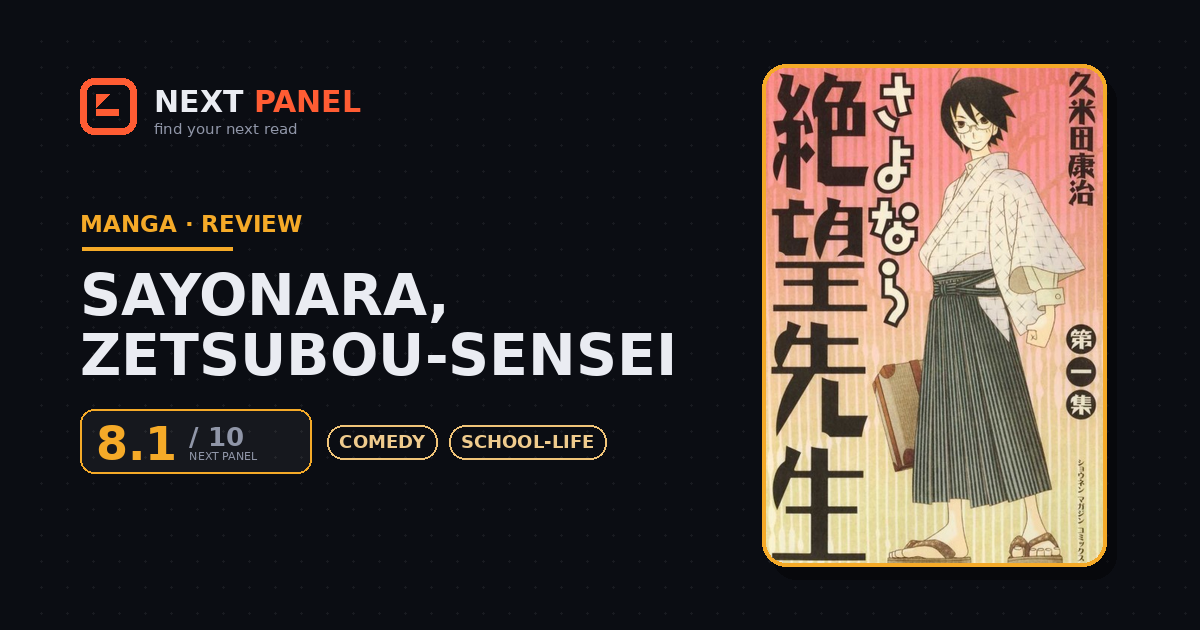
| Community score | AniList 8.1 · MangaUpdates 8.3 |
| Content | Suicide themes played for dark comedy |
| Where to read | Kodansha — official |
Overview
Sayonara, Zetsubou-Sensei follows Nozomu Itoshiki, a homeroom teacher so pessimistic he tries to hang himself from a blossoming cherry tree in the first chapter, and the class of students who keep talking him out of it. Each student in Class 2-He is built around a single social tic or cultural obsession, taken to an absurd extreme, from compulsive stalking to pathological positivity to conspiracy-theory paranoia, and Koji Kumeta uses that structure to run through a rapid-fire satire of 2000s Japanese media, politics, and internet culture. It reads less like a conventional gag manga and more like a running op-ed disguised as one, packed with sight gags and references that assume you're paying close attention rather than skimming for the next punchline.
What it does well
Kumeta's page density is the first thing that stands out. Panels are stuffed with sight gags, parody signage, and background text that reward rereading, and the character designs, thin, angular, deliberately blank-eyed, give the satire a cold, controlled look instead of a loud one. That restraint is what keeps the comedy from curdling into pure shock humor; the jokes land because the delivery stays so deadpan. The ensemble cast is the real engine: each girl in Itoshiki's class embodies a specific obsession or anxiety, stalking, hoarding, chronic overexplaining, and Kumeta rotates through them fast enough that the joke structure never goes stale across thirty volumes. Underneath the gag-a-page format, the series builds toward a genuinely unexpected, quietly devastating explanation for why the class behaves the way it does, tied to organ donation and grief, that recontextualizes the whole cast once it lands and gives the whole run a shape it didn't seem to be building toward.
Where it falls short
This is a dense, reference-heavy satire of specifically Japanese media and social issues from the mid-to-late 2000s, and a lot of the humor depends on context American and other Western readers won't have without footnotes. Even with strong translation notes, some jokes just don't survive the trip, and a handful of chapters read as a list of names and headlines with the comedy stripped out. The gag-a-page structure can also feel repetitive if you're not locked into Kumeta's rhythm, since individual chapters rarely build on each other in a conventional plot sense. And because only fourteen of the original thirty volumes ever got an official English release before the licensor folded, readers who fall for it in English hit a hard wall partway through the story with no legal way to keep going.
Verdict
A dense, visually inventive satire that rewards close reading and pays off with a much sadder note than the opening gags suggest. Worth it for readers who want something sharper and stranger than a standard school comedy, as long as you go in knowing the official English translation stops less than halfway through and accept that some of the humor simply won't translate.
Strengths & Weaknesses
Strengths
- Extremely dense, detail-packed art that rewards rereading, with visual gags stacked into nearly every panel.
- A large ensemble cast built around sharp, specific satirical hooks instead of generic personality quirks.
- A gag-a-page structure that unexpectedly pays off with a genuinely poignant explanation for the whole cast.
- Sharp, fearless satire of Japanese media and social issues that doesn't pull punches.
Weaknesses
- Heavily dependent on specifically Japanese cultural and media references that don't all survive translation.
- Gag-a-page pacing can feel repetitive if you're not locked into Kumeta's rhythm.
- Only fourteen of the original thirty volumes ever received an official English release.
Similar Titles
Another absurdist, gag-dense comedy built around a rotating ensemble cast.
Azumanga Daioh
A gentler, less satirical ensemble school comedy from the same general era.
A different kind of teacher-and-class comedy, louder and more action-driven.
Where to Read Officially
| Platform | Format | Pricing | Region notes | Link |
|---|---|---|---|---|
| Kodansha | Digital | Paid | Region availability varies | Open |
Frequently Asked Questions
Is Sayonara Zetsubou-Sensei fully available in English?
No. Del Rey and then Kodansha Comics released fourteen of the original thirty volumes before the English edition stopped in 2012.
Is Sayonara Zetsubou-Sensei finished in Japanese?
Yes. It ran in Weekly Shonen Magazine from 2005 to 2012 and is complete at thirty volumes.
Do I need to understand Japanese pop culture to get the jokes?
Not entirely. The core character comedy works on its own, but a lot of the sharpest jokes reference specific 2000s Japanese media and social issues.